A Guide to the Retail Supply Chain for MENA SMEs

If you're running a retail or distribution business in MENA, you already know the pattern. You pay suppliers before you get paid by customers. You bring in stock because you can't afford empty shelves, then demand shifts and the wrong items sit in the warehouse. A large buyer places a healthy order, then settles the invoice late enough to disrupt your next purchasing cycle.
That isn't just an inventory issue. It's a retail supply chain issue.
Most SME owners still treat supply chain problems as separate operational annoyances. Purchasing is one problem. warehousing is another. collections sit with finance. That's a mistake. Your products, information, and cash all move through the same system. If one part slows down, the whole business feels it.
Your Business Is a Supply Chain
The term “Supply Chain Management” was coined in 1983, and the discipline matters even more now because the Middle East and Africa retail market is projected to reach USD 1.3 trillion by 2025, according to GoBolt's retail supply chain overview. For an SME owner in the UAE or wider MENA region, that isn't abstract market commentary. It means competition is rising, customer expectations are tightening, and weak execution gets exposed fast.
A simple example makes this obvious. A distributor imports consumer goods, stores them locally, sells to retail partners, then waits for payment. In that one cycle, the business has already managed procurement, inbound logistics, inventory holding, fulfilment, invoicing, and collections. If even one handoff breaks, cash gets trapped.
What most owners get wrong
Many businesses think supply chain starts in the warehouse. It doesn't. It starts when you decide what to buy, how much to commit, and when to pay for it. It ends only when the cash from that sale is back in your account.
That's why I tell clients to stop saying, “We have an inventory problem,” when what they really have is a coordination problem. Forecasting, supplier terms, order timing, delivery execution, and collections all sit inside the same operating system.
Practical rule: If stock decisions and cash decisions happen in separate conversations, your supply chain is already underperforming.
If you're trying to sharpen your e-commerce fulfilment thinking, Reddog Group on ecommerce logistics gives a useful outside view of how online demand changes operational pressure. If your business sits closer to wholesale or FMCG movement, this guide on consumer goods distribution is also worth reviewing alongside your own order-to-cash process.
The real issue is flow
Healthy SMEs don't just move goods. They move goods without freezing cash.
That's the lens you should use from now on. Every purchase order, every stock transfer, every delivery delay, and every late invoice payment affects capital velocity. Once you see your business that way, better decisions follow quickly.
Understanding the Stages of Your Supply Chain
Think of your product as a baton in a relay race. Every stage matters, but the handoff matters more. Most retail supply chain failures don't happen because one team is incompetent. They happen because one handoff is late, unclear, or poorly measured.
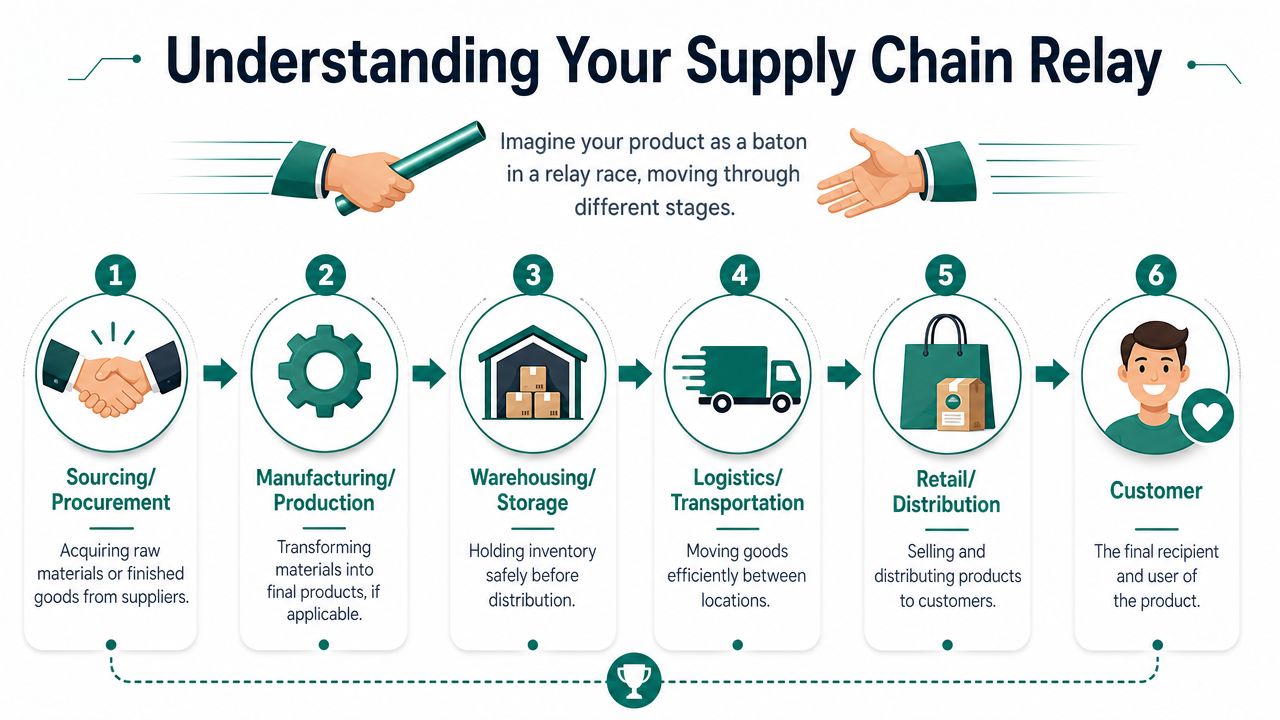
The six stages that matter
Sourcing and procurement comes first, encompassing the selection of suppliers, negotiation of terms, placement of orders, and commitment of cash. Bad procurement decisions usually show up later as excess stock, weak margins, or urgent reordering.
Manufacturing or assembly applies if you're producing, bundling, or modifying products before sale. Even if you aren't a manufacturer, some form of product preparation often happens. Kitting, labelling, and localization all add time and cost.
Warehousing and storage is where many SMEs lose control. Stock sits too long, records drift away from reality, and no one is fully confident about what can be sold today.
Where the baton usually gets dropped
The next stages are more visible, so owners notice them sooner:
- Logistics and transportation moves goods between supplier, warehouse, branch, and customer.
- Retail and distribution covers picking, packing, dispatching, and delivery coordination.
- Customer receipt and returns closes the loop, including reverse logistics when products come back.
A slow final-mile delivery is annoying. A messy returns process is expensive. But the bigger problem is usually earlier in the chain, where no one corrected a purchasing assumption or flagged a replenishment risk in time.
When buyers, warehouse staff, and finance teams work from different versions of the truth, delays become normal.
What to tighten first
You don't need a massive ERP project to improve this. Start with three actions:
- Map each handoff. Who owns the move from supplier order to inbound receipt, from receipt to available stock, and from delivery to invoice?
- Name the approval points. Where does work wait for someone to review, confirm, or release it?
- Track exceptions, not just routine flow. Delayed shipments, short deliveries, damaged stock, and disputed invoices deserve immediate visibility.
If purchase orders are still being handled informally, fix that before you buy more software. A tighter purchase workflow creates better data upstream and fewer surprises downstream. This practical explainer on purchase order management is a good place to tighten that discipline.
Key Metrics That Reveal Your Supply Chain Health
Most SMEs track sales obsessively and supply chain health casually. That's backwards. Sales tell you what happened. Supply chain metrics tell you whether your business can repeat results without choking on stock, delays, or cash pressure.
One historical lesson is worth remembering. Major efficiency gains came from containerization in the late 1960s and computerized inventory management in 1967, yet 69% of companies still lack total visibility of their supply chain, according to Blume Global's supply chain history analysis. Modern tools exist. Visibility is still poor.
Inventory turnover
This metric tells you whether stock is moving or ageing.
If turnover is weak, your warehouse is storing cash in physical form. Slow stock doesn't just consume space. It distorts forecasting, creates markdown risk, and limits your ability to buy what customers want now.
Ask one blunt question every month: which SKUs are earning the right to be reordered, and which ones are only being carried because no one wants to admit they were overbought?
Fill rate and on-time delivery
These metrics show whether you can serve demand reliably.
A low fill rate usually means one of two things. You either bought the wrong stock mix, or you had the right demand signal but failed to replenish in time. On-time delivery tells a different story. It reveals whether your internal execution and logistics partners can meet the promise your sales team makes.
Use both together. A business can deliver on time and still disappoint customers if the order is incomplete.
Cash conversion cycle
This is the metric owners should respect most.
Your cash conversion cycle measures how long your money stays tied up between paying for stock and collecting cash from sales. If you import goods, hold inventory, sell on terms, and then chase payment, that cycle can stretch painfully. Even profitable businesses get squeezed here.
Watch this closely: rising revenue with a worsening cash conversion cycle is not healthy growth.
A simple operating dashboard
You don't need endless reporting. You need a short list that forces action:
- Inventory turnover by category so you can see where capital is stuck.
- Fill rate by customer segment so you can spot service failures early.
- On-time delivery by route or partner so poor execution isn't hidden.
- Invoice ageing so collections risk is visible to operations, not just finance.
- Cash conversion cycle trend so growth doesn't outrun liquidity.
Good metrics don't decorate a dashboard. They trigger decisions.
Common Supply Chain Pain Points for MENA SMEs
MENA SMEs face the same supply chain basics as everyone else, but the financial consequences hit harder because imported goods, payment delays, and seasonal demand swings stack on top of each other. In the UAE, that pressure is amplified by trade intensity. As Deloitte notes in its retail supply chain discussion, non-oil trade reached record levels in 2024, and for SMEs that rely on imported goods, supply-chain delays turn directly into working-capital strain.
That last point matters more than most articles admit. A delayed shipment doesn't just postpone sales. It extends the period in which your cash is committed but unavailable.
The inventory trap
Owners often respond to uncertainty by buying extra stock. The logic feels sensible. If lead times are unstable, carry more inventory. If Ramadan demand might spike, buy ahead. If a key supplier is inconsistent, protect yourself.
Then reality hits. Demand shifts, a promotion underperforms, or one category slows while another takes off. Now your cash is sitting in cartons, and your next profitable order becomes harder to fund.
The opposite mistake is just as common. You buy too cautiously, then lose sales because the right stock isn't available when customers are ready to buy.
The payment lag problem
Many SMEs celebrate a large sale too early. The goods are delivered. The invoice is issued. Internally, everyone counts it as success.
But if the buyer pays well after delivery, you're still carrying the burden. Payroll doesn't wait. Rent doesn't wait. Supplier commitments don't wait. A business can look busy and still be short of usable cash.
Late collections don't only hurt finance. They weaken purchasing power and reduce your ability to replenish winning products.
Supplier pressure arrives before customer cash
Imported retail models become unforgiving. Suppliers often ask for payment before shipment, on shipment, or on delivery. Your customer may pay much later. That gap has to be covered somehow.
When owners ignore this mismatch, they create a false sense of profitability. Margins may look acceptable on paper, but the business remains fragile because it funds too much of the cycle itself.
This is where working capital tools can plug directly into the supply chain. Comfi’s invoice discounting, for example, lets SMEs convert outstanding receivables into cash within hours, so supplier payments no longer depend on when customers choose to settle. The business funds the next purchase from confirmed cash rather than from an optimistic assumption about when an invoice gets paid.
Regional demand isn't smooth
MENA businesses also deal with compressed buying periods, campaign-led spikes, and product categories where trends move quickly. Static reorder rules don't cope well with that environment.
What works better is a tighter operating rhythm:
- Review demand signals weekly during active trading periods, not only at month-end.
- Separate core stock from speculative stock so your essential items aren't judged by the same rules as trend-driven items.
- Flag slow collections early because sales on paper don't replenish shelves.
- Treat landed stock as committed cash and manage it with the same attention you'd give a bank balance.
The businesses that stay stable aren't always the ones with the largest warehouses. They're the ones that connect inventory decisions to cash consequences early enough to act.
Practical Strategies to Optimize Your Supply Chain
Most SMEs don't need a dramatic reset. They need discipline. The strongest retail supply chain improvements usually come from better routines, cleaner data, and tighter coordination between sales, purchasing, and finance.
One useful principle from supply-chain analytics is simple: real-time data from sales and inventory systems improves forecasting and helps prevent costly stock issues, especially where product life cycles are short, as explained in GoCrisp's guide to real-time retail supply chain analytics. Waiting for month-end reports is too slow.
Start with one monthly operating meeting
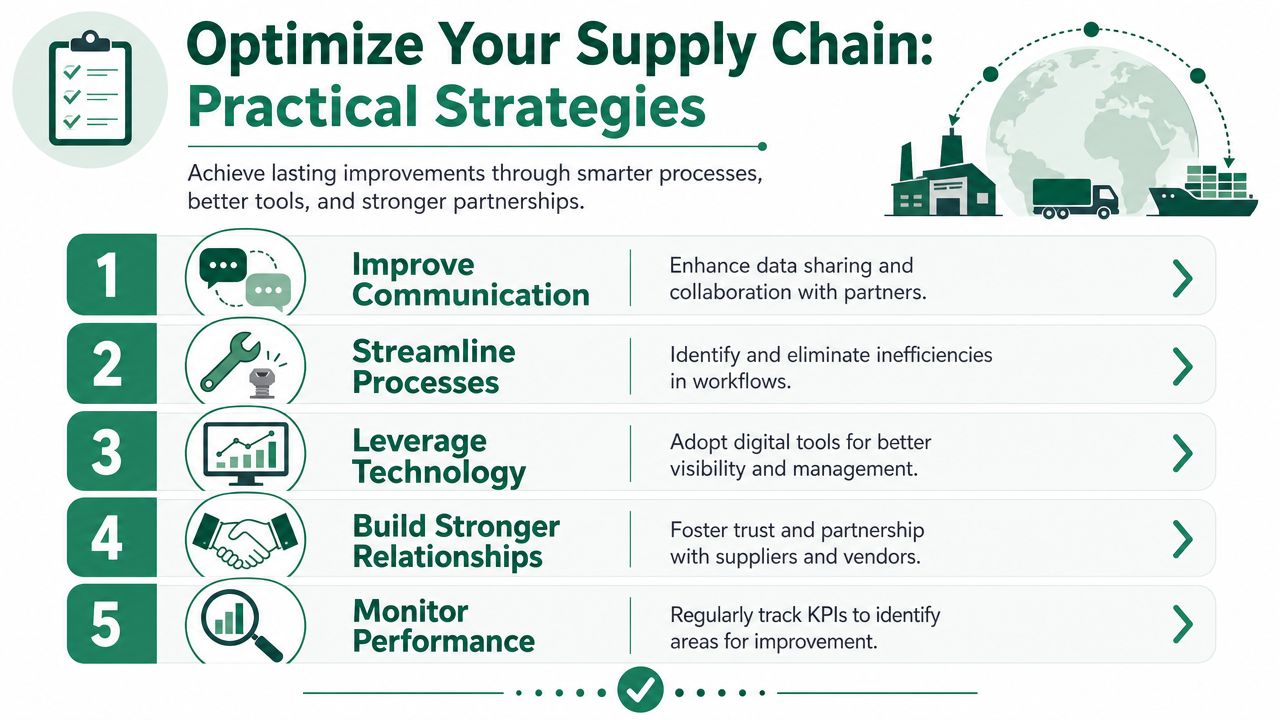
You need a basic sales and operations rhythm. Once a month, sit sales, purchasing, warehouse, and finance in the same room. Review what sold, what slowed, what is overstocked, what is delayed, and what needs to be bought next.
Keep the conversation focused on decisions, not presentations.
- Review demand by category instead of only total sales.
- Check supplier performance using actual delivery behaviour, not assumptions.
- Compare stock position to customer commitments so inbound plans match real need.
- Bring finance into the room because stock planning without cash context is guesswork.
Upgrade visibility before complexity
Many SMEs jump too quickly toward heavy systems when a simpler fix would help more. If your stock counts are unreliable, your SKU naming is inconsistent, or your teams update records late, expensive software won't save you.
Use tools that give you one live view of sales, stock, and pending orders. The important part isn't sophistication. It's timeliness and consistency.
Clean operational data beats impressive dashboards built on bad inputs.
Tighten supplier communication
Strong supplier relationships reduce friction in ways spreadsheets won't show. Share realistic forecasts with key suppliers. Flag likely demand surges early. Confirm lead times more often than feels necessary.
If you import regularly, your team also needs a firmer grip on shipping responsibilities and cost transfer points. This plain-English J.W. Smith's guide to Incoterms is useful if your buyers still confuse where supplier responsibility ends and yours begins.
Replace static reorder rules
A fixed min-max rule might be adequate for stable items. It fails when lead times vary or promotions distort demand. Reorder decisions should reflect current sales patterns, supplier reliability, and how expensive a stockout would be.
Try this instead:
- Classify SKUs by importance. Fast movers, core lines, seasonal items, and speculative stock should not be managed the same way.
- Review lead time reality. Use actual supplier performance, not the lead time written in an old email.
- Set exception alerts. Focus management attention on outliers, not routine items.
- Link purchasing to collections. If receivables are slipping, buying plans need adjustment.
This is what practical optimisation looks like. Less drama. Better signals. Faster action.
Unlocking Growth with Modern Financial Tools
You clear a strong sales month, but cash is still tight. Stock has moved, invoices are sitting in customer queues, and the next supplier payment is due before collections land. For many MENA SMEs, that is the core supply chain problem. Goods are moving, but cash is moving too slowly.
Operations can reduce waste and improve planning. They cannot fix a timing gap on their own. If your business buys inventory upfront, sells on terms, or carries high-ticket stock, capital velocity needs to be managed as part of daily operations. Treat it like replenishment, not a separate finance topic.
Use the right tool for the right blockage
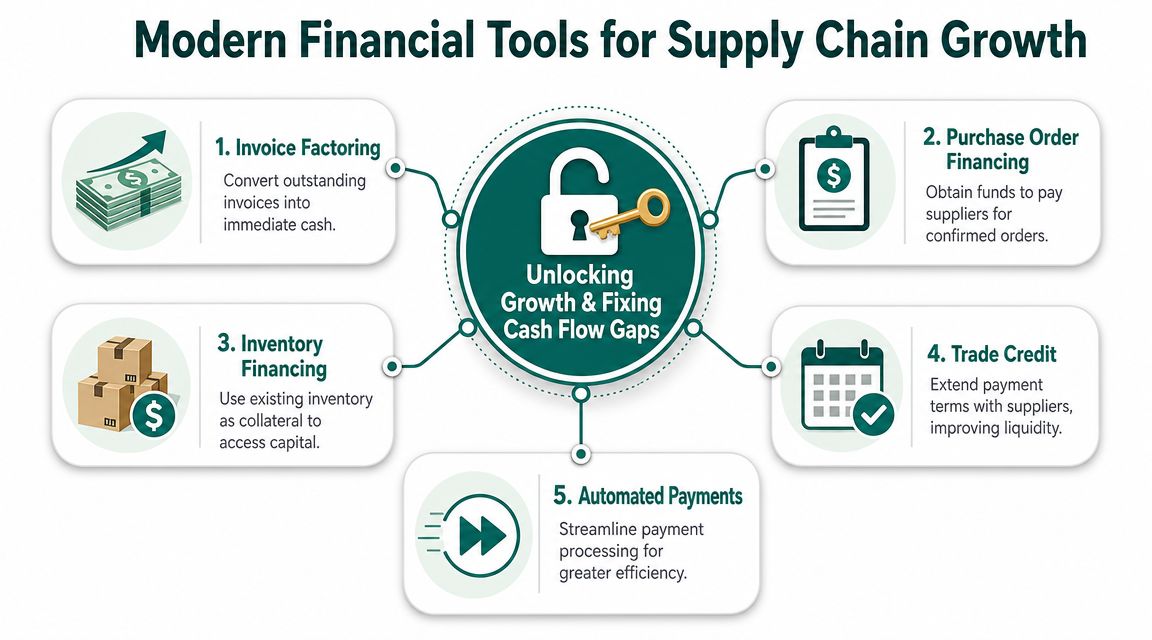
Different cash delays need different tools. If you treat every shortfall as a generic funding problem, you will pay for capital without fixing the process that is slowing the business down.
Invoice discounting works when sales are healthy but collections are slow. You have delivered the order, raised the invoice, and are waiting. Faster access to receivables gives you room to reorder on time, protect supplier relationships, and avoid buying too cautiously.
Buyer payment terms through BNPL-style structures work when customers want more time, but you cannot afford to carry that burden on your own balance sheet. This matters for wholesalers and suppliers trying to increase order size without creating a collections problem for the finance team.
Dealer financing works for inventory-heavy models where capital sits inside unsold units. Automotive dealers feel this most sharply, but the principle applies anywhere ticket sizes are large and stock rotation is uneven. If too much money is parked in inventory, growth stalls even when demand is there.
Treat financing as a supply chain tool
The right question is simple. Where is cash getting trapped, and which tool releases it with the least operational friction?
Use that lens to assess your options:
- Receivables delay: Measure how quickly approved invoices convert into usable cash.
- Supplier pressure: Check whether financing helps you buy to forecast instead of cutting orders because liquidity is thin.
- Inventory drag: Focus on whether the facility improves stock rotation and replenishment timing.
- Customer credit demand: Look at whether sales can offer terms without creating more admin and collection risk.
That is how strong operators think. They do not chase money. They fix the stage of the cycle that is slowing both cash recovery and sales capacity.
Where fintech fits
Fintech tools are useful when they sit inside normal buying and selling workflows. If a funding product adds more approvals, more spreadsheets, and more chasing, it solves one problem and creates another. If it shortens the time between invoice, stock decision, and supplier payment, it improves the supply chain.
If you are dealing with delayed replenishment and unstable working capital, this guide to supply chain disruption financing in the UAE is a practical reference.
The right fintech partner offers tools that release cash already tied up in receivables or inventory, so the business can keep buying, selling, and collecting without forcing every decision through a cash shortage. Look for providers that understand MENA trading patterns, offer fast turnaround, and integrate into your existing invoicing and payment workflows.
A healthy retail supply chain returns cash fast enough to support the next purchase, not just the last sale.
The practical test
Before you adopt any financial tool, ask four questions:
- Which delay is hurting cash flow most right now?
- Does this tool shorten that delay, or does it only postpone pressure?
- Can your operations and finance teams run it without extra admin?
- Will it improve purchasing, fulfilment, or collections within the next cycle?
If the answer to the fourth question is no, skip it. You do not need more financial products. You need faster capital movement through the business.
Your Action Plan for a Stronger Supply Chain
Late supplier payments, slow-moving stock, and overdue customer invoices create the same outcome. Cash gets trapped, purchasing gets reactive, and growth stalls.
Treat that as an operating problem first. MENA SME owners who get this under control usually do three things well. They know where cash slows down, they fix the process causing the delay, and they add financing only where it increases capital speed through the business.
Start with a hard review of the full path from purchase order to collected cash. Do it on one page. If your team cannot explain where time is lost between buying, receiving, selling, invoicing, and collecting, you are managing inventory and cash flow by feel. That is expensive.
A practical checklist
- Map your order-to-cash flow and list every handoff from supplier order to customer payment.
- Identify the delay that hurts cash most. Focus on one issue, such as ageing stock, weak collections, poor stock accuracy, or slow replenishment.
- Pick one metric and improve it this quarter. Inventory turnover, stock coverage, or cash conversion cycle are good starting points.
- Fix the process before adding software. Tighten purchase orders, receiving discipline, stock updates, or invoice follow-up.
- Add financing where it removes friction in the cycle. Invoice discounting, buyer payment terms, or dealer financing should support faster purchasing, faster selling, or faster collection.
Stability does not mean zero disruption. It means your business can absorb delays without starving the next buying cycle of cash.
That is the shift many MENA retailers need. Stop separating operations from finance. Your supply chain is only healthy when stock flow and cash flow improve together.
If your team identifies receivables timing or inventory lock-up as the primary drag on capital velocity, it pays to evaluate tools purpose-built for that gap. Comfi offers invoice discounting, buyer payment terms, and dealer financing designed for MENA SMEs, so you can keep stock moving and suppliers paid without waiting for every customer to settle first.