Purchase Order Management for MENA SMEs: 2026 Guide

An urgent order goes out on WhatsApp. The supplier replies with a revised price. Someone in operations says, “ok, ship it”. A month later the invoice lands in finance, the delivered quantity is short, and nobody can find the version that was approved.
That's how spend gets out of control in a growing SME.
Purchase order management fixes that. Not because it adds paperwork, but because it creates a single record of what the business agreed to buy, from whom, at what price, on what terms, and by when. In MENA businesses, where supplier relationships move fast and teams often work across WhatsApp, email, spreadsheets, and accounting software at the same time, that record matters more than most owners realise.
A clean PO process protects margin, gives finance a better view of committed spend, and reduces the friction that appears later in receiving, invoicing, and payment. It also does something more strategic. It turns messy buying activity into verifiable transaction data that supports stronger cash flow planning and better access to modern payment and invoice solutions.
Why Purchase Order Management Matters Now More Than Ever
When a business is small, informal buying feels efficient. A manager messages a supplier directly, the supplier ships, and finance sorts the paperwork later. That works until volume rises, more staff start ordering, and suppliers begin offering different prices, lead times, and terms across channels.
At that point, procurement stops being a back-office habit and becomes a control issue.
Informal buying always shows up later
The damage rarely appears at the moment of purchase. It appears later when:
- Invoices don't match memory: Finance gets billed for a price nobody can verify.
- Goods arrive partially: The warehouse receives less than expected, but the invoice requests full payment.
- Suppliers get mixed signals: Sales, operations, and finance each give different instructions.
- Cash flow becomes foggy: You know what has been paid, but not what has already been committed.
In practice, poor purchase order management doesn't just create admin work. It weakens supplier discipline and makes monthly closing harder than it needs to be.
Practical rule: If your team can place an order without creating a record that finance can check later, you don't have control. You have trust-based spending.
The regional direction is clear. In Dubai, the government's eProcurement Platform was launched in 2016 and by 2024 reported AED 2.37 billion in procurement transactions, a signal that digital procurement workflows have become central to public-sector buying in the emirate, as noted in this overview of purchase order management. SMEs won't copy a government platform, but they should learn from the same principle. Buying needs structure once transaction volume and stakeholder count increase.
Good PO control helps both finance and operations
A strong PO process does three things at once:
- It protects price integrity so the business pays what was agreed.
- It improves delivery follow-up because open orders can be tracked.
- It supports supplier relationships by reducing disputes and back-and-forth.
That matters in fast-moving trading, distribution, retail, automotive, and wholesale environments across the region. The companies that scale cleanly are not always the ones with the most advanced ERP. They're usually the ones that make agreed purchasing rules stick.
Understanding the Complete PO Workflow
A purchase order should move through the business in a clear sequence. If steps are skipped, finance inherits the mess later.
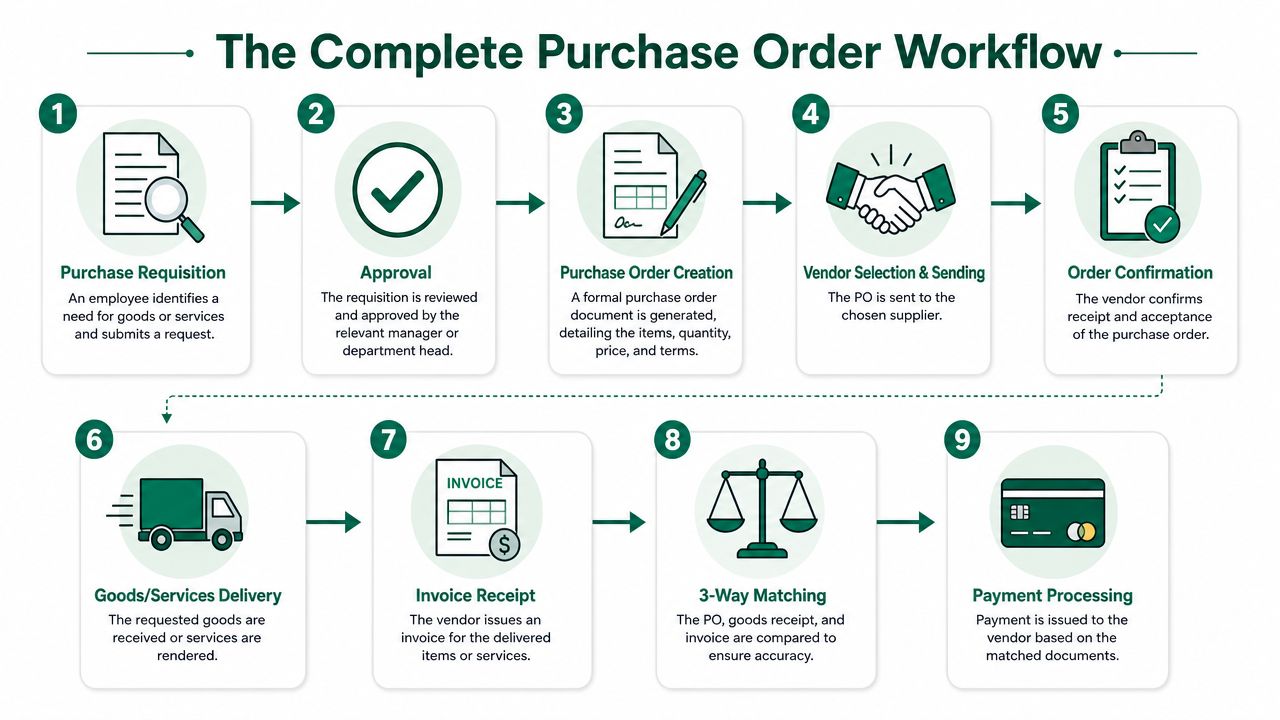
The workflow from request to payment
Here's the practical flow most SMEs should aim for:
- Someone raises a need
The process starts with a purchase requisition. This is the internal request, not the supplier-facing document. - A manager approves the request
Approval should confirm budget, need, and supplier choice. In a smaller business, this might be a department head plus finance. - The PO is created properly
The PO should include a unique PO number and date, buyer and supplier details, item or SKU descriptions, quantities, prices, delivery dates, location, and payment terms. - The supplier receives and confirms it
Sending a PO is not enough. The supplier should confirm acceptance, especially when timing, quantity, or pricing is sensitive. - Goods or services are received
Someone has to record what was delivered. If your business has a warehouse, this is usually receiving. If it's a service, the department owner may confirm completion. - The invoice arrives
At this stage, many weak processes fail. Finance gets an invoice before anyone has confirmed what was received. - Finance checks the documents before payment
This is the control point that matters most.
Why the three-way match matters
Effective PO management works as a controls framework, and the core mechanism is the three-way match. Finance compares the PO, the goods receipt, and the supplier invoice before payment. That check reduces discrepancy risk and prevents payment for unordered, unreceived, or mispriced goods, as explained in Ramp's guide to purchase order best practices.
That sounds simple, but it changes behaviour across the business.
- Procurement becomes more careful when they know the invoice must tie back to the PO.
- Receiving teams become more disciplined when their confirmation affects payment.
- Suppliers learn quickly that price or quantity changes must be documented.
If the invoice arrives first and everyone scrambles to justify it later, the process is upside down.
What works in the real world
Most SMEs don't fail because they can't create a PDF PO. They fail because the document isn't connected to receiving and finance.
That's where digitisation helps. Even if you aren't on a full ERP, tools that support document extraction can reduce manual effort. For teams dealing with supplier PDFs in different formats, purchase order document parsing is one practical way to standardise incoming PO data before it reaches operations or accounts.
A useful test is this: can your finance team answer four questions quickly?
- What is still open
- What has been received
- What is disputed
- What is ready to pay
If the answer requires checking five inboxes and two spreadsheets, the workflow isn't complete.
Overcoming Common PO Management Hurdles in MENA
The ideal workflow is straightforward. The daily reality is not.
Many SMEs in MENA operate with a mix of accounting software, Excel files, WhatsApp approvals, supplier emails, and warehouse notes. That setup can work for a while, but once purchasing volume rises, the gaps between those tools become the main problem.
The bottleneck is usually between systems
For many SMEs, the issue isn't creating the PO. The issue is the gap between PO, inventory, accounting, and financing workflows. Lack of integration with accounting systems is a common problem, and many businesses still operate with fragmented tools where invoices arrive before goods are even logged, as discussed in this procurement guidance for low-integration environments.
That creates a familiar pattern:
- Operations says the order was placed.
- The warehouse says delivery is pending.
- Finance says the invoice is already due.
- Nobody is fully sure which version is correct.
Four hurdles that cause most of the damage
Manual tracking breaks under pressure
Spreadsheets are useful until multiple people edit them, suppliers change delivery dates, and line items split across partial receipts. Then version control becomes the primary workload.
A spreadsheet can list orders. It can't reliably enforce approval logic or maintain an audit trail on its own.
Maverick spend bypasses pricing discipline
This happens when staff buy directly from a supplier outside the formal process. It usually starts for understandable reasons. Urgency, convenience, or a familiar relationship. But once it becomes normal, budgets lose meaning and negotiated supplier terms become harder to protect.
Receiving is often under-documented
Many teams record that “stock came in” without linking receipt details back to the original PO line items. That creates confusion when invoice quantities don't match what the warehouse accepted.
Finance sees the problem too late
By the time the invoice reaches accounts payable, the operational evidence may already be scattered. That's one reason payment disputes escalate. If you want a useful primer on where invoice issues become business risk, this piece on payment risk in business transactions is worth reading.
The fix is rarely “buy a bigger system”. The fix is usually to define one source of truth and force every team to use it.
What actually helps
In low-integration environments, the best improvements are often boring and effective:
- One PO format only: No custom versions by team or supplier.
- One approval path: Even if it starts with email approval, make it mandatory.
- One document location: Cloud folder, shared drive, or a procurement tool. Not inboxes.
- One receiving record: Every delivery must be logged against the PO.
That won't make your process perfect. It will make it controllable. For a growing SME, that's the threshold that matters.
Measuring Success with Key PO Management KPIs
If purchase order management is improving, finance should be able to see it in a few practical metrics. You don't need a long dashboard. You need a short list that reveals where friction sits.
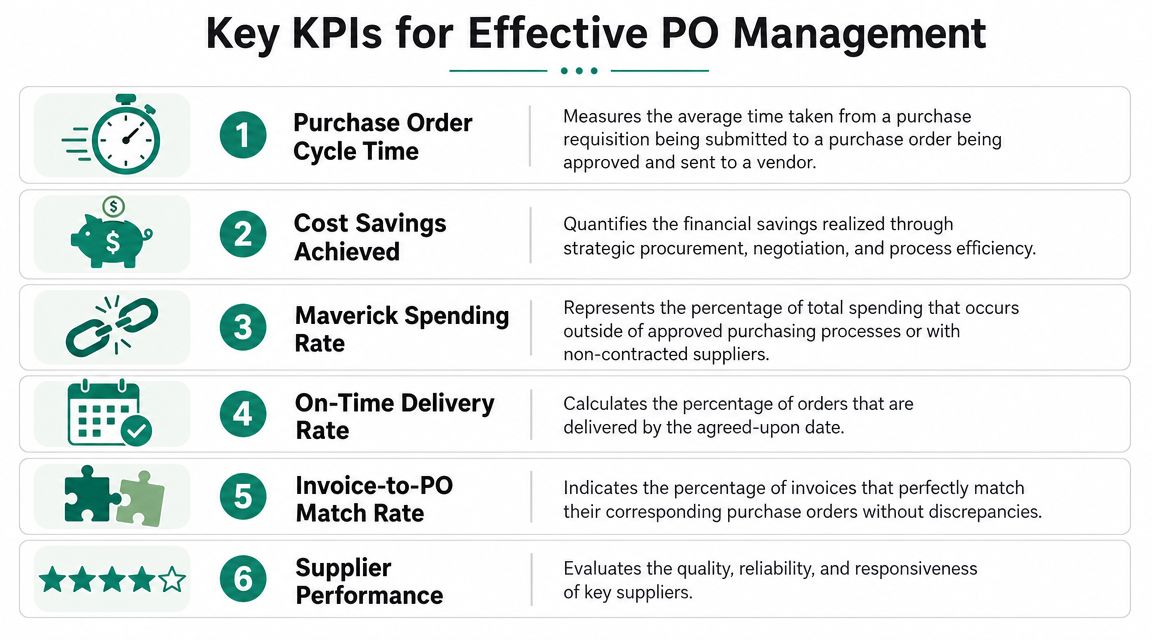
The KPIs worth tracking first
Purchase order cycle time
This measures how long it takes from requisition to approved PO sent to the supplier.
A long cycle time often means too many approval handoffs or poor supplier master data. If urgent buys keep bypassing the process, cycle time is usually one reason.
First-time match rate
This tracks how many invoices match the PO and receipt on the first review, without rework.
A weak match rate usually points to one of three problems. Bad PO detail, poor receiving discipline, or suppliers invoicing against outdated terms. This is one of the cleanest indicators of process quality.
Maverick spend rate
This shows how much spend happened outside the approved PO process.
You can track it by reviewing supplier invoices and tagging those with no linked PO. If the number is high, your issue is not software. Your issue is governance.
On-time delivery rate
This measures whether suppliers deliver by the agreed date.
It helps procurement and finance for different reasons. Procurement sees supplier reliability. Finance sees whether committed spend is turning into usable stock or delayed inventory.
Purchase order accuracy rate
This looks at whether the original PO was correct when issued. Wrong price, wrong quantity, wrong item code, wrong location. All of those count against accuracy.
What each KPI tells finance
Here's the useful interpretation:
- Cycle time tells you whether the process is fast enough to be used.
- First-time match rate tells you whether the controls are clean.
- Maverick spend rate tells you whether policy is being followed.
- On-time delivery tells you whether suppliers are performing.
- PO accuracy tells you whether your base data is reliable.
A process that people avoid is not a process. It's a policy document no one respects.
These metrics also connect directly to broader financial performance. When PO discipline improves, cash planning usually becomes more predictable because committed spend and inbound stock are easier to map against the wider cash conversion cycle for SMEs.
Start small and review monthly
Don't wait for a perfect dashboard. Start with two or three reports your team can maintain consistently. Review them once a month with finance, operations, and whoever approves spend.
Patterns matter more than precision in the early stage. If first-time match rates are improving and off-process buying is falling, you're moving in the right direction.
Choosing the Right Tech for PO Automation
Not every business needs a full procurement suite. Many just need less manual handling, cleaner approvals, and a better trail between order, receipt, and invoice.
The right tool depends on your transaction volume, team size, and how fragmented your current process is.
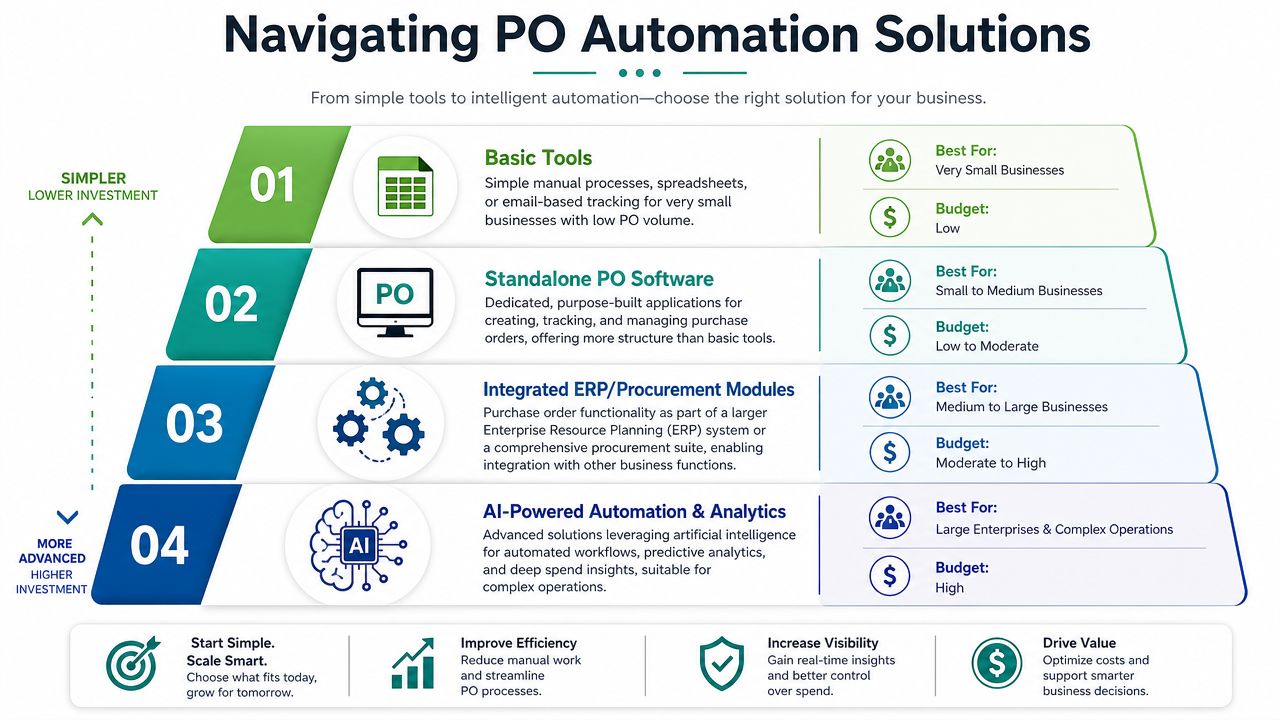
Level one suits very small teams
If you're still early-stage, a disciplined spreadsheet plus a standard PO template can work. The key word is disciplined.
This setup only holds if:
- approvals are mandatory,
- document storage is centralised,
- and receiving records are updated consistently.
If any of those are weak, the spreadsheet becomes a false comfort.
Accounting software works for many SMEs
For a lot of growing businesses, the next step is using the PO features inside accounting tools such as Zoho Books or Xero. These are often enough when the main need is to create formal POs, track supplier bills, and keep finance close to the transaction record.
That choice works well when:
- purchasing is moderate,
- warehouse complexity is low,
- and supplier management is still relatively simple.
It starts to strain when approvals branch by department, partial deliveries are common, or inventory data needs tighter control.
Standalone procurement tools add structure
Dedicated PO or procurement software is the better fit when the main pain is process discipline rather than pure accounting. These platforms typically offer:
- Approval workflows for different thresholds or departments
- Supplier portals for confirmations and updates
- Status tracking on open orders
- Better audit trails for finance and internal review
This is often the sweet spot for distributors, wholesalers, and multi-branch businesses that have outgrown ad hoc methods but aren't ready for a major ERP project.
ERP makes sense when operations are tightly linked
If purchasing, inventory, receiving, accounting, and reporting all need to sit in one system, an ERP becomes more attractive. But many SMEs implement ERP too early and then customise around broken habits.
That usually ends badly.
Choose ERP when your process is already defined and your team is ready to follow it. Don't choose it because you hope technology will create discipline by itself.
Buy the smallest tool that solves the actual bottleneck. Complexity is not the same as control.
A simple selection test
Before choosing any technology, ask:
- Does it enforce approvals
- Can it track partial receipts
- Does finance see invoice status against the PO
- Can open commitments be reviewed easily
- Will the team use it
If the answer to the last question is no, the rest doesn't matter.
How Smart POs Unlock Working Capital
A well-run PO process does more than keep procurement tidy. It creates verifiable transaction evidence. That has financial value.
When a business can show a clear chain from approved order to receipt to invoice, it becomes easier to support faster processing, cleaner reconciliation, and stronger confidence around what is owed and what is still pending.
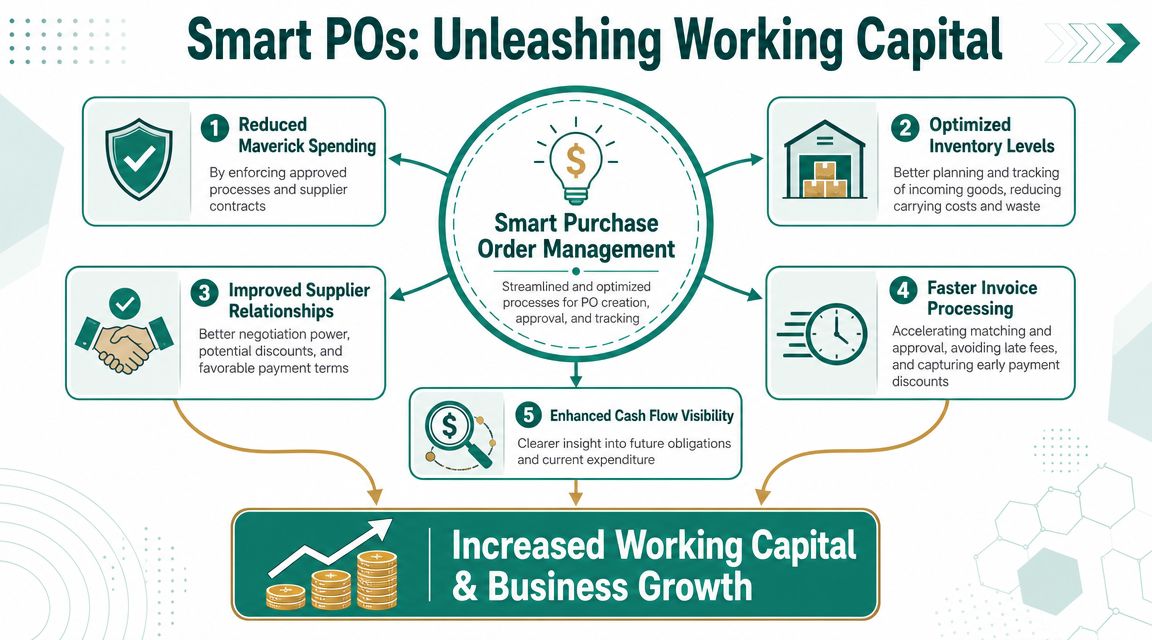
Good PO data improves cash visibility
Finance teams often focus on cash already paid or invoices already due. Smart POs add another layer. They show committed spend before payment happens.
That changes planning in practical ways:
- Purchasing can see what is still open.
- Finance can estimate upcoming obligations earlier.
- Management can spot whether stock is arriving in line with planned sales or projects.
This matters even more in trading and import-heavy businesses where lead times, landed cost assumptions, and supplier terms can shift. For teams dealing with margin pressure on imported goods, Coreties' cost plus import insights offer useful context on how upstream cost structure affects commercial decisions later.
Clean records support modern payment workflows
Operations and financial strategy meet.
Modern invoice and payment solutions depend on confidence in underlying trade data. A vague invoice with no linked PO, unclear receipt status, and inconsistent approval trail is hard to trust. A structured transaction record is far more usable.
That's why strong purchase order management can help businesses use tools such as:
- Invoice Discounting: Suppliers can act on approved invoices with less friction when the underlying order trail is clear.
- B2B BNPL terms: Buyers and sellers both benefit when the commercial record is documented and easy to verify.
- Dealer and distributor models: Verifiable order and receipt data support cleaner inventory-linked decision-making.
If you operate in the region and want to explore how this connects to practical SME trade flows, this guide to purchase order financing in the UAE gives a helpful market lens.
The strategic gain is not just speed
The deeper benefit is confidence.
With smart POs, finance can separate approved commitments from informal promises. Suppliers get fewer disputes. Operations gets clearer delivery tracking. Management gets a more believable picture of what cash will be needed and when.
That's how administrative discipline becomes a growth lever.
Clean POs don't create cash by themselves. They make the business easier to trust, easier to analyse, and easier to operate.
For many SMEs, that's the difference between constantly reacting to shortages and making deliberate decisions about stock, supplier terms, and sales expansion.
Your Action Plan for Better PO Management
Most businesses don't need a full transformation to improve purchase order management. They need a few rules that everyone follows every time.
Start with process, not software
Do these first:
- Create one standard PO template: Include PO number, date, supplier, delivery location, item details, quantities, prices, terms, and approver.
- Make approval mandatory: Even if approval starts by email, no PO should go to a supplier without it.
- Centralise storage: Keep POs, confirmations, receipts, and invoices in one shared location.
- Record receipt properly: Don't rely on verbal confirmation from the warehouse or requestor.
- Hold invoice payment until review: If details don't align, stop and resolve the discrepancy before payment.
Tighten behaviour across teams
Run a short internal session with operations, procurement, warehouse, and finance. Explain one thing clearly. The PO process isn't there to slow them down. It's there to stop avoidable disputes, bad payments, and missing visibility.
Then choose a few habits to enforce:
- No supplier order without a PO
- No invoice processed without a PO reference
- No delivery accepted without a receipt record
- No exceptions handled on chat alone
Review one month at a time
Pick a small set of checks for your monthly review:
- open POs,
- invoices with no PO,
- frequent supplier mismatches,
- and off-process purchases.
That's enough to expose most weaknesses early. Once the basics are stable, then automate further.
If your business has already tightened its PO process and wants a better way to access cash from approved trade activity, Comfi helps MENA SMEs use clean invoice and payment workflows more effectively through digital solutions for Invoice Discounting, B2B Buy Now, Pay Later, and automotive dealer financing. The stronger your purchase order discipline, the easier it is to turn operational control into healthier cash flow.