Mastering Supplier Relationship Management: A Guide for SMEs

A supplier rarely becomes a problem on a quiet day. The issue shows up when your biggest customer is waiting, your warehouse team is asking where the stock is, and one missed delivery suddenly turns into a sales problem, a cash-flow problem, and a reputation problem.
That's why supplier relationship management matters so much for SMEs in the UAE. It isn't a corporate exercise for large procurement teams. It's a practical way to make sure the suppliers you depend on stay responsive, predictable, and aligned with how your business runs.
In this market, many SMEs still manage suppliers through WhatsApp messages, urgent calls, and last-minute negotiations. That can work for a while. It usually breaks when order volumes rise, payment timing tightens, or a key supplier starts prioritising another buyer who looks easier to serve.
Why Supplier Relationships Are Your Hidden Asset
A weak supplier relationship often hides inside normal operations until pressure exposes it. One late container, one unresolved quality issue, or one supplier who stops picking up your calls can drag down fulfilment, collections, and customer retention at the same time.
Strong supplier relationships do the opposite. They give you earlier warning when something is slipping, better cooperation when plans change, and more room to solve problems before they reach your customer. For an SME, that's not a soft benefit. It affects stock availability, margin protection, and how confidently you can take on new business.
Why SRM matters more than price negotiations
Many owners still treat suppliers mainly as a price discussion. That's too narrow. A low unit price won't help if the supplier misses delivery windows, ignores documentation requirements, or slows down when your payment pattern becomes inconsistent.
According to Amazon Business's summary of a Deloitte survey, more than 60% of chief procurement officers said supplier collaboration was the strategy that delivered the most value. That matters in the UAE because supplier concentration is often high, and a small number of suppliers can influence your replenishment speed and working capital efficiency.
Practical rule: If a supplier can disrupt your sales within a week, that supplier deserves active management, not occasional follow-up.
What changes when you manage suppliers properly
Supplier relationship management means moving from reactive buying to structured oversight. In practice, that usually includes:
- Segmenting suppliers by importance, risk, and switching difficulty
- Tracking performance with simple scorecards
- Setting a review rhythm so issues don't wait for a crisis
- Creating clear escalation paths when service drops
The hidden asset isn't the supplier itself. It's the discipline your business builds around that relationship. When that discipline is missing, every disruption feels sudden. When it's present, your team sees patterns earlier and acts faster.
For UAE-based SMEs in trading, distribution, automotive, electronics, and wholesale, that difference is often what separates controlled growth from constant firefighting.
The Core Pillars of a Strong SRM Strategy
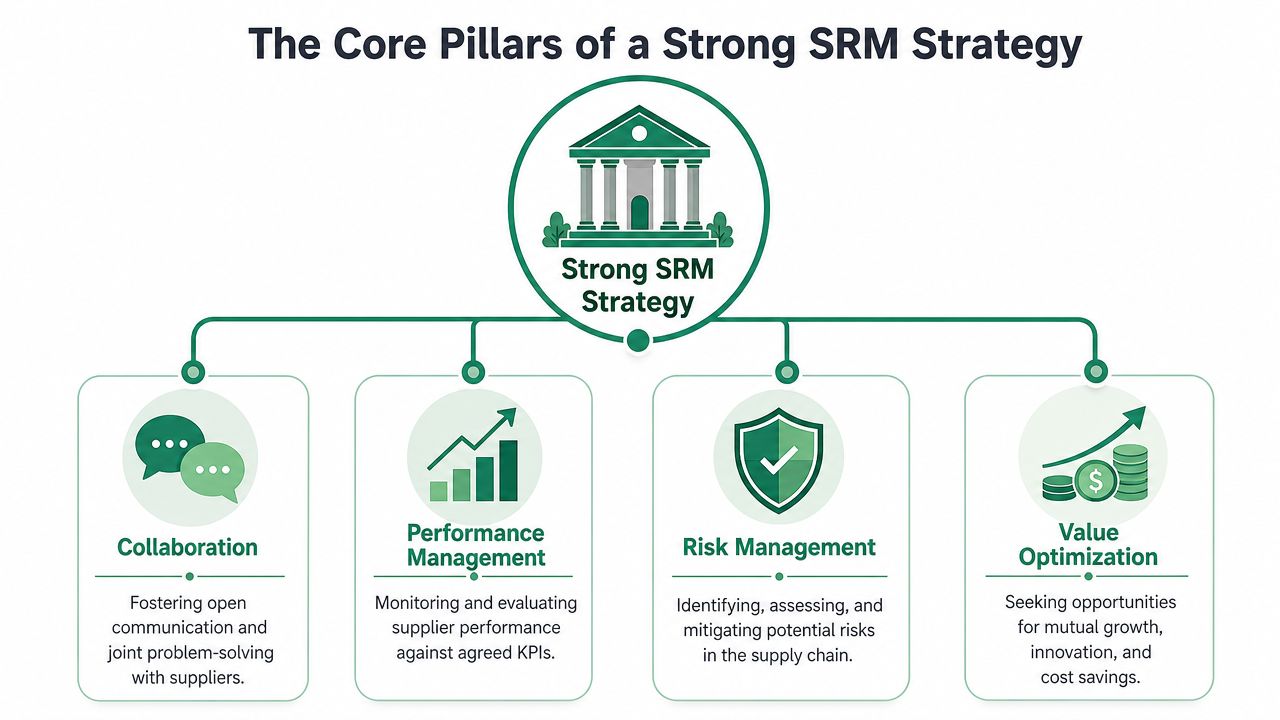
A workable SRM model doesn't need to be complicated. It needs to be organised. Most SMEs get better results when they focus on four pillars and keep each one practical.
Supplier segmentation
Not every supplier deserves the same level of attention. That's the first rule. The most effective SRM models segment suppliers by operational importance. Strategic partners get formal reviews and detailed scorecards, while routine suppliers are managed with lighter controls, as outlined in Ivalua's guidance on supplier relationship management.
For an SME, segmentation usually works best when you ask a few direct questions:
- Revenue impact. If this supplier stops shipping, do your sales stop?
- Replacement difficulty. Can you switch quickly, or would it take time?
- Operational dependency. Does this supplier affect a key product line or customer promise?
- Commercial negotiating power. Are terms stable, or does every order require negotiation?
A local distributor might buy packaging from five vendors but rely on one core inventory supplier for the bulk of revenue. Those relationships shouldn't be managed the same way.
Performance management
Once suppliers are segmented, expectations need to be measurable. Many SMEs fall short in this area. They know a supplier is “good” or “difficult”, but there's no shared record of what that means.
Use a scorecard tied to the contract and operating reality. Keep it lean. Focus on delivery, quality, responsiveness, document accuracy, and issue resolution. If commercial terms matter, include them too.
If you're reviewing payment discussions alongside supplier performance, this guide on how to get extended payment terms from suppliers in the UAE is useful because it shows how negotiation posture and operating credibility often move together.
Risk management
Risk management in SRM isn't just about supplier failure. It's about spotting deterioration early. A supplier may still be shipping, but warning signs often appear first through partial deliveries, slower replies, quality drift, or repeated invoice disputes.
Watch for operational signals before financial stress becomes visible. Procurement teams usually see trouble in service behaviour first.
Build a short watchlist for strategic suppliers. It should cover delivery reliability, compliance issues, concentration risk, and any sign that the supplier no longer sees your account as a priority.
Relationship development
This is the part people often reduce to “keep in touch”. That's too vague. Real relationship development means creating mutual value. Share demand forecasts when possible. Explain upcoming campaigns. Give earlier notice of volume changes. Bring issues to the supplier with evidence, not emotion.
A strong relationship doesn't mean avoiding difficult conversations. It means both sides can have them early, clearly, and without damaging trust.
Measuring Success with the Right KPIs
If you don't measure supplier performance, you'll end up managing by memory. That usually means the loudest recent issue gets all the attention, while deeper patterns stay hidden.
The best KPI set for supplier relationship management is small enough to use and specific enough to act on. For SMEs, that usually means choosing measures that connect directly to stock flow, compliance, cash timing, and customer service.
Quality and compliance KPIs
These indicators show whether the supplier is delivering what was agreed, not just whether goods arrived.
- Defect trend. Track whether received goods repeatedly fail inspection or create returns later. This helps separate one-off errors from a recurring quality issue.
- Specification accuracy. Useful when you buy technical items, parts, or regulated products. If the supplier frequently misses documentation or agreed specs, risk sits in the process, not just the product.
- Invoice and document accuracy. Repeated mismatches between goods, invoices, and supporting paperwork create delays in approval and payment.
Delivery and service KPIs
These measures reveal whether the supplier supports your operating rhythm.
- On-time delivery. This is often the first KPI to monitor because it directly affects fulfilment and customer commitments.
- In-full delivery. A shipment that arrives on time but short doesn't solve your problem.
- Lead time consistency. Even when average delivery looks acceptable, unpredictable lead times make purchasing harder to plan.
- Response time for issues. Measure how quickly the supplier acknowledges and resolves disruptions, not only how quickly they answer a message.
If your team is also tightening payment and supplier terms, it helps to align procurement KPIs with a clear understanding of what trade credit means in practice. Many supplier disputes that look operational are rooted in unclear expectations around settlement and credit periods.
Commercial and cash-flow KPIs
These KPIs are where many modern SRM programmes become more useful. They connect supplier behaviour to liquidity and control.
- Price adherence. Are agreed rates being honoured, or are there frequent exceptions?
- Dispute frequency. Repeated disputes usually signal process weakness, poor controls, or commercial friction.
- Payment acceptance behaviour. If a supplier becomes harder to work with when payments stretch, that's a relationship health issue worth tracking qualitatively.
- Order flexibility. Can the supplier accommodate urgent changes without destabilising service?
Innovation and collaboration KPIs
Not every supplier contributes ideas, but strategic ones should improve with you over time.
- Forecast adoption. Does the supplier use the demand information you share?
- Improvement follow-through. When review meetings identify actions, does the supplier complete them?
- Problem-solving quality. Some suppliers explain issues. Better suppliers propose solutions.
A KPI is useful only if it changes a decision. If your team tracks a number but never acts on it, remove it.
For most SMEs, a monthly scorecard for core suppliers and a lighter quarterly review for routine ones is enough to create discipline without creating admin overload.
Building Your SRM Governance Model
A scorecard alone won't fix supplier management. Governance is what turns information into action. It defines who reviews what, how often, and what happens when performance slips.
In many UAE SMEs, supplier oversight is still informal. One buyer handles calls, finance handles payment issues, operations escalates when stock is missing, and no one owns the full relationship. That structure works only until the supplier becomes critical.
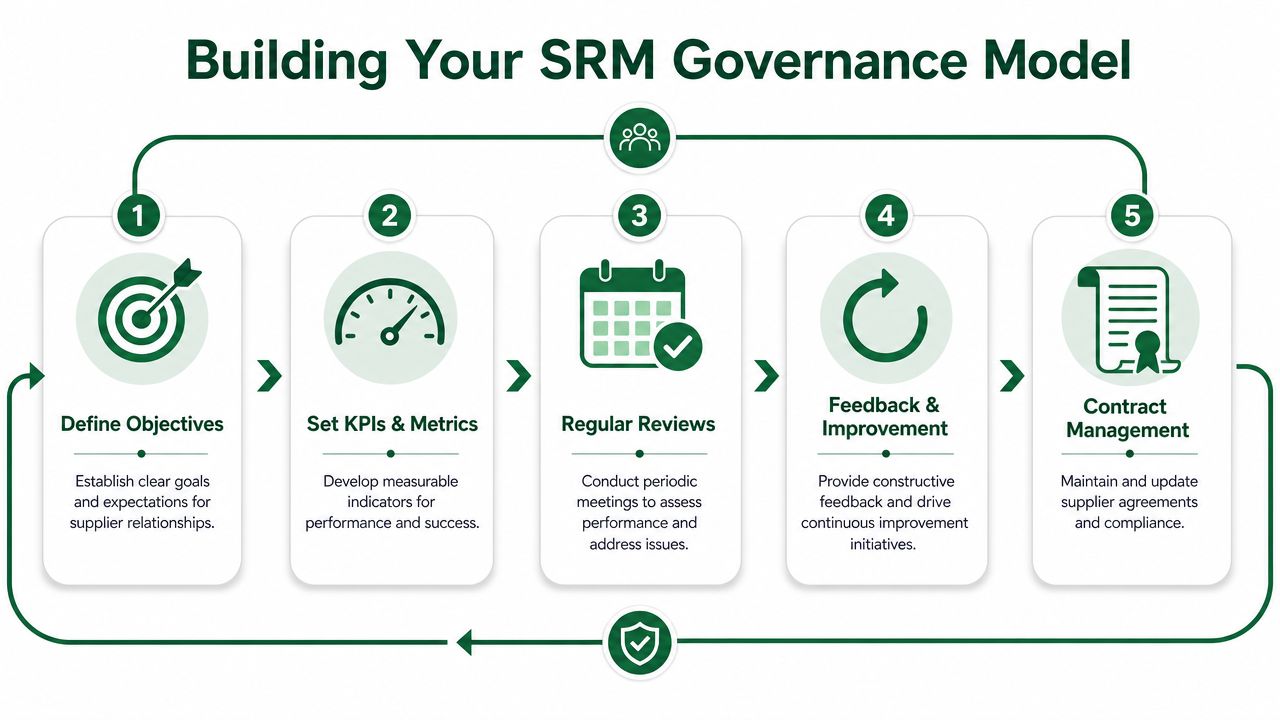
Build governance by supplier tier
The best governance models are tiered. Strategic suppliers need more touchpoints, more senior oversight, and clearer escalation rules. Routine suppliers need consistency, but not constant meetings.
A practical model often looks like this:
Strategic suppliers
Formal scorecards, scheduled business reviews, named owners in procurement and finance, and clear escalation for service or risk issues.Important operational suppliers
Periodic reviews, KPI checks, issue logs, and contract monitoring without heavy executive involvement.Transactional suppliers
Basic service tracking, automated reminders, and exception-based management.
This shift towards structured, data-driven governance is a meaningful opportunity for SMEs. JPMorganChase notes that mature SRM is about strategically engaging key suppliers for long-term value, while only about 13% of organisations qualify as leaders in vendor-management maturity. For an SME, that gap means disciplined execution can still stand out.
Create review rhythms people will actually follow
Good governance is regular, not theatrical. Don't hold quarterly reviews packed with slides if your team never uses the output. Use shorter, repeatable routines.
Try this structure:
- Monthly operational check-in for core suppliers. Review delivery, open issues, pending claims, and upcoming demand shifts.
- Quarterly business review for strategic suppliers. Cover broader trends, service gaps, commercial alignment, and improvement actions.
- Exception review when a trigger is hit. For example, repeated late deliveries, unresolved documentation problems, or a sudden change in service quality.
Define ownership across teams
One of the biggest SRM mistakes is assuming procurement owns everything. It doesn't. Supplier performance often sits across functions.
- Procurement owns commercial alignment and ongoing relationship management
- Operations or supply chain owns service feedback and delivery impact
- Finance owns invoice flow, dispute visibility, and payment discipline
- Leadership steps in when a strategic supplier relationship needs reset or support
Governance should remove ambiguity. If a supplier misses the mark, your team should know who calls, who reviews, and who approves the next step.
Keep the model simple enough to run with your current team. A lean governance rhythm done consistently beats a complex model that lives in a slide deck.
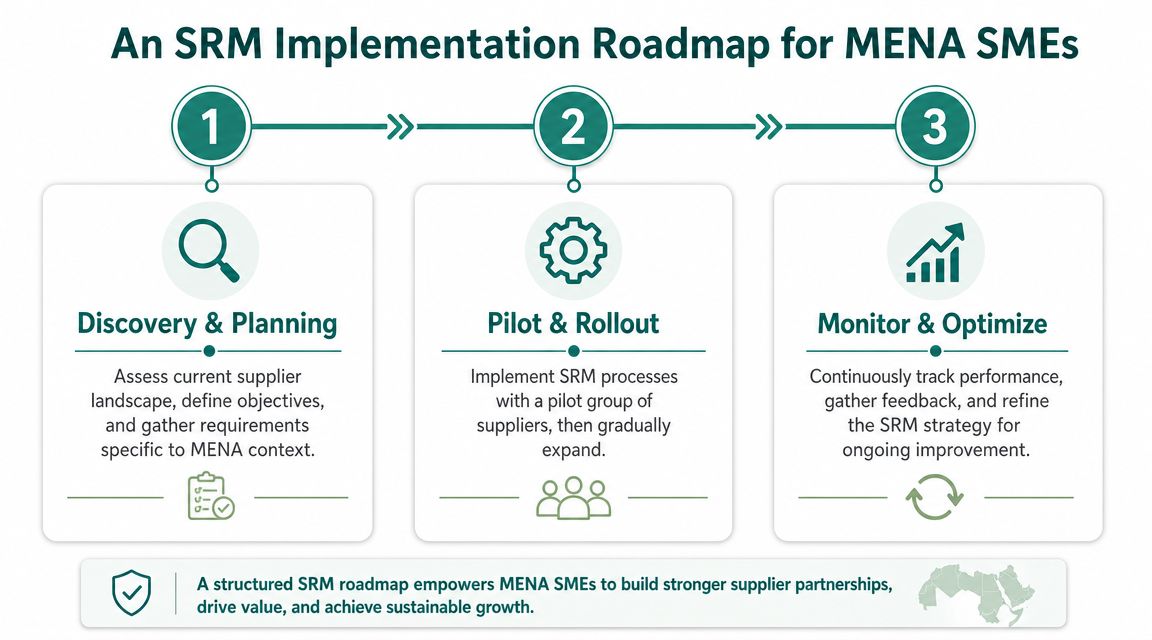
An SRM Implementation Roadmap for MENA SMEs
Most SMEs don't need a large transformation project to start supplier relationship management. They need a practical rollout that fits the team they already have.
The easiest way to implement SRM is through three lenses: people, process, and technology. If one of those is missing, the programme usually stalls.
People first
A supplier relationship without clear ownership becomes a shared problem and an unmanaged one. Even if you don't have a procurement department, assign one accountable owner for each important supplier.
That owner doesn't need to do everything. They need to coordinate the relationship, keep the scorecard current, and make sure issues don't die between departments.
For SMEs, the most common setup is:
- Commercial owner from purchasing or operations
- Finance contact for payment and invoice matters
- Backup decision-maker when escalation is needed
Train these people to ask better questions. Not just “Where is the shipment?” but “What changed in your lead time?”, “What's causing the repeat mismatch?”, and “What do you need from us to stabilise performance?”
Put a light process in place
You don't need procurement software on day one. You do need a repeatable process.
Start with a pilot group of suppliers and follow a basic sequence:
- List your suppliers and mark which ones affect revenue, customer delivery, or hard-to-replace inventory.
- Segment them into strategic, important, and routine.
- Set a scorecard for the top tier using a handful of practical KPIs.
- Schedule reviews and document actions after each one.
- Escalate consistently when service or compliance drops.
One thing matters here. Don't try to roll this out across every vendor at once. A pilot with a small number of important suppliers will teach you what works in your business.
Choose technology that matches your stage
Many SMEs overbuy software or underbuild controls. Both create waste.
A sensible technology path usually looks like this:
- Spreadsheet and shared folder when you're starting
- ERP reports and approval workflows once data is spread across teams
- Supplier portals, dashboards, or integrations when transaction volumes grow and manual follow-up slows you down
What matters isn't how advanced the tool looks. It's whether your team can see supplier status, review open issues, and act before problems hit the customer.
A useful rule in the MENA SME context is to digitise the points where handoffs fail most often. That may be invoice matching, approval delays, proof-of-delivery visibility, or supplier communication trails. Start where friction is already costing time and trust.
Integrating Fintech for a Modern SRM Advantage
Traditional SRM advice usually stops at meetings, scorecards, and supplier reviews. That's still important, but it's no longer enough for many MENA businesses. In practice, supplier performance is often tied to how smoothly information and payments move through the relationship.
A supplier may look operationally sound on paper and still deprioritise your account if settlements are unpredictable, invoice approvals take too long, or no one can see where a transaction is stuck. In such situations, fintech becomes part of supplier relationship management, not a separate finance topic.

Two examples from day-to-day trading
Take a Dubai auto dealer trying to restock fast-moving vehicles. The supplier relationship may seem strong until inventory sits too long and cash gets trapped in current stock. Once payment timing tightens, ordering becomes cautious, and the supplier may reserve preferred allocation for buyers who can settle more smoothly. In that case, SRM isn't only about review meetings. It's about creating a cleaner link between stock movement, invoice handling, and supplier confidence.
Now look at an electronics distributor selling to retailers across the region. Sales may be growing, but if collections remain slow and supplier invoices are approved manually, service quality starts to wobble. Suppliers don't always complain loudly. Sometimes they just ship slower, become less flexible, or insist on tighter terms.
That's why modern SRM increasingly connects risk and cash flow. As Ramp's overview of SRM explains, when supplier payment is delayed, performance can suffer, and stronger frameworks link KPIs to financial incentives and early warning indicators.
What financially synchronised SRM looks like
The practical goal is simple. Suppliers should know what has been approved, what is pending, and when settlement is likely. Your team should know when friction in that process is starting to affect supply reliability.
That often means:
- Cleaner AP workflows so invoices don't get lost in approval chains
- Shared status visibility so disputes are resolved with facts
- Structured payment timing that supports continuity, not last-minute damage control
- Integration between procurement and finance so supplier conversations reflect the full picture
If your AP process is still mostly manual, Snyp's practical AP automation tips are worth reviewing because they focus on the key bottlenecks that delay approvals and create supplier friction.
Where tools fit
Some businesses use ERP workflow tools. Others use supplier portals, invoice platforms, or embedded payment infrastructure. In the UAE market, solutions such as Comfi's approach to supply chain disruption support in the UAE sit in this broader shift toward tighter coordination between invoice settlement, supplier continuity, and purchasing flexibility. The point isn't to add another platform for its own sake. The point is to reduce the gap between a supplier shipping goods and your business processing the transaction cleanly.
The strongest supplier relationship is often the one with the least financial ambiguity.
When suppliers trust the process around payment and status visibility, they usually become easier to plan with, not just easier to negotiate with.
Key Takeaways for Sustainable Supplier Partnerships
Supplier relationship management works best when you stop treating it as a procurement formality and start treating it as an operating system for supplier performance.
A few principles matter most:
- Prioritise the right suppliers. Your critical suppliers need more than occasional contact.
- Measure what affects the business. Focus on delivery, quality, responsiveness, disputes, and the cash-flow signals that change supplier behaviour.
- Run a visible governance rhythm. Reviews, ownership, and escalation rules should be clear before something goes wrong.
- Connect finance and procurement. Supplier health often weakens through payment friction long before it shows up as a major supply issue.
- Keep the model practical. A lean scorecard and regular follow-up beat a complex SRM programme that your team won't maintain.
For MENA SMEs, the opportunity is simple. Many businesses still manage suppliers informally. That leaves room for smaller, organised companies to build an advantage through consistency, faster issue resolution, and better financial coordination.
If you want supplier relationships that support growth, don't wait for a disruption to force the change. Build the structure while things are still stable. That's when supplier relationship management starts paying off.
If you're looking at supplier performance and cash-flow pressure together, Comfi is one option to explore. It helps businesses manage invoice settlement and payment timing through digital workflows, which can support smoother supplier coordination when cash is tied up between buying and selling.