A Practical Guide to Treasury Management for SMEs

If you’ve ever felt like your company’s finances were a step behind, constantly reacting to problems instead of getting ahead of them, you’re not alone. Many businesses focus on bookkeeping and accounting but miss the bigger picture. That’s where treasury management comes in—it’s the shift from simply recording financial history to actively steering your company’s financial future.
What Is Treasury Management and Why It Matters
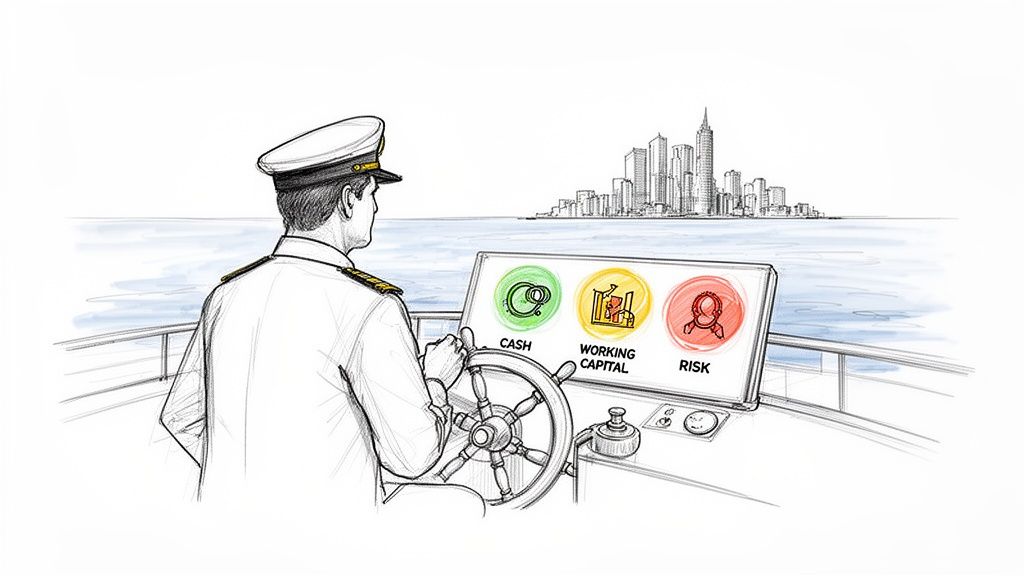
Think of it this way: effective treasury management is like being the captain of a ship. It’s your job to manage your resources—cash, fuel, and supplies—to navigate both open water and unexpected storms, making sure you reach your destination not just safely, but on schedule.
It’s about moving beyond just balancing the books. You’re proactively shaping your company’s financial health, building a resilient organization that can do more than just survive market shifts—it can thrive in them.
The Three Pillars of Treasury Management
At its core, treasury management is built on three fundamental pillars. Get these right, and you’ll have the structure you need to protect and grow your business.
- Cash and Liquidity Management: This is the absolute bedrock. It’s about keeping a close eye on your daily cash position, forecasting every dollar that comes in and goes out, and making sure you always have enough liquid cash for short-term needs like payroll and supplier payments.
- Working Capital Optimization: This pillar is all about making the money tied up in your operations work harder. It means getting customers to pay faster, keeping inventory levels lean, and negotiating better terms with suppliers to free up cash.
- Financial Risk Management: This involves spotting, measuring, and neutralizing financial risks before they become problems. These risks could be anything from a customer who might default on a payment to sudden spikes in interest rates or volatility in foreign currency exchange rates.
By mastering these three areas, treasury management elevates your finance function from a reactive support role into a strategic driver of your entire business.
To really grasp how crucial this is, consider how analytics for finance can turn a finance department into a strategic partner. When you turn raw data into real insights, you can make smarter decisions about where to allocate capital, how to manage risk, and where to find growth. This proactive approach is what separates businesses that are just getting by from those that consistently hit their goals.
The Foundation: Cash Flow Planning in Treasury Management
Effective treasury management all boils down to one thing: getting a firm grip on your cash flow. Without a crystal-clear picture of every dollar moving in and out of your business, you're essentially flying blind. That's why building a solid financial roadmap through cash flow planning isn't just a nice-to-have—it's absolutely essential.
The process involves looking back at historical data to project future sales and expenses, giving you a forecast of where your cash will be. When done right, this allows you to see cash surpluses and shortfalls on the horizon, giving you precious time to act strategically instead of just reacting.
Of course, a good forecast is only as strong as the data it’s built on. This means mastering fundamental financial disciplines is non-negotiable. For example, a rock-solid understanding of a bank reconciliation statement is crucial to ensure your books actually match the bank's reality, giving you an accurate starting point.
Creating Predictability in an Unpredictable Market
Ultimately, the goal of cash flow planning isn’t just to keep your head above water; it’s to create predictability. For any small or medium-sized enterprise (SME), predictability is a genuine superpower. It’s what transforms reactive, fire-fighting leadership into proactive, strategic command.
When your cash flow is predictable, you’re no longer guessing. You can confidently plan for major investments, navigate seasonal slumps, and decide when to expand your operations.
This is precisely where modern platforms like Comfi come into play. One of the single biggest roadblocks to predictable cash flow is the uncertainty of B2B payments. Waiting 30, 60, or even 90 days for an invoice to get paid blows a massive hole in any financial plan you try to make.
By ensuring businesses can get paid immediately on their invoices, Comfi helps turn uncertain, future revenue into definite, immediate cash in the bank. This certainty empowers businesses to build a cash flow forecast they can actually trust. It’s how many clients have managed to unlock their working capital and de-risk their sales ledger, paving the way for more confident and strategic growth.
How to Optimize Your Working Capital Cycle
Working capital is simply the cash tied up in the day-to-day rhythm of your business—the money flowing between buying inventory, making sales, and eventually, getting paid. Think of it as your company's operational fuel. If that flow is sluggish, your cash is trapped. Speed it up, and you unlock capital, boost liquidity, and gain serious financial flexibility.
Effective treasury management is all about actively shortening this cycle. Instead of passively waiting for cash to trickle back in, you put smart strategies in place to accelerate it. The goal is to shrink the time it takes to turn your investments in inventory and other resources back into cash you can actually use.
Imagine a small electronics distributor. They buy components, assemble them into products, sell them to retailers, and then wait to get paid. Every single day their cash is stuck—either as components sitting on a shelf or as an unpaid invoice—is a day that cash isn't working for them.
Key Levers for a Shorter Cycle
To free up this trapped cash, you really only need to pull on three main levers in your operations. Each one gives you a way to directly improve your working capital position.
- Get Paid Faster (Receivables): The single biggest drag on working capital is almost always waiting for customers to pay. You can shorten your Days Sales Outstanding (DSO) significantly by setting clear payment terms, offering small discounts for early payment, and having a consistent follow-up process.
- Fine-Tune Your Inventory: Every item sitting in your warehouse represents cash that’s just sitting there. Adopting just-in-time inventory methods, getting better at sales forecasting to avoid overstocking, and liquidating slow-moving products are all proven ways to turn those assets back into usable funds.
- Manage What You Owe (Payables): While you want to get paid quickly, it can be a smart move to negotiate longer payment terms with your own suppliers—without damaging those crucial relationships, of course. This lets you hold onto your cash a little longer, using it for other operational needs before it has to go out the door.
The less time your money is stuck as either inventory or an outstanding invoice, the more financial power you have. A shorter cycle directly translates to a stronger, more resilient business that can react faster to opportunities.
Mastering this flow is the core of what’s known as the cash conversion cycle. You can go deeper on this by reading our detailed guide on the cash conversion cycle and how to calculate it for your business. By optimizing each stage, you transform working capital from a passive number on a balance sheet into an active tool for growth.
Using Modern Platforms to Make Your Cash Flow Predictable
Even the most carefully crafted cash flow plan can fall apart when it collides with a single, frustrating reality: late payments. For many SMEs, the gap between sending an invoice and actually seeing the money hit your bank account is a constant source of friction and a huge barrier to solid treasury management. Waiting 30, 60, or even 90 days to get paid injects a massive dose of uncertainty into your operations.
This unpredictability makes building a cash flow forecast you can actually rely on nearly impossible. How can you confidently pay your own suppliers, cover payroll, or invest in that new piece of equipment when a huge chunk of your revenue is just sitting in your accounts receivable ledger? This is where modern financial platforms completely change the game.
Turning "Eventually" into "Right Now"
The core function of these platforms is to close that agonizing payment gap. By providing a way for businesses to get paid on their invoices almost immediately, they turn uncertain, future income into cash you can use today. Instead of having money tied up for months, it can be accessed in a matter of hours or days.
This one simple change creates a powerful ripple effect across your entire business. With a steady, predictable stream of cash, you can finally:
- Build a cash flow forecast that’s far more accurate and reliable.
- Pay your own suppliers on time, which can open the door to better pricing and terms.
- Confidently pull the trigger on growth initiatives, like a new marketing campaign or buying more inventory.
- Dramatically cut down on the time and stress of chasing down late payments.
The real shift is moving from a reactive position of constantly chasing money to a proactive one of strategic financial control. Predictability becomes your new normal.
This is a massive step forward for treasury management in small and medium-sized businesses. For instance, clients who use Comfi to get their invoices paid faster often find they can unlock significant working capital that was previously just trapped on their sales ledger.
This newfound liquidity gives them the power to jump on opportunities they would have otherwise had to pass up. It’s not just about getting paid faster; it's about building a more resilient and agile financial operation. A deeper look into the mechanics of modern B2B payments shows how these solutions directly fuel stronger, more predictable growth. By making sure your payments are consistent and on time, you de-risk your sales and stabilize the very foundation of your financial planning.
Managing Key Financial Risks in Your Business
Smart treasury isn't just about chasing growth; it's about building a financial fortress. A solid treasury function protects your business from the kinds of financial shocks that can knock a company off course. Every SME faces risks, but thinking ahead turns potential disasters into manageable problems.
For most businesses we see, the real dangers boil down to three core threats. Each one is a different beast, but they’re all connected by a single lifeline: your cash flow.
The Big Three Financial Risks
- Liquidity Risk: This is the one that keeps finance leaders up at night—the very real danger of running out of cash to pay your bills. Even a profitable company on paper can find itself in hot water if its cash is all tied up in unpaid invoices when payroll and supplier payments are due.
- Credit Risk: This is the risk that your customer simply won’t pay you. For an SME, a single large customer defaulting on an invoice can be enough to trigger a full-blown liquidity crisis. To get a better handle on this, check out our deep dive into managing payment risk.
- Currency Risk: If you buy from or sell to international partners, you’re exposed to this risk. It’s the threat that comes from unpredictable swings in foreign exchange rates. A sudden dip in a customer's currency can instantly shrink your profit margins, just as a spike in a supplier's currency can drive up your costs overnight.
The goal of modern treasury isn't to avoid risk entirely—that's impossible. It's about building a financial structure resilient enough to absorb these hits without derailing your day-to-day operations or stalling your growth plans.
This is exactly where modern financial platforms are changing the game. They tackle the root cause of many of these risks: slow and unpredictable payment cycles.
By offering solutions that ensure invoices get paid on your terms, they can effectively take buyer credit risk completely off your books. This one move instantly stabilizes your cash position, smooths out revenue, and makes your entire treasury operation stronger against the most common financial threats.
Building Your SME Treasury Management Framework
So, where do you actually begin? The idea of building a treasury management framework can sound intimidating, like something reserved for massive corporations. But it doesn't have to be. For an SME, it’s all about taking practical, deliberate steps to build financial muscle over time, without needing a huge team or expensive software.
The entire process boils down to one thing first: visibility. You can’t manage what you can’t see. Before you do anything else, you need a crystal-clear picture of your cash flow. A good, simple metric to start tracking is your Days Sales Outstanding (DSO), which tells you exactly how long it takes, on average, to get paid after you make a sale.
Once you have that baseline, you can start making small changes that deliver big results.
A Practical Roadmap to Implementation
Think of this as a marathon, not a sprint. The goal is to make steady, gradual improvements that show real value without overwhelming your finance team.
- Phase 1: Achieve Visibility. This is your foundation. Start by getting all your financial data in one place. Simple accounting software can give you a real-time snapshot of your cash on hand, who owes you money, and what you owe. Everything else you do will build on this single source of truth.
- Phase 2: Target High-Impact Areas. Don’t try to boil the ocean. Zero in on your single biggest headache—which for most SMEs, is getting paid. Focus all your initial energy on tightening up your receivables process and bringing cash in the door faster.
- Phase 3: Automate and Integrate. Once you’re getting a handle on the basics, you can bring in technology to do the heavy lifting. Platforms that automate invoice collections can plug right into your existing accounting software, saving hours of manual work and cutting down on human error.
The most effective treasury management strategy for an SME is one that starts small, proves its value quickly, and scales as the business grows.
This simple, phased approach is designed to tackle the core financial risks that can destabilize a growing business.
As you can see, the whole point of a treasury framework is to get a firm grip on your liquidity, credit, and currency risks. By tackling these issues one by one—starting with your most painful vulnerability—you create a more predictable and durable business. Making treasury management feel achievable is the secret to actually getting it done.
Frequently Asked Questions
Making the leap into more formal treasury management can feel like a big step, so it’s natural to have questions. Here are a few of the most common ones we hear from business leaders.
When Should My Business Start Focusing on Treasury Management?
That’s an easy one: from day one. Even a brand-new startup has to manage its cash, pay its bills, and get paid by customers. While you might not need a dedicated treasury department, the core principles of knowing your liquidity and financial risks are vital for survival at every stage.
As your business grows and deals get more complex, you’ll naturally start to formalize these processes. The key is to build good habits early on.
Is Treasury Management Only for Large Corporations?
That’s a common myth, but it’s just not true anymore. While massive corporations have big treasury teams, the fundamental functions—managing cash, optimizing working capital, and heading off risk—are just as critical for SMEs. In fact, you could argue they’re even more important for businesses with tighter margins and less access to capital.
Modern platforms have made powerful financial tools accessible and affordable for companies of all sizes, completely leveling the playing field.
How Can Fintech Platforms Help with Cash Flow Planning?
This is where things get really interesting. Fintech platforms like Comfi directly improve your cash flow planning by making your revenue predictable. When you can get paid on your invoices almost immediately, you erase the huge uncertainty of waiting weeks or months for customers to pay.
This certainty is the foundation of a reliable cash flow forecast. And when you have a forecast you can trust, you can finally stop reacting to cash crunches and start making smart, strategic decisions that drive real growth.
Transform your uncertain receivables into predictable cash flow with Comfi. Our platform helps businesses in the UAE unlock working capital by ensuring you get paid on your invoices fast, so you can stop chasing payments and start focusing on growth. See how you can improve your treasury management today at https://comfi.ai.