Purchase Order Financing UAE A Guide for SMEs

A large order should feel like progress. For many UAE SMEs, it also triggers a cash problem the same day.
You have a buyer ready to purchase. Your supplier wants payment before production or shipment. Payroll, rent, freight, and customs do not pause just because revenue is coming later. That gap is where many promising deals stall.
This is why purchase order financing UAE searches keep rising in practical relevance. Business owners are not looking for theory. They are trying to answer one immediate question. How do you fulfil a confirmed order without draining your cash reserves or turning the buyer away?
Your SME Won a Huge Order Now How Do You Fund It
A distributor in Dubai lands a sizeable order from a reputable buyer. On paper, it is a great month. In the bank account, it is a problem.
The buyer will pay later. The upstream supplier wants money now. If the SME cannot bridge that gap, the order becomes a missed opportunity instead of growth.
That is the classic use case for purchase order financing. A provider steps in against a verified purchase order, pays the supplier or manufacturer, and helps the SME fulfil the order. The business does not need to fund the full cost upfront from its own balance sheet.
Why this feels attractive at first
For a growing supplier or wholesaler, the logic is easy to understand:
- You accept larger orders: You do not have to reject good business just because cash is tied up elsewhere.
- You protect supplier relationships: Upstream vendors get paid on time.
- You keep momentum: Sales teams can keep closing, rather than slowing down to match cash flow.
Operationally, this works best when your documentation is organised. Teams that invest in clean workflows around POs, supplier confirmations, and delivery records usually move faster. If your internal process is still messy, this guide on automating purchase order management is useful because bad admin often kills otherwise fundable deals.
Where the tension starts
The challenge is that a confirmed order is not the same as cash in hand. Purchase order financing can help, but it also brings conditions, approvals, and structural limits that many SMEs only discover after they apply.
Tip: If one large order would strain your cash flow, the true issue is not sales. It is timing between payment out and payment in.
That timing issue matters more in fast-moving sectors such as distribution, automotive, electronics, and wholesale trade, where delayed decisions can cost you supplier allocation, margin, or the customer itself.
How Purchase Order Financing Works: A Traditional Model
Traditional purchase order financing is best understood as a three-party arrangement. You have the SME supplier, the end buyer, and the finance provider.
The provider is not just handing your business unrestricted cash. The provider is usually stepping into a specific transaction and controlling how funds move through it.
The standard flow
Under UNECE-aligned trade finance processes used in the UAE, the supplier submits a PO financing request, the funder performs due diligence on the customer and supplier, and approved deals typically fund 70% to 100% of supplier invoices for orders above AED 50,000. The same framework notes that 15% to 20% of rejections occur because margins are below 20% or the order is cancellable, and links these funding gaps to 35% SME growth stagnation in referenced trade data (UNECE purchase order financing workflow).
What happens in practice
- You receive a purchase order
Your customer sends a formal order for goods you can supply. - You approach a provider
You submit the PO, supplier details, buyer details, and supporting documents. - The provider checks the deal
The provider reviews whether the order is genuine, whether the buyer is creditworthy, and whether your supplier can deliver as promised. - Funds go to the supplier
In many structures, the provider pays your supplier directly rather than transferring unrestricted funds to your company. - Goods are produced and delivered
Your supplier manufactures or releases the goods. Shipment goes to the end customer. - The buyer pays after delivery
Payment often goes through the financing structure first. - You receive the remaining balance
Once the provider deducts fees and any agreed charges, your business receives the remainder.
Why funders structure it this way
This model reduces the provider’s transaction risk. Direct supplier payment gives the provider tighter control over whether the financed order gets fulfilled.
That can make sense from a risk standpoint. It can also make the SME feel like it has less control over its own trade cycle.
Key takeaway: Traditional PO finance is transaction-led, not business-led. The provider underwrites a specific order, not your broader operating rhythm.
When the model fits
It tends to fit best when:
- The buyer is strong: A recognized buyer with clear payment history improves the odds.
- The order is straightforward: Standard goods are easier than customized fulfilment.
- Your margin is healthy: Thin-margin deals struggle under this structure.
- Your paperwork is clean: Missing documents slow everything down.
The model is useful. It is just not as flexible as many SMEs expect when they first hear the phrase “funding against a PO”.
The Hidden Risks and Downsides of PO Financing
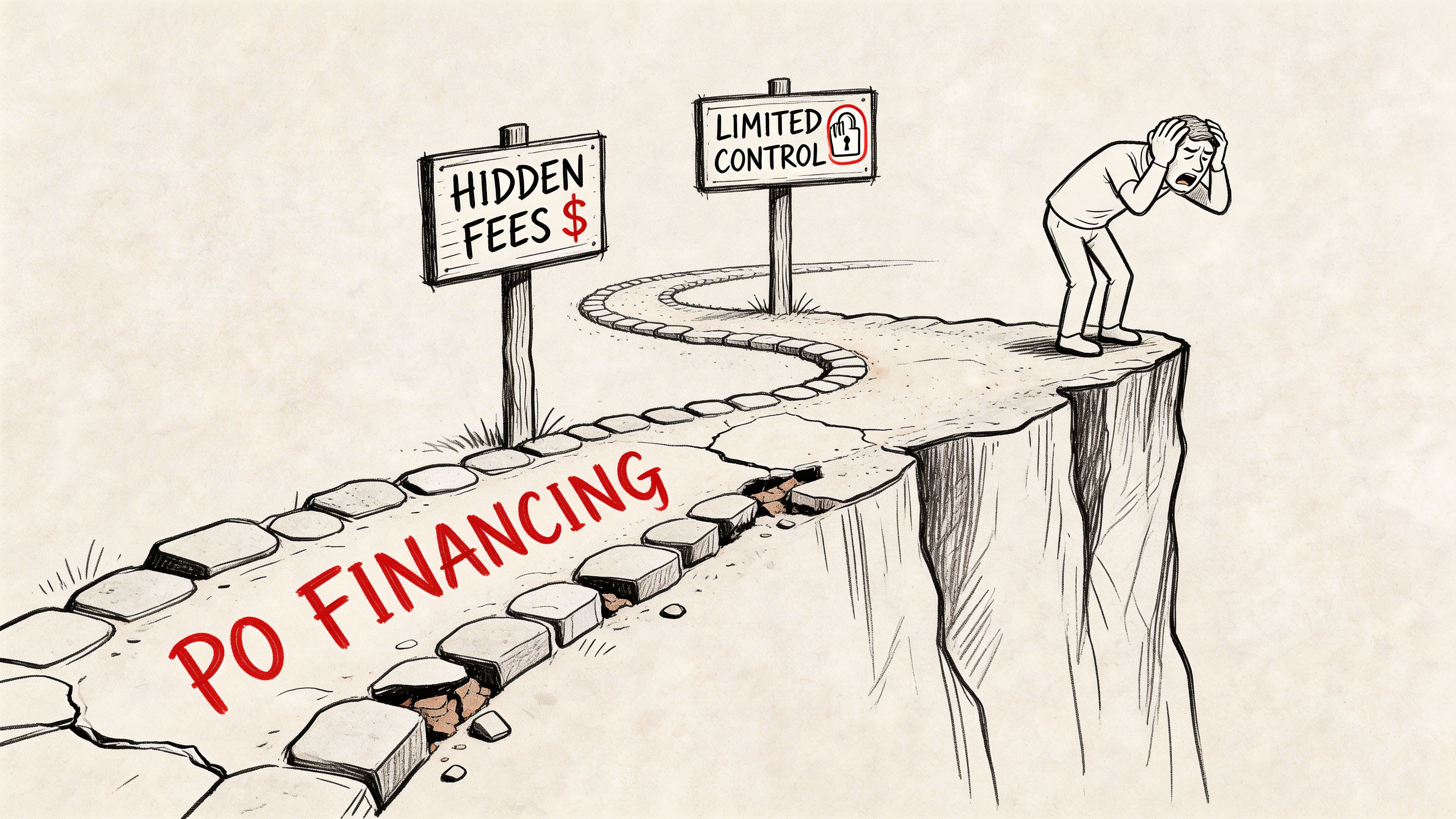
Purchase order financing sounds simple until the conditions start narrowing the deal.
Many SMEs assume approval mainly depends on their own business momentum. In reality, the buyer often matters more than the supplier. That creates a problem you cannot fully control.
The main friction points
Eligibility in the UAE typically depends on buyer credit quality and a gross margin of at least 20%. Poor buyer credit accounts for 70% of rejections in cited local lender data, and the resulting cash flow bottlenecks can reduce order fulfilment by 40%. The same source notes that traditional bank approvals can take 2 to 4 weeks, compared with 24 to 48 hours on digital platforms (UAE PO financing requirements and timelines).
That one fact explains most of the pain in the market.
What often goes wrong
- Your buyer fails the credit test: You may have done nothing wrong, but the transaction still gets rejected.
- Your margin is too tight: If the deal is commercially sound for you but not wide enough for the financing model, it may not qualify.
- The order terms are not rigid enough: Cancellable or changeable orders often create problems.
- The process becomes document-heavy: Purchase orders, supplier invoices, buyer verification, company records, shipment planning. Every missing item slows the file.
Why this hurts fast-growing SMEs
A business that is scaling rarely has perfect symmetry across buyers, suppliers, and internal controls. One customer pays reliably but uses unusual procurement language. Another is large but slow to confirm details. A third places frequent orders but each one varies in value.
Traditional PO financing handles repeatable, neat transactions better than messy real-world growth.
Practical view: The more your deal needs explanation, the less attractive it becomes in a rigid PO financing workflow.
Margin leakage is easy to underestimate
The first trap is focusing only on getting the order funded. The second trap is ignoring what happens to your economics after fees, delays, and admin time.
If the order has a healthy gross margin and the process is smooth, the model can still work. If the margin is already under pressure from freight, discounts, or supplier pricing, PO finance can turn a good top-line order into a weak bottom-line outcome.
Speed matters more than most founders admit
In wholesale and distribution, delay is not neutral. If approval drags, suppliers reshuffle stock, buyers chase alternatives, and your team spends time on financing paperwork instead of fulfilment.
That is why many SMEs start by asking for purchase order financing UAE, then later realise the better question is different. They do not just need a way to fund an order. They need a structure that moves at the speed of their sales cycle.
Why Invoice Discounting Is a More Agile Solution
When traditional purchase order financing feels too rigid, invoice discounting usually becomes the cleaner answer.
The difference is important. PO financing is built around an order that still has to be fulfilled. Invoice discounting is built around an invoice for goods or services already delivered. That shift removes a large part of the execution risk and usually makes the process more practical for SMEs.
Why it is often easier to use
Traditional PO financing often excludes SMEs with limited payment histories. That gap matters in the UAE because 32% of the population is described as underbanked or unbanked in the cited research, which leaves many smaller suppliers with thinner formal documentation. The same source states that modern invoice discounting platforms can reach approval rates as high as 85%, showing a different approach from older bank-led models (invoice discounting and underserved SME access).
That is the core advantage. Invoice discounting works with the commercial reality many SMEs face, rather than the idealised profile traditional funders prefer.
What makes it more agile
A modern platform is usually built for operating speed, not paperwork theatre.
Key practical advantages often include:
- Faster approval: Some digital platforms can approve quickly.
- Faster access to cash: Funds can arrive rapidly after approval.
- A digital-first workflow: Upload, review, and track in one place rather than through scattered email chains.
- Fewer documents: Some providers require significantly fewer documents than traditional sources.
Those differences matter when your finance manager is trying to support sales, not build a filing cabinet.
Why the model suits SME growth better
Invoice discounting lets the business unlock cash from receivables that already exist. The goods are delivered. The invoice is issued. The commercial event has happened.
That tends to be easier for all parties to understand and verify.
It also gives SMEs more flexibility in situations where:
- Orders vary in size from month to month
- Your buyer base is broad rather than concentrated
- You need repeat liquidity, not one-off transaction support
- Your team cannot afford long approval cycles
Tip: If your biggest bottleneck appears after delivery, not before production, invoice discounting is usually a better fit than PO-based funding.
What to look for in a modern platform
Not all invoice discounting setups are equal. Good ones are built for execution.
Check for:
- Digital onboarding: No printing, signing, scanning, and repeating.
- Clear eligibility checks: You should know quickly if a deal is viable.
- Operational fit: The platform should fit your invoicing and collections process.
- Visibility: Finance teams need status updates without chasing people.
For businesses evaluating digital options, this overview of Comfi's invoice discounting is a useful example of what a modern invoice discounting workflow can look like in practice.
Invoice discounting does not replace every use case for PO finance. It does solve a broader set of day-to-day cash timing problems with less friction.
PO Financing vs Invoice Discounting vs Dealer Support
The UAE market is large enough to support several capital solutions, and demand is growing. In March 2025, gross credit reached AED 2.24 trillion, up 9.4% year on year, with non-resident lending up 37%, according to the cited market summary. That points to active business borrowing and strong cross-border trade activity, especially where speed matters in commercial transactions (UAE credit growth and trade financing demand).
The right structure depends less on buzzwords and more on where cash gets stuck in your cycle.
Purchase order based funding
Best when the problem starts before goods are fulfilled.
- Use it if: You have a valid customer PO but need help paying the upstream supplier.
- Works for: Suppliers, importers, distributors, and traders handling fulfilment risk.
- Less suitable when: Your margins are tight, your buyer is hard to underwrite, or the order terms are flexible.
- Reality check: It can solve a single transaction, but it may not support repeat growth smoothly.
Invoice discounting
Best when the problem starts after you have delivered and invoiced.
- Use it if: Your receivables are tying up cash you need for payroll, stock, or the next order.
- Works for: SMEs with recurring invoices, B2B sellers, wholesalers, and service-led businesses with reliable billing cycles.
- Operational upside: It is usually cleaner than PO finance because the trade event has already happened.
- Good fit for: Businesses that want speed, a digital workflow, and simpler repeat access.
How to Apply and Get Approved Quickly
The UAE banking environment is active. The banking system’s loan portfolio grew 11.1% year on year in Q2 2025, and deposits rose 13.1%, based on the Central Bank’s cited quarterly review. That is a healthy backdrop, but it also shows how much demand exists for faster, more accessible specialist options alongside traditional banks (Central Bank UAE quarterly economic review).
If speed matters, the application process needs to be treated like an operational workflow, not a finance event.
Start with fit, not forms
Before uploading anything, check whether the product matches your bottleneck.
If the cash problem sits in unpaid invoices, invoice discounting is usually the cleaner route. If the pressure sits in inventory or supplier prepayment, another structure may fit better.
For businesses comparing options, this guide to https://comfi.ai/blog/bank-loan-eligibility helps frame why traditional lending criteria often feel slow or mismatched for SMEs.
Prepare only what matters
Fast approvals usually come from document quality, not document quantity.
Have these ready in clean digital form:
- Company records: Trade license and basic business details.
- Commercial evidence: Invoice, buyer details, and any delivery proof if relevant.
- Banking and finance basics: The documents a provider needs to verify your business quickly.
- Clear point of contact: One person who can answer commercial questions fast.
Submit through a digital workflow
The quickest processes usually follow a simple path:
- Eligibility check
You find out early whether the deal fits the provider’s criteria. - Document upload
Files are submitted digitally rather than circulating across email threads. - Review and confirmation
The provider validates the commercial documents and counterparties. - Funds released
Once approved, cash can move quickly into the transaction.
Tip: Delays usually come from mismatched names, incomplete invoices, missing delivery evidence, or unclear buyer details. Clean those first.
Move like your sales team moves
A lot of SMEs still approach funding as a one-off emergency step. That creates friction every month.
A better approach is to build a repeatable process. Standardize your invoices, keep buyer records current, and know which deals you want to submit before you need the cash. That is how finance stops being reactive and starts supporting growth.
Choosing the Right Path to Fuel Your Growth
A large order is only valuable if your business can turn it into cash without creating stress elsewhere.
Traditional purchase order financing has a place. It can help when a confirmed order arrives before you have the cash to fulfil it. But for many UAE SMEs, the practical drawbacks are hard to ignore. Approval can hinge on the buyer more than the supplier. Documentation can pile up. Margins can narrow. Timing can slip.
That is why many growth-focused businesses move toward structures that match how they operate. If your sales cycle depends on fast fulfilment and steady receivables, invoice discounting is often the more agile path. If stock is trapping cash, dealer-focused support may be the better fit.
Good finance decisions are rarely about taking the first available option. They are about choosing the option that removes friction from your operating cycle. The same mindset applies to the rest of your cost base. Teams reviewing overhead and process waste may also find value in these proven cost reduction strategies, especially when tighter cash conversion is a priority.
Choose the structure that helps you move faster, protect margin, and accept the next order with confidence.
If your business needs a faster way to unlock cash from invoices, Comfi offers a digital UAE-based option built for SMEs across MENA. Businesses can get approval within 2 hours, access funds within 24 hours, complete the process online, and submit 4x fewer documents than traditional sources. If your growth is being slowed by receivables or inventory timing, Comfi is worth exploring.