Credit Risk Assessment: A Guide for MENA SMEs

A buyer asks for 60-day payment terms. The order looks good. The relationship looks promising. But one question matters most: will you get paid in full and on time?
That is credit risk in practical terms.
For many SME owners across MENA, this is not a banking concept. It is a daily operating decision. Every time you extend trade terms, ship stock before cash arrives, or hold inventory while waiting for settlement, you take a credit position.
What Is Credit Risk and Why It Matters for MENA Businesses
Credit risk is the risk that a customer, buyer, or counterparty will not pay what they owe when due. Credit risk assessment is the process of judging that risk before it damages cash flow.
For an SME, it often comes down to a simple decision. A wholesaler in Dubai gets a large order from a new retailer who wants delayed payment. The wholesaler can insist on cash and risk losing the order, or offer terms and accept uncertainty.
Assessment helps answer a few practical questions:
- Can this customer pay? A live business is not always a liquid one.
- Will this customer pay on time? Some profitable buyers still pay late.
- How much exposure is safe? Even a good customer becomes risky if one account grows too large.
- What warning signs matter? Slow replies, stretched payment cycles, and abrupt order changes often appear before missed payments.
Why the issue is harder in MENA
Many solid businesses in the region still look weak through a traditional bank lens. The World Bank identifies weak credit information systems and a lack of reliable collateral as major barriers for MENA businesses, and this SME opacity can block 75-85% of conventional applications according to the World Bank paper on financing constraints in MENA.
That matters even if you are not applying for credit yourself. It affects your customers too. If a buyer cannot access formal finance because their file looks incomplete, they may ask suppliers for longer terms. The supplier then becomes the risk manager.
Practical rule: If your margins are modest, one bad payer can do more damage than several good new customers can repair.
A useful response is to treat receivables as a live risk system, not just a back-office record. Even simple reporting helps. If you are improving internal visibility, these strategies for building powerful dashboards are a sensible starting point because they show how to turn scattered operating data into something management can use.
For MENA SMEs, understanding credit risk is not about sounding more financial. It is about protecting growth. You want more sales, but not fragile sales. You want larger buyers, but not concentrated risk. You want terms that help you win business without giving up control of cash flow.
The Two Sides of Credit Risk Analysis
Assessing a customer is a bit like hiring a senior employee. You review the CV for facts and numbers. Then you meet the person to judge whether those facts are enough to trust them.
Credit risk analysis works the same way. It has two sides: qualitative analysis and quantitative analysis.

What qualitative analysis tells you
Qualitative analysis looks at the story behind the numbers. A spreadsheet rarely shows whether management is disciplined, whether a market is weakening, or whether a business depends too heavily on one contract.
Things to review include:
- Management quality. Has the owner managed through difficult cycles before?
- Operating discipline. Do they send documents promptly, communicate clearly, and handle disputes in an organised way?
- Industry conditions. A strong company in a stressed sector can still become risky.
- Customer concentration. If most revenue comes from one buyer, your risk may be higher than sales volume suggests.
- Reputation in trade circles. Suppliers often know who pays slowly before formal records show it.
This side of the assessment relies on judgment, so teams need a consistent process rather than instinct alone.
What quantitative analysis tells you
Quantitative analysis looks at measurable indicators. It asks what the numbers show about repayment capacity, stability, and financial strain.
Common checks include:
- Payment behaviour. Are invoices paid on time, or only after repeated reminders?
- Cash flow patterns. Does money move through the business regularly, or in sharp and unpredictable bursts?
- Balance sheet strength. Can the business absorb a weak month without falling into delay?
- Existing obligations. A customer may look active while already stretched by other commitments.
- Credit score and financial ratios. These give a shorthand view of risk, though never the full picture.
A practical reference point for comparing methods is this guide to risk assessment methods for SMEs, which shows how structured reviews can improve consistency.
A strong assessment asks both “what do the numbers say?” and “what kind of business behaviour sits behind them?”
Why you need both
A customer can pass the maths test and still be a bad payer. Another can have thin formal records but run a stable, disciplined operation.
That is why the best credit risk assessment combines both lenses:
- Numbers without context can create false confidence.
- Context without numbers can create wishful thinking.
For a busy SME owner, the takeaway is simple. If you are only checking trade licence documents and gut feel, you are under-analysing. If you are only scanning financial statements and ignoring how the business operates, you are also missing risk.
Core Quantitative Assessment Methods Explained
Once you move into the numbers side of credit risk assessment, a few terms appear again and again. They sound technical, but the logic is straightforward when tied to one invoice or one customer account.

Start with the simplest building blocks
Think about a dealer selling stock to a buyer on deferred terms. The dealer wants to know three things: how likely non-payment is, how much money is exposed, and how much might still be lost after recovery efforts begin.
That is where these concepts help:
- Credit scoring. A summary grade based on available data. It helps teams rank customers quickly, even if a human makes the final decision.
- Probability of Default or PD. The chance that the customer will not meet their obligation over a defined period.
- Loss Given Default or LGD. The part of the exposure you may not recover if the customer defaults.
- Exposure at Default or EAD. The amount at risk when default happens.
If those labels feel abstract, reduce them to one sentence each:
A score says how risky they look.
PD says how likely trouble is.
LGD says how much pain remains after recovery.
EAD says how much money is on the table.
How this looks in a business decision
Suppose a buyer wants larger limits. You do not need a bank-style model to think clearly about the decision.
Ask:
- What is their current score or grade?
- Has their payment pattern improved or weakened?
- If they fail to pay, how much exposure would be open that day?
- What assets, guarantees, or stock positions would affect recoverability?
Decision shortcut: When limit size rises faster than payment quality, risk is increasing even if sales look healthy.
In the UAE, quantitative financial ratios are central to risk assessment, with common indicators including liquidity ratios such as the current ratio, indebtedness ratios such as debt-to-equity, and profitability indicators such as EBITDA margin. These are often viewed against regional context, including Dubai's implied probability of default of 10.6%, as noted in market data on Dubai's credit profile.
Ratios that actually help SMEs
You do not need a huge dashboard to start. Three categories do most of the work:
- Liquidity checks. Can the business meet short-term obligations?
- Debt burden checks. Is debt already heavy relative to the company base?
- Profitability checks. Does the business earn enough to support operations and absorb shocks?
For sectors like automotive, these measures become more useful when paired with stock movement and invoice timing. A dealer may look profitable on paper while still running tight cash because vehicles sit too long before sale and settlement.
The point of quantitative methods is not academic precision. It is faster, cleaner judgment. Good numbers do not eliminate risk, but they make surprises less likely.
Key Data Sources for an Accurate Assessment
A supplier in Riyadh extends 60-day terms to a dealer who looks busy, has a full warehouse, and keeps placing orders. On paper, the file is thin. There are limited audited accounts, uneven monthly cash balances, and little formal borrowing history. A traditional bank model may read that as uncertainty. A fintech lender or trade credit team may see something more useful: invoices are paid with only small delays, stock keeps moving, and repeat buyers keep coming back.
That gap is the SME opacity problem. Many MENA businesses are commercially active but poorly represented by standard credit files. If your assessment relies only on formal statements, you can miss both kinds of risk. You may reject a healthy trading business, or approve a weaker one that looks tidy only because the documents are static and out of date.
Traditional data still matters, but it rarely tells the full story
Formal records give you the legal and financial skeleton of the business. You still need them because they confirm identity, ownership, and basic financial condition.
Useful traditional sources include:
- Audited or management financial statements to review revenue, margins, debt, and working capital
- Bank statements to check cash movement, bounced payments, and account behaviour
- Trade references from suppliers who have already tested the customer in real trading conditions
- Company documents such as commercial registration, licences, shareholder details, and tax records where available
These records are often enough for large, mature firms. They are often incomplete for SMEs.
A younger distributor in the UAE may be growing quickly but have only a short trading history. A seasonal wholesaler in Egypt may show lumpy cash patterns that look weak outside peak months. An automotive dealer may hold a lot of value in inventory while cash in the bank stays tight between sales cycles. None of that automatically signals poor credit quality. It signals a need for context.
Alternative data helps you see how the business actually trades
Alternative data is useful because it captures behaviour, not just snapshots. Credit assessment works like checking the health of an engine. Financial statements are the warning lights. Transaction and invoice data are the sound of the engine while it is running.
For opaque SMEs, the most helpful operating signals often include:
- Invoice history, including issue dates, due dates, settlement speed, and overdue patterns
- Transaction flows through bank accounts, wallets, or payment gateways that show real commercial activity
- Past repayment behaviour across supplier terms, short-term finance, or instalment obligations
- Buyer and supplier concentration to show whether the business depends too heavily on a few counterparties
- Inventory and order movement in sectors where stock turnover affects cash generation
- Disputes, returns, and credit notes because repeated friction often points to future collection problems
This matters a lot for suppliers and dealers. If a customer pays a little late but consistently converts stock, invoices repeat on predictable cycles, and disputes stay low, that business may be safer than its thin formal file suggests. By contrast, a customer with polished documents and weakening transaction activity may deserve tighter terms.
The practical lesson is simple. In MENA, especially among SMEs, creditworthiness often shows up in the trading record before it appears in the annual accounts.
Clean data beats more data
More files do not automatically produce better decisions. A messy invoice ledger with duplicate customer names, missing due dates, and unclear payment status can distort the picture. Analysts end up comparing records that do not match, and small errors become bad limit decisions.
For teams cleaning up records before a serious assessment, this overview of Icypeas' data governance strategies is useful because it focuses on the practical discipline required to make business data dependable.
What SMEs should prepare before requesting or granting credit
If you want a fair assessment, prepare evidence of how the business trades week to week, not just a compliance pack assembled at the last minute.
Start with:
- Recent invoices and ageing reports
- Collections history by customer
- Bank movement matched to sales activity
- Top buyer concentration records
- Dispute, return, and credit note patterns
- Inventory movement if stock turnover drives cash flow
That set gives a clearer view of stability, discipline, and cash conversion. For MENA SMEs, that is often the difference between a generic credit decision and one that reflects the true strength of the business.
Implementing a Credit Risk Framework in Your Business
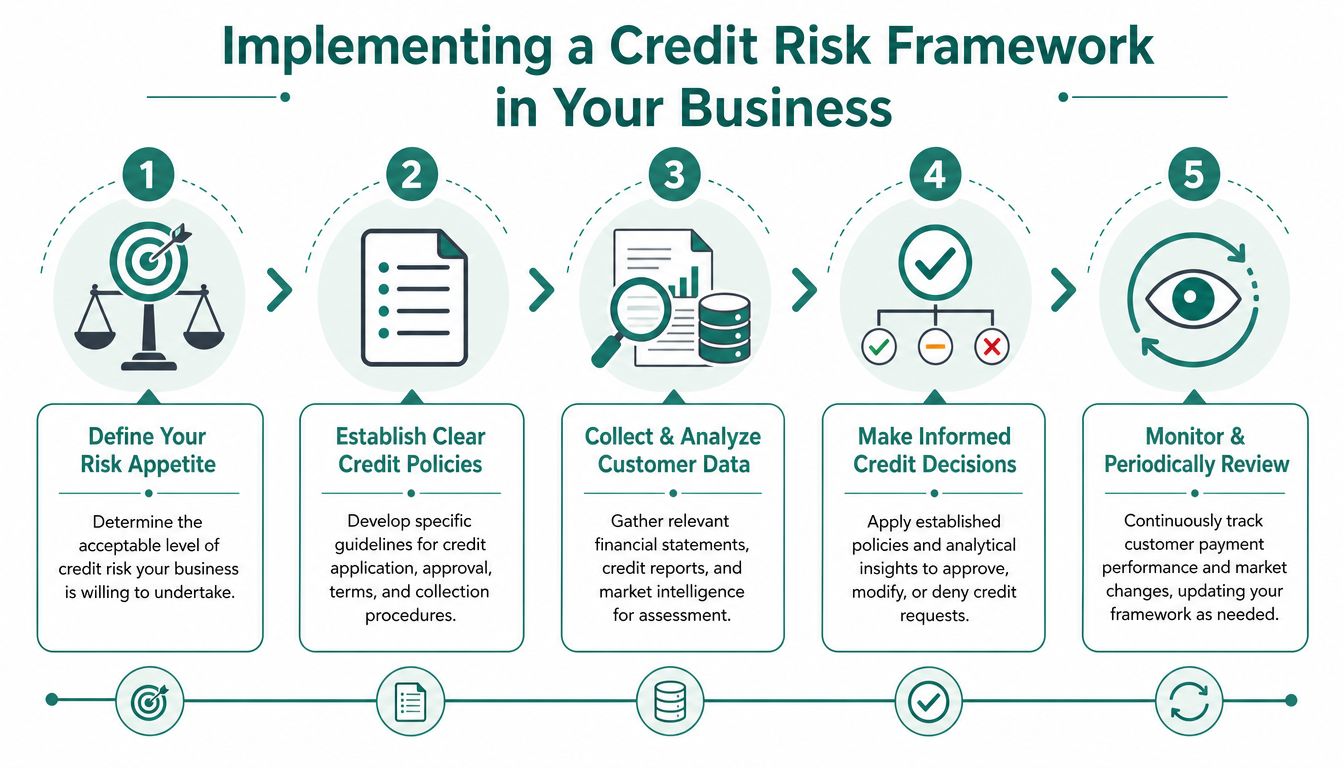
You do not need an enterprise risk department to put structure around credit decisions. Most SMEs can build a workable framework with a few clear rules, regular review habits, and consistent recordkeeping.
Step one to step three
Start with policy before software.
- Define who gets terms. Decide which customer profiles qualify for open account trading and which require tighter controls.
- Set clear approval limits. A sales manager should not be improvising payment terms in the middle of a negotiation.
- Choose your review inputs. Pick a short set of factors you will check every time, such as transaction record, documents, payment history, and sector risk.
A simple written policy removes much of the emotion from credit decisions. It also makes conversations easier when the sales team pushes for exceptions.
Step four and step five
Then build the operating loop that keeps the framework alive.
- Track exposure weekly. Look beyond overdue invoices to total open exposure by customer.
- Flag changes early. Slower replies, part-payments, rising disputes, or unusual order jumps often come before default.
- Escalate collections fast. The longer a payment issue sits, the harder it becomes to solve politely.
- Review limits regularly. Good customers can earn more room. Weakening customers should lose it.
For auto dealers and similar inventory-heavy businesses, this discipline matters even more. In the UAE automotive market, inventory can remain unsold for up to 180 days, and that delay directly affects liquidity, as discussed in this dealer financing overview for the UAE automotive market.
One sector example that makes this real
If you are a dealer, distributor, or supplier holding physical stock, your credit framework must include stock timing, not just receivables timing.
The working rule is simple:
- Know how long inventory sits
- Know how quickly payment settles after sale
- Know how much cash is trapped during that gap
The cash conversion cycle is a practical KPI here. For UAE used car dealers, it is assessed as Average Days in Stock + Average Days Receivable - Average Days Payable, and for typical cash-based dealers it often simplifies to Average Days in Stock + 5-10 days for finance settlement, according to guidance on car dealership KPIs in the UAE.
If stock sits too long, even a profitable dealer can feel cash-poor. That is a credit risk issue, not just an operations issue.
A basic SME framework does not need to be complex. It needs to be repeatable. If your team can explain why a customer got terms, what signals are being monitored, and what triggers intervention, you have already moved far beyond ad hoc selling.
Regulatory and Best Practice Considerations in MENA
In the UAE, the regulatory standard used by financial institutions is far stricter than many SMEs realise. That matters because when a bank, platform, or financial partner evaluates your business or your buyers, they are expected to follow formal risk discipline.
The Central Bank of the UAE requires Licensed Financial Institutions to use a detailed credit risk framework, classify risk for every facility, measure it across levels such as obligor, segment, and portfolio, and use data-driven methods to identify concentration risk, according to the CBUAE credit risk management standards.
What that means in practice
For an SME, the practical consequences are clear:
- Your information needs to be consistent. If your numbers, documents, and transaction story do not align, your risk profile looks weaker.
- Concentration matters. Heavy dependence on one customer or one sector can affect how partners view your stability.
- Ongoing monitoring is normal. Assessment does not stop at onboarding. Strong partners keep reviewing live exposure and changes in behaviour.
If you want a more detailed operating view of how these controls work in day-to-day portfolio management, this guide to credit risk management workflows is a useful companion.
Best practices SMEs should adopt anyway
Even if you are not regulated like a financial institution, a few habits make your business easier to support and safer to run:
- Review customer limits regularly rather than treating them as permanent.
- Avoid oversized exposure to one buyer even when the relationship feels secure.
- Keep collections records organised so delays are visible early.
- Separate sales approval from risk approval where possible, even in a small team.
A smart SME does not copy bank regulation line by line. It borrows the useful discipline. The benefit is simple: fewer surprises, cleaner funding conversations, and more control over growth.
How Fintech Automates and Strengthens Credit Risk Management
A supplier gives a dealer 60-day terms, shipments keep moving, and sales look healthy. Then payments start slipping. The problem is not only late cash. It is that the supplier often spots the risk too late, because the buyer looked thin on paper from the start and the warning signs were buried in invoices, order patterns, and collection notes.
That is the SME opacity problem in MENA. Many good businesses do not fit neatly into bank-style credit models because audited statements may be limited, bureau data may be thin, and ownership structures can be harder to read from standard forms alone. Fintech platforms improve this by using live business evidence, such as invoice history, transaction behaviour, repayment patterns, and trade activity, to build a clearer picture of whether a buyer is likely to pay.
For an SME owner, the practical benefit is simple. Credit assessment stops being a one-time paperwork exercise and becomes an operating system for daily decisions. A good fintech setup works like a control tower. It pulls signals from sales, finance, and collections into one view so your team can approve faster, spot trouble earlier, and avoid giving generous terms to the wrong buyers.
Tools built for underwriting automation for SME workflows usually handle work such as:
- Collecting business and trade data in one process
- Checking each case against predefined credit policies
- Routing exceptions to a human reviewer
- Tracking payment behaviour after approval
- Starting collections actions earlier when risk rises
This matters even more for suppliers, dealers, and distributors. In these businesses, risk sits inside the transaction flow. A buyer may look acceptable at onboarding but weaken after a few delayed invoices, a drop in order frequency, or growing disputes. Automated monitoring catches those changes earlier than a monthly spreadsheet review.
The role of AI is not to replace judgment. It is to help teams sort weak signals from useful ones at scale, especially when each buyer leaves only partial formal records. NILG.AI's article on AI solutions for credit scoring gives a useful technical view of how these models support credit decisions.
In practice, a platform such as Comfi can sit inside the sales and receivables workflow, assess buyer risk using business data, manage collections, and help clients access working capital without requiring the supplier to build a full internal credit operation.
The result is better control, not just more speed. Management spends less time chasing overdue invoices or debating unclear cases, and more time protecting margin, preserving cash flow, and growing sales with buyers who can support that growth responsibly.
If you are reviewing how to offer payment terms without taking on unmanaged exposure, Comfi is one option to explore. It helps suppliers, dealers, and distributors in MENA assess buyers, automate collections workflows, and free up cash tied up in receivables or inventory so teams can grow with more control over risk.