Subcontractor Payment Terms UAE: Your 2026 Guide


You finish the work. Your team has paid wages, ordered materials, covered transport, and kept the site moving. Then the invoice sits. The main contractor says payment hasn’t come through from the employer yet. Accounts tells you certification is still pending. Retention will be released later. Later often means after your cash has already been stretched thin.
That’s the daily reality behind subcontractor payment terms UAE. The issue usually isn’t whether the work was done. It’s when cash lands in your account, and what contract wording stands between completion and payment. For an SME, that gap can decide whether you take the next project, delay supplier orders, or spend your time chasing receivables instead of running the business.
Most subcontractors don’t fail because they can’t deliver. They get squeezed because contract risk and cash-flow timing don’t match. Labour is weekly or monthly. Materials often need quick settlement. Plant hire doesn’t wait. Your receivable does.
The Subcontractor's Dilemma An Introduction
You finish a package, certify what you can, submit the invoice, and still end up financing the project yourself.
That is the problem behind subcontractor payment terms UAE. The work may be complete and the value already sitting on site, but cash can still be held up by approval chains, upstream payment delays, and retention deductions that sit outside the subcontractor’s control. Meanwhile, wages, plant, fuel, materials, and supplier accounts keep falling due on their normal cycle.
For an SME, that gap is more than an admin frustration. It changes how the business operates. A job can show a healthy margin on paper and still create pressure in the bank account if the contract pushes payment too far behind delivery.
A profitable project can still weaken the business if cash arrives after your costs have already been paid.
The trap usually starts at contract stage. Many owners focus on price, scope, and programme. The harder commercial risk often sits in a few lines on certification, release conditions, set-off rights, and retention. Those clauses decide whether you get paid on a timetable you can plan around, or whether you end up carrying someone else’s funding problem.
In the UAE, that issue is felt most sharply in construction and other project-based trades where subcontracting is standard practice. Delayed payment at the top of the chain tends to flow straight down to smaller firms with less room to absorb it. That is why this topic is not only legal. It is a working-capital issue.
Where subcontractors usually get trapped
The pressure usually comes from several terms working together, not one clause in isolation:
- Pay dependency: Your invoice is tied to the main contractor receiving money first.
- Certification delay: Completed work does not convert into payment until someone signs off.
- Retention deduction: Part of the amount earned is held back well beyond the invoice period.
- No direct claim route: If the payment chain breaks, recovery options are often slow and limited.
The practical response has two parts. First, tighten the contract and the invoice process so fewer delays are built in from day one. Second, use financing or early-payment tools where appropriate so a slow payer does not dictate your payroll, supplier timing, or ability to take the next job.
The Legal Landscape for UAE Subcontractor Payments
The legal position in the UAE is straightforward in one sense and difficult in another. Contracts govern. That matters because there isn’t a broad private sector payment security regime that automatically protects subcontractors in the way many SME owners expect. If your subcontract is weak, the law often won’t fill the gap for you.
A major exception exists on the public side in Abu Dhabi. The Abu Dhabi Executive Council's 2019 circular requires government departments and state-owned entities to settle undisputed invoices from contractors and subcontractors within 30 days, as outlined in DLA Piper's UAE construction law overview. That rule matters because it shows what faster payment can look like when the payer is required to act within a defined timeframe.
Public benchmark versus private reality
For SME subcontractors, the problem is that this benchmark doesn’t solve the private market. Many private subcontracts still rely heavily on contract wording that gives the main contractor broad protection and gives the subcontractor limited influence.
That creates a practical divide:
- Public projects in Abu Dhabi: There’s a defined 30-day standard for undisputed invoices under the circular linked above.
- Private projects: Payment timing usually depends on the subcontract, certification process, and whether the main contractor has been paid.
- Dispute position: Without strong contractual rights, subcontractors often end up arguing after the cash problem has already started.
What this means in practice
If you’re an SME owner, don’t assume fairness will be implied. It usually won’t. Payment security in private UAE contracting is mostly negotiated, documented, and enforced through the subcontract itself.
That changes how you should approach the deal.
Practical rule: Treat the subcontract as your payment protection document, not just a scope document.
The strongest subcontractors I’ve seen don’t only review price, scope, and programme. They also check the mechanics of invoicing, approval, notice periods, supporting documents, final account triggers, and any words that make payment conditional on someone else’s action. Those details decide whether cash comes in when expected or drifts for months.
Decoding Common Payment Clauses and Timelines
A subcontract can say “30 days” on one page and still leave you waiting months in practice. The delay usually sits in the conditions attached to payment, not in the headline number.
The main legal point is straightforward. Pay-when-paid clauses can be enforceable under UAE law, and retention remains a common feature of construction subcontracts, as explained in Fenwick Elliott's note on subcontracting under UAE law. For an SME, that means signed wording can convert a profitable job into a working-capital problem.
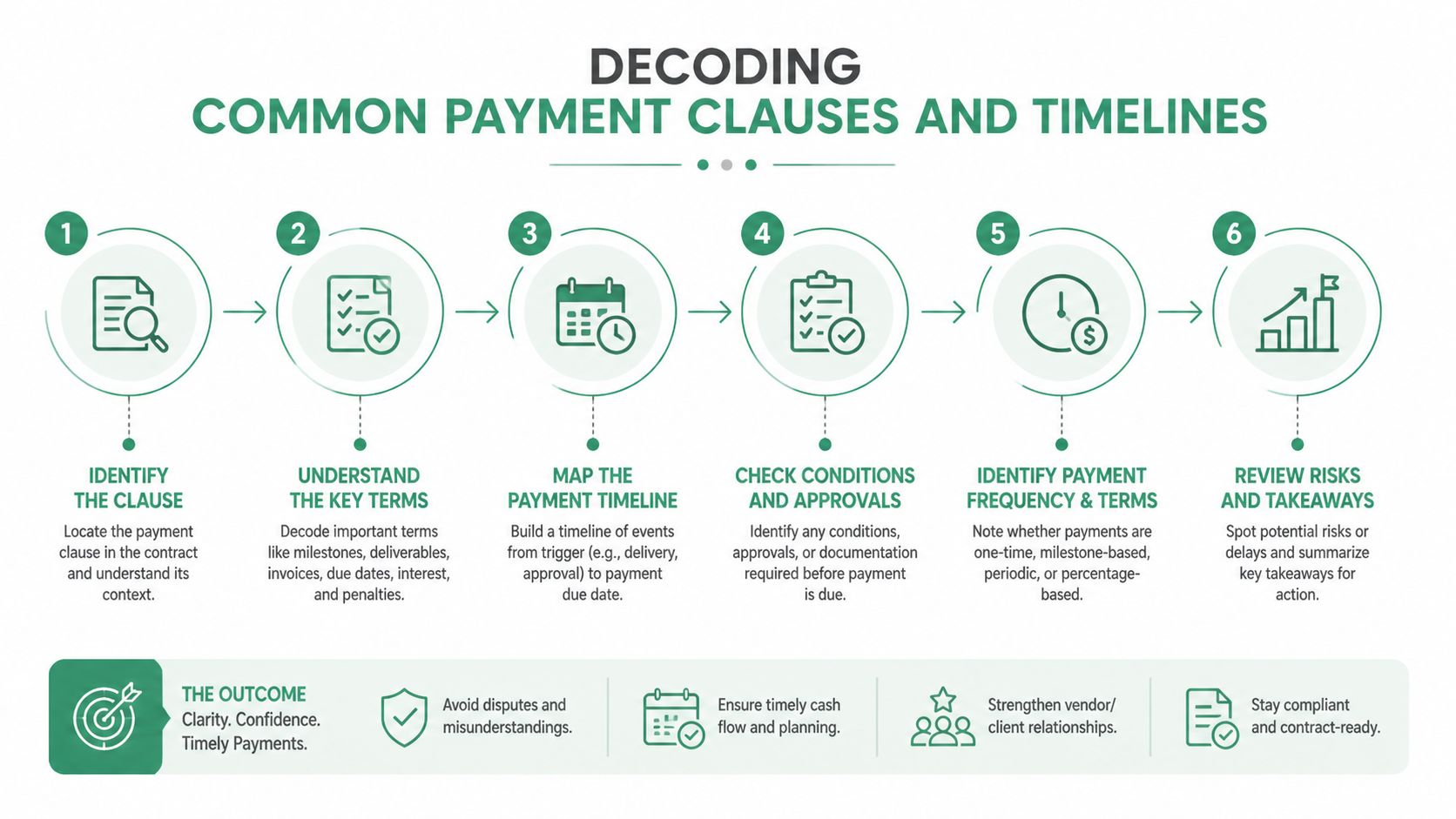
The clauses that matter most
- Pay-when-paid
This is usually the clause that causes the biggest cash shock. Your right to payment is tied to the main contractor getting paid by the employer. If the employer delays, certifies late, or disputes part of the main contract account, your invoice can sit unpaid even where your own work is complete. - Pay-when-certified
This shifts the pressure to the certification process. It may sound more manageable than pay-when-paid, but the risk is still real. If the contract does not define who certifies, what documents are required, and how long certification can take, the payment date becomes uncertain. - Retention
Retention reduces the cash you receive now for work already done. In many UAE subcontracts, money is held back and released in stages linked to practical completion and the defects liability period. The percentage and release mechanics matter more than the label. A fair retention clause with clear release dates is very different from one that leaves release open-ended. - Milestone and stage payment wording
Good milestone wording creates a billing path you can use. Bad wording creates arguments. If a milestone depends on broad phrases such as “subject to approval” or “to contractor’s satisfaction,” collection becomes slower and harder to enforce.
What to read line by line before you sign
Read the payment clause as a process map, not a legal formality.
- Invoice trigger: Does the clock start on submission, certification, approval, or receipt of upstream funds?
- Supporting documents: Are delivery notes, test records, signed timesheets, inspection requests, or approvals required before the invoice is valid?
- Notice rules: Does a late notice affect entitlement, valuation, or timing?
- Set-off rights: Can the main contractor deduct alleged backcharges, delay costs, or contra claims without agreement?
- Final account wording: Is final payment tied to a clear deadline, or to events outside your control?
- Retention release conditions: Are release dates linked to objective project events and written time limits?
One practical test helps. If your project manager and finance lead cannot explain the full route from completed work to cleared payment in under a minute, the clause set is carrying more risk than it appears.
That matters because cash timing decides whether you can keep labour on site, pay suppliers on agreed terms, and tender for the next job. Owners who want a clearer handle on term length can review this guide to credit period management for businesses. The same discipline also helps with understanding profit and cash flow, which is where many subcontractors misread the actual exposure.
The practical trade-off is simple. A subcontract with weak payment mechanics may still be worth taking if the margin is strong, the main contractor has a reliable payment record, and you have enough working capital or invoice finance in place to absorb the delay. If those supports are missing, the clause is not just legal wording. It is a financing burden pushed onto your business.
The Crushing Effect of Delayed Payments on SME Cash Flow
A common UAE subcontractor scenario looks like this. Labour has to be paid on Friday, supplier invoices are already due, and the work has been done. But your certified amount is still sitting in someone else’s process, waiting on approval, upstream payment, or both. That gap is where otherwise healthy SMEs get squeezed.
For many subcontractors, the main problem is timing. Operating costs hit now, while payment can sit in a long contract cycle. Al Tamimi's discussion of subcontractor entitlement and payment timing highlights how a 56-day payment cycle to the main contractor can leave the subcontractor carrying costs first, and restrictive payment wording can stretch the wait much further.

Why the strain gets worse across multiple projects
One slow-paying job hurts. Three of them at the same time can freeze the business.
The pressure builds because costs do not wait for certification or release. Wages, plant, transport, accommodation, and supplier payments leave your account on fixed dates. Incoming cash arrives later, in pieces, and often subject to conditions you do not control. The same Al Tamimi analysis highlights the practical result. The subcontractor effectively finances part of the project while waiting for money to move down the chain.
Retention makes that position worse. Even where interim payments start to come through, a slice of earned money can stay tied up until project milestones or final account steps are completed. On paper, the job may still show margin. In the bank, the business can still be under pressure.
Profit isn’t the same as cash
Owners often see this too late. Revenue is booked, the project team reports progress, and the monthly management accounts look acceptable. Yet payroll becomes tighter, supplier calls increase, and bidding for the next job starts to feel risky. That is the difference between accounting profit and available cash. Numeric explains it well in this note on understanding profit and cash flow.
In practice, delayed payment changes decision-making across the company:
- Supplier pressure: You start asking for extended terms or part deliveries because client receipts have slipped.
- Tender restraint: Good opportunities get passed over because mobilisation would put too much strain on working capital.
- Finance distraction: The team spends its time chasing certificates, statements, and overdue invoices instead of planning cash use properly.
- Margin loss: You accept discounts, settlement compromises, or expensive short-term funding just to bring cash in earlier.
I see the same pattern with SME contractors repeatedly. The legal clause creates the delay, but the commercial damage shows up elsewhere. Supplier relationships weaken. Buying power drops. Senior management starts making short-term decisions to keep sites moving.
If receivables are already drifting beyond agreed dates, tighten your outstanding invoices process and follow-up approach. If long payment terms are built into the subcontract, process discipline alone will not close the gap. At that point, the business needs a funding plan that matches the contract reality, not just stronger credit control.
Slow payment shifts financing risk from the project chain onto the subcontractor’s balance sheet.
Contract Negotiation Strategies to Protect Your Payments
The best payment dispute is the one you prevent at tender stage. Many SME subcontractors assume standard forms can’t be moved. That isn’t always true. You won’t win every point, but you can often improve the commercial position if you know which terms matter most.
Terms worth pushing on first
Start with the clauses that directly control cash release.
- Replace pay-when-paid where possible
If the main contractor won’t remove it, try to narrow it. Push for payment after certification of your completed work rather than payment only after upstream receipt. - Define payment milestones clearly
Vague milestones invite delay. Tied-to-event wording should be specific enough that someone independent can tell whether the milestone has been achieved. - Cap or reshape retention
If the contractor insists on retention, negotiate lower exposure, staged release, or a retention bond alternative where the project and your bargaining position allow.
Wording that saves arguments later
A good subcontract doesn’t just say when payment is due. It also says what counts as a valid invoice, who must certify, how quickly comments must be raised, and what happens if there’s partial disagreement.
Useful asks include:
- A short review period so silence doesn’t become endless delay.
- Payment for undisputed sums even if part of the invoice is under review.
- A clear document list attached to the subcontract, so the accounts team can’t add fresh requirements later.
- Late payment interest wording where commercially realistic.
Strong subcontractors negotiate process, not only price.
Look beyond the payment clause itself
Payment problems often begin with operational confusion. If site records, approvals, variation instructions, and handover evidence are messy, even a decent payment clause becomes hard to enforce. That’s why broader contractor administration matters too. This summary of Safety Space's contractor management insights is useful because it links payment outcomes to documentation, accountability, and role clarity.
One practical habit works better than most legal speeches. Before signature, ask the other side to walk you through an actual invoice cycle from submission to release. If they can’t explain who certifies, who approves, and what can pause payment, you’re looking at future friction.
Unlocking Cash Flow with Modern Payment Solutions
Some clauses can be improved. Some can’t. On many projects, especially where the bargaining power sits with the main contractor, the subcontractor still ends up carrying a slow payment cycle. That’s where modern payment tools become practical, not theoretical.
The useful distinction is this. You’re not trying to rewrite the whole project. You’re trying to stop approved receivables from sitting idle while your business needs cash now.

How invoice-based payment acceleration works
In plain terms, the process usually looks like this:
- You complete work and issue the invoice.
The key is that the invoice should be approved, certified, or otherwise acceptable under the contractual process. - The invoice is reviewed by a payment platform or invoice discounting provider.
The provider checks the receivable quality and the relevant buyer or counterparty details. - You receive access to the invoice value earlier.
That lets you use money already earned instead of waiting through the full contractual cycle. - Settlement happens later through the normal payment chain.
Your site operations don’t have to wait for every upstream step to finish.
The commercial benefit is practical. It separates your operating cash from the slowest parts of the project payment chain.
When this approach makes sense
Invoice-based solutions fit best when the issue is timing rather than disputed performance. They’re especially useful when:
- Your invoices are approved but slow to be paid
- You’re managing multiple live projects at once
- Retention and delayed certification are squeezing your monthly liquidity
- You want to take on fresh work without waiting for old receivables to clear
One route in the UAE market is invoice discounting for SMEs and contractors. Comfi is one example of a platform that lets businesses upload approved invoices and release cash tied up in receivables, instead of waiting for the full payment cycle to run its course. The practical point isn’t the brand. It’s the mechanism. Approved invoices can become usable cash sooner.
Good payment tools don’t change the contract. They reduce the damage the contract can do to your day-to-day cash position.
The subcontractors who handle growth well usually do two things at once. They tighten contract terms where they can, and they build a reliable receivables process for the terms they can’t change.
What to Do When a Payment Dispute Arises
When payment stops moving, speed matters. Not aggressive speed. Organised speed. Most subcontractors lose ground at the start because the file is incomplete, the notices are late, or the internal story isn’t consistent across commercial, site, and finance teams.
First steps before formal escalation
Start with the basics and do them properly:
- Rebuild the payment file
Pull the subcontract, variation records, delivery evidence, site instructions, approvals, payment applications, certificates, and correspondence into one place. - Check the trigger event
Confirm whether payment depended on certification, upstream payment, milestone completion, or another stated condition. - Issue a formal written demand
Keep it factual. Identify the amount, the contractual basis, the supporting records, and the response date you require.
Escalation routes that are usually available
If the issue doesn’t resolve through direct commercial discussion, the next options usually move through increasing cost and complexity:
- Negotiation between commercial teams
This is often the fastest route where the dispute is really about paperwork, valuation, or timing. - Mediation or without-prejudice settlement talks
Useful where both sides want to preserve the project relationship. - Arbitration or court proceedings
Necessary in some cases, but expensive, document-heavy, and rarely the first choice for an SME trying to protect liquidity.
A hard truth sits behind all of this. Formal disputes may establish rights, but they don’t usually solve today’s payroll or supplier deadlines. That’s why prevention matters more than reaction for most subcontractors.
When a payment dispute starts, your leverage comes from records, contract wording, and disciplined follow-up. Not from frustration.
If you’re already in dispute, get legal review early and narrow the issue fast. Don’t argue everything at once. Is it certification, valuation, notice compliance, set-off, or upstream payment dependency? The faster you isolate the actual blocker, the better your chance of resolving it without a long procedural fight.
If delayed receivables are limiting how your business operates, Comfi is one option to consider for releasing cash tied up in approved invoices. For UAE SMEs dealing with long contractor payment cycles, that can help turn completed work into usable cash sooner, without waiting for the entire chain to settle.
Related Reading
- How Comfi’s B2B Buy Now Pay Later Solution Enhances Cash Flow for Businesses in the UAE
- Deferred Payment for Business Purchases UAE: A Guide 2026
- Software Reseller Payment Terms UAE: A Practical Guide
- Unlock Cash Flow: How to Get Extended Payment Terms From Suppliers in the UAE
Looking to improve your cash flow? Explore Comfi's Buy Now Pay Later solutions. Get started today.