Unlock Electrical Goods Import Financing UAE

You’ve finally landed a strong order for switchgear, control panels, motors, or other electrical stock. Your buyer in the UAE wants delivery on time. Your overseas supplier wants payment before release. Your payment terms with your clients doesn't matter to the customs.
That’s where most pressure starts.
For many SMEs, Electrical goods import financing UAE isn’t really about “finance” in the abstract. It’s about keeping stock moving without draining your account every time a container ships.
The Importer's Dilemma in the UAE's Booming Market
A common situation looks like this. A distributor in Dubai wins a bigger order than usual from a contractor or retailer. On paper, that’s good news. In practice, it creates stress immediately because the supplier needs payment, freight and customs costs are approaching, and the buyer may still expect trade terms.
The scale of the opportunity explains why this problem keeps showing up. The UAE's electrical and electronic equipment imports reached USD 60.98 billion during 2024, with demand concentrated in trade hubs like Dubai and Abu Dhabi, according to Ken Research on the UAE trade finance market. That tells you this isn’t a niche issue. It’s part of how the market works.
Why electrical importers feel the squeeze faster
Electrical goods often tie up cash in awkward ways. Items may be high value, compliance-heavy, and ordered in batches large enough to secure better pricing. That means one purchase order can absorb a large share of an SME’s available cash before any revenue arrives.
Buyers also tend to care about availability more than your financing difficulty. If you can’t fund the shipment quickly, they’ll often shift to another supplier who can.
Practical rule: Your biggest growth constraint often isn’t demand. It’s the time gap between paying for stock and getting paid for selling it.
If you’re still learning the wider trade mechanics around sourcing, shipping, and payment timing, this guide to import export business gives useful context before you build a more specific funding workflow for electrical imports.
Mapping the Cash Flow Gap in Electrical Goods Imports
The easiest way to understand the problem is to treat an import cycle like a relay race. Your cash runs the first legs. Revenue only joins near the end.
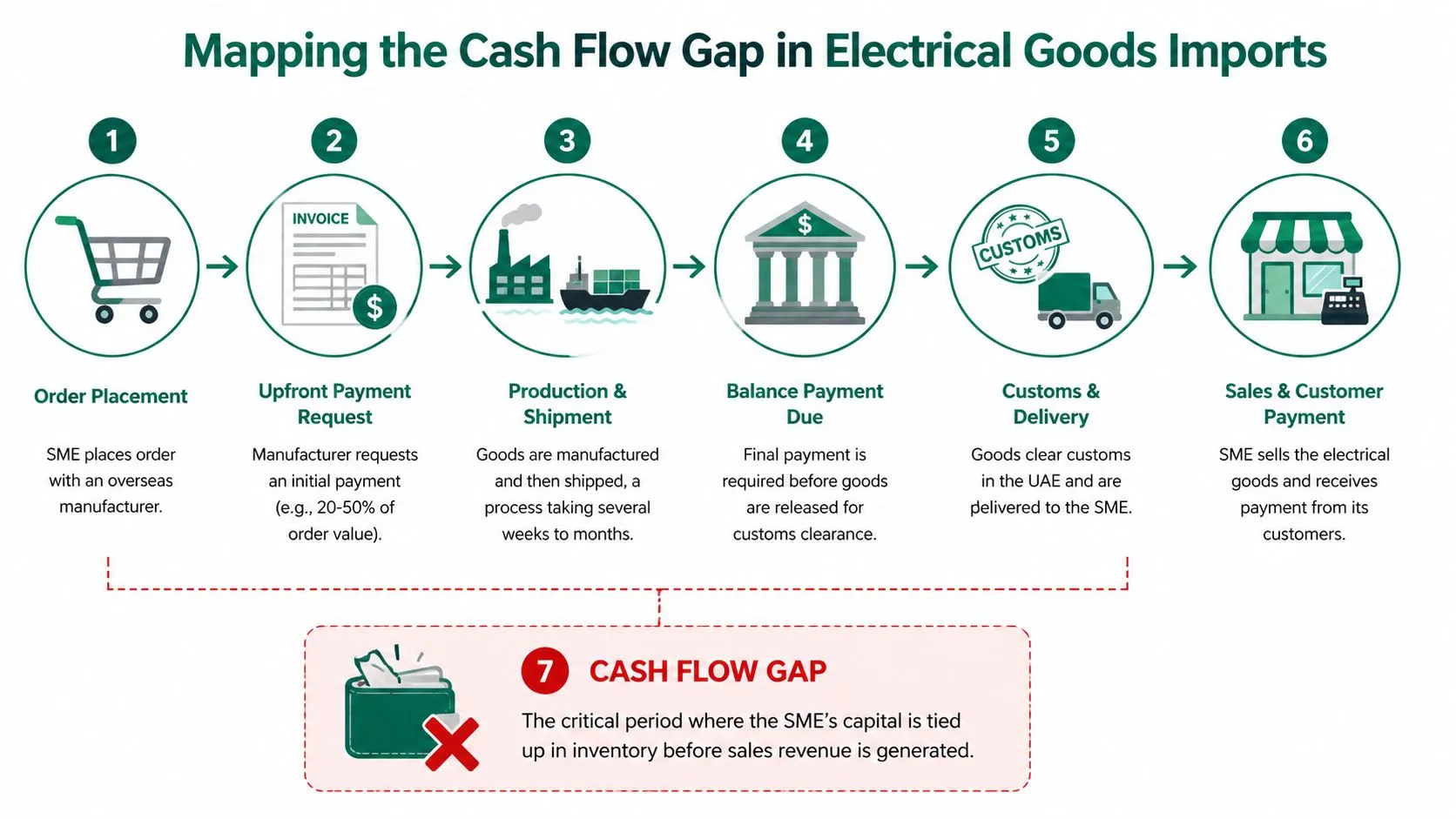
Where the gap actually appears
The sequence is usually straightforward:
- You place the order. The supplier confirms quantity, specs, price, and payment terms.
- The supplier asks for payment. Sometimes it’s partial upfront, sometimes payment is required before release.
- Goods move. Production, packing, and shipping begin.
- Documents are assembled. Commercial invoice, certificate of origin, packing list with HS codes, import permits, and product compliance documents all matter.
- Goods reach the UAE and enter clearance. Customs, inspection, and release take time.
- You deliver and wait for your buyer to pay. That’s often the last step, not the first source of cash.
The pinch point sits between supplier payment and customer collection. According to the US country commercial guide for UAE import requirements and documentation, the import process for electrical goods creates a 21 to 30 day working capital gap. Importers often pay suppliers while goods are still in transit or customs, long before sales proceeds come back.
Why electrical goods are slower than they look
Electrical imports don’t just move from port to shelf. They often need technical specifications, compliance papers, and accurate classification before release. Even when the shipment itself is routine, paperwork can hold the commercial cycle back.
A lot of owners get confused here because the goods may be physically close, but financially unavailable. The stock exists. Your money is already spent. Yet you still can’t invoice fully, deliver fully, or collect fully.
The dangerous moment isn’t when sales are weak. It’s when sales are strong but cash is trapped mid-cycle.
A plain-language example
Say you import a batch of industrial electrical items for a buyer in Abu Dhabi. Your supplier wants payment now. Your goods then sit in the logistics and clearance chain. Your customer plans to pay on agreed business terms after delivery. During that period, your balance sheet carries the burden.
That’s the cash flow gap. Not because the deal is bad, but because the timing is misaligned.
Traditional Financing Routes and Their Hurdles for SMEs
Most importers first hear about bank tools such as Letters of Credit, Trust Receipts, or short-term trade facilities. These aren’t useless. They’ve been part of cross-border trade for years. The issue is fit.
What these products mean in simple terms
An LC is a bank promise tied to trade documents. It can reassure the supplier, but it usually comes with process, documentation, and bank conditions.
A Trust Receipt helps importers take possession of goods while payment sits on a short leash. A short-term facility can also support purchases, but approval often depends on existing banking relationships and available security.
Where SMEs get stuck
The biggest practical problem is collateral. Existing UAE import-finance coverage often highlights LCs but skips over the burden this creates for smaller businesses. GTR’s UAE trade finance market coverage notes that traditional bank products can require 100% cash collateral for import LCs, which blocks SMEs that don’t have idle liquidity.
That creates a frustrating trade-off:
- Cash in the bank: safe, but unavailable for payroll, rent, and day-to-day trading
- Cash tied to collateral: secure for the bank, but frozen for the business
- Order opportunity: real, but hard to capture if you can’t move fast
Why this matters in electrical distribution
Electrical distribution is rarely a slow, leisurely sector. Customers need stock for projects, maintenance schedules, and resale deadlines. If funding depends on lengthy review cycles or full cash backing, the importer loses speed right when speed matters most.
Banks are built to reduce their risk. SMEs are trying to keep operations moving. Those goals don’t always line up.
Modern Solutions to Bridge the Import Financing Gap
Newer trade payment tools focus less on fixed collateral and more on the commercial transaction itself. That matters for importers who need speed, flexibility, and a cleaner way to manage supplier and buyer timing.
Why flexibility matters in electrical imports
Electrical goods imported into the UAE generally face a standard 5% customs duty, and certain components can face anti-dumping duties that squeeze margins, as explained in Middle East Briefing’s overview of UAE customs duties. When landed costs move unexpectedly, a rigid funding setup becomes a problem. A flexible one gives you room to absorb timing shocks without pausing the business.
Two modern models importers should understand
Invoice discounting helps you release cash tied up in approved receivables. Instead of waiting for your customer’s payment date, you use the invoice to bring cash forward. If you want to see how one digital option works, Comfi’s invoice discounting product shows the basic model.
B2B Buy Now Pay Later changes the buyer side of the transaction. Your supplier can be paid upfront while your buyer receives structured payment terms. That can help you close larger orders without asking every customer to pay immediately.
Here’s the practical difference:
- Invoice discounting is useful when you’ve already issued invoices and don’t want cash locked up while customers take their agreed payment period.
- B2B BNPL is useful when the sale itself depends on offering terms to the buyer while keeping supplier payment prompt.
Pros and trade-offs
- Faster access to cash: Better suited to import cycles where delay creates stock shortages.
- Less dependence on hard collateral: Helpful for SMEs that are trading actively but don’t want funds locked in bank security structures.
- Digital handling: Easier for finance teams that want document upload and approval workflows in one place.
- Cost discipline still matters: Any external payment solution has a commercial cost, so margins and pricing need to be managed carefully.
- Buyer quality still counts: Strong customer invoices are more useful than weak ones.
Flexible payment tools don’t replace trade discipline. They work best when your invoices, buyer quality, and import paperwork are already organised.
A Practical Workflow Unlocking Capital for Your Next Shipment
Take a fictional wholesaler in Dubai called Electronix Trading LLC. The company imports motors, generators, and control components for contractors and maintenance buyers. Business is healthy, but cash gets tight whenever several orders land at once.
How the workflow plays out
Electronix receives a large local order tied to a construction schedule. The supplier overseas is ready to ship, but wants payment before release. Electronix could drain its account to secure the stock, but that would leave very little room for salaries, freight surprises, or the next order.
Instead, the finance manager reviews the customer order, expected invoice timing, and buyer payment behaviour. Rather than treating the import as a standalone stress event, the company structures it around incoming receivables and buyer terms. That keeps the order moving without forcing the business into a cash freeze.
For owners comparing options, it can help to step back and review wider borrowing and asset-based structures first. This article on understanding equipment financing options is US-focused, but it’s still helpful for understanding how different funding tools behave in real operations.
What changes operationally
The business can pay the supplier promptly, receive the goods, clear them, and deliver to the customer without waiting for old invoices to convert into cash first. That changes daily decision-making.
Instead of saying, “We can only take this order if we collect two older payments first,” the team can think in terms of fulfilment capacity and margin.
This matters in a market with consistent demand. The UAE imported USD 102.7 million worth of electrical motors and generators in 2025, according to OEC data on UAE electrical machinery and electronics imports. For distributors handling this category, timing often decides who captures the order.
Where many SMEs improve
Electronix also learns a useful lesson. Growth pressure doesn’t always require more sales effort. Sometimes it requires a better transaction structure.
If your sales team is winning business but finance keeps rationing inventory purchases, your bottleneck probably sits between order acceptance and cash conversion. A practical overview of that issue appears in this guide to purchase order financing in the UAE, especially for businesses balancing supplier payment and buyer collection on different timelines.
Mitigating Risks Beyond Just Cash Flow
Cash flow is the obvious problem. It isn’t the only one.
Electrical importers also deal with supplier delays, classification mistakes, customs queries, and landed-cost surprises. If your capital is already stretched, even a minor disruption can force bad decisions. You may rush a supplier payment, delay a restock, or turn down a viable order because you need to preserve cash for uncertainty.
Capital access changes your risk posture
When you can access capital more predictably, you gain room to act sensibly. You can hold a safety buffer for clearance delays. You can keep a reliable supplier relationship by paying on time. You can protect your customer relationship instead of apologising for stock gaps.
- Supplier confidence: Faster payment can strengthen your position with overseas manufacturers.
- Operational buffer: You’re less likely to scramble when freight, duties, or release timing shifts.
- Commercial stability: Sales teams can quote with more confidence when fulfilment is less fragile.
A practical example of this broader resilience mindset appears in this UAE electronics case study, which looks at how payment structure and risk management connect in day-to-day trading.
Good import finance discipline doesn’t just fund inventory. It gives you time to make better decisions under pressure.
Future-Proofing Your Electrical Goods Import Business
The UAE electrical goods trade rewards companies that can move quickly without losing control of margin or paperwork. That’s why Electrical goods import financing UAE should be viewed as an operating system issue, not just a funding issue.
Traditional bank tools still have a place. But if they slow you down, lock up too much cash, or make every shipment feel like a separate crisis, they may no longer fit how your business trades.
The importers who stay competitive are usually the ones who align three things well: supplier payment timing, customs reality, and buyer payment terms. When those three move together, growth feels manageable. When they don’t, even profitable orders create strain.
If your business imports electrical goods into the UAE and keeps running into timing gaps between paying suppliers and collecting from buyers, it may be worth exploring Comfi. Comfi offers tools such as Invoice Discounting, Buy Now Pay Later, and Dealer Financing that help SMEs release cash tied up in trade cycles without relying on the old bank-first playbook.