Cross Border Payments: MENA SMEs

A supplier has shipped the goods. Your buyer has confirmed payment. Your team has already counted the revenue in the month's plan. Then the money disappears into the banking system for days, sometimes longer, while inventory decisions, supplier conversations, and payroll timing all keep moving.
That's the core problem with cross border payments for MENA SMEs. The issue isn't only transfer mechanics. It's what happens to your business while the payment is in transit.
For businesses importing stock, paying overseas vendors, or collecting from buyers across markets, payment timing shapes cash flow more than many founders realise. The market is also too large to treat as a back-office detail. The global cross-border payments market was valued at over $194 trillion in 2024 and is projected to exceed $290 trillion by 2030, according to Financial Professionals' cross-border payments overview. For UAE-based SMEs, that matters because the country sits at the centre of regional trade, re-export activity, and supplier networks that span Asia, Europe, and Africa.
Your Guide to Cross Border Payments in MENA
A finance manager at a trading business in Dubai usually sees the same pattern. A customer abroad says payment has been sent. The receiving bank says it hasn't landed yet. Treasury asks whether to release a supplier payment anyway. Sales wants to book the next shipment. Operations wants to know if restocking can proceed.
That's why cross border payments aren't just “international bank transfers”. They're a chain of banks, networks, currency conversions, screening checks, and settlement processes that can either support growth or choke it.
For SME owners, the practical question is simple. How quickly can cash move from a confirmed deal into usable funds?
If your answer is unclear, your business is probably carrying hidden risk in receivables, payables, and inventory planning. That's also why teams trying to improve collections and supplier payments often end up redesigning the whole payments and receivables workflow, not just changing banks.
Why this matters more in MENA
MENA businesses often operate across multiple currencies, time zones, and regulatory environments at once. A wholesaler may buy from one market, warehouse in the UAE, and sell into another. Each hand-off creates another opportunity for delay, fees, or missing information.
Cross border payments affect cash twice. First through explicit fees, then through the time your money stays unavailable.
A delayed payment can postpone a purchase order, strain a supplier relationship, or force you to hold inventory decisions longer than you should. For SMEs, that's not administration. That's growth capacity.
How Your Money Travels Across Borders
Most business owners see a payment confirmation and assume the hard part is over. It isn't. Sending money internationally works more like moving cargo through several checkpoints than sending a local transfer.
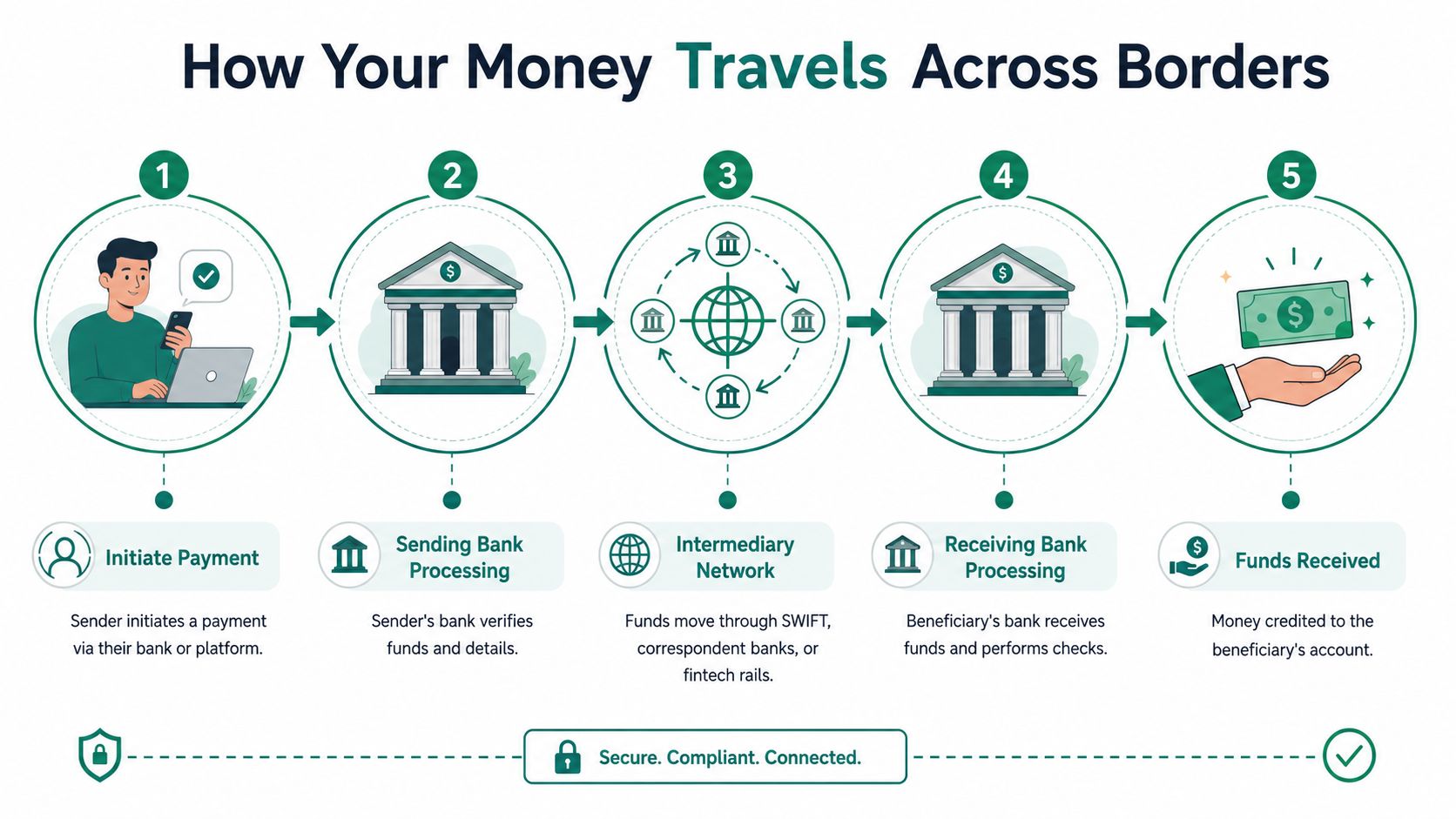
The five parts of the journey
A cross border payment typically follows a path like this:
- Payment initiation
Your business submits the transfer through a bank or payment platform. That instruction includes beneficiary details, payment purpose, currency, and supporting data. - Sending bank review
The sender's bank checks account balances, validates details, and runs internal controls. - Movement through payment rails
This is the route the payment takes. It may move through SWIFT messages and correspondent banks, or through newer fintech rails. - Receiving bank checks
The beneficiary bank receives the instruction, reviews the transfer, and may request clarifications or apply local compliance rules. - Final credit to the recipient
Only after those steps does the supplier or beneficiary get usable funds.
Why the route matters
Think of payment rails as shipping routes. Some are direct and well organised. Others involve multiple handovers, customs-style checks, and waiting in line.
Traditional SWIFT wires often move through intermediary banks. Each intermediary can introduce another pause, another charge, or another request for clarification. That's one reason legacy systems can feel unpredictable for SMEs.
If you want a practical explainer on the operational side, this guide to international payments for B2B companies is useful because it connects the payment route to what businesses experience on the ground.
Why some payments are fast and others are not
The biggest difference is infrastructure. Legacy systems like SWIFT wire transfers often require 3 to 5 days for settlement due to batch processing and manual checks. Modern real-time payment rails and blockchain-based layers like RippleNet can process transactions in under 3 seconds. The G20 roadmap also targets 75% of cross-border payments providing fund availability within one hour by the end of 2027, according to the G20 cross-border payments roadmap.
That doesn't mean every fintech payment lands instantly. It means the underlying system is capable of operating far faster when the corridor, compliance setup, and receiving infrastructure support it.
Operational takeaway: If your team still treats every international payment as a bank-to-bank wire, you're probably using the slowest route by default.
Where SMEs usually lose visibility
Problems often start with poor data at initiation. A small mismatch in beneficiary information, invoice references, or compliance documentation can trigger manual review. Once the payment enters an intermediary chain, tracking also gets harder.
That's why good payment operations depend on more than the transfer itself. They depend on clean invoice data, pre-validation, and systems that reduce manual corrections before the payment even leaves your account.
Why Global Payments Get Stuck and What It Costs You
Cross border payments usually don't fail because one bank is incompetent. They get stuck because the system still carries four persistent structural problems.
The four friction points
The Financial Stability Board identifies high costs, low speed, limited access, and insufficient transparency as the core ongoing challenges in cross-border payments, as outlined in the FSB's cross-border payments work. For MENA SMEs, those aren't abstract policy issues. They show up in the month-end cash position.
Here's how they usually play out:
- High costs
The visible transfer fee is only part of the story. FX spreads, intermediary deductions, amendment fees, and compliance handling can all reduce the amount that arrives. - Low speed
Payments queue across cut-off times, business days, batch cycles, and document checks. That slows down supplier release and reconciliation. - Limited access
Smaller firms often don't get the same service levels, corridor coverage, or pricing quality that larger corporates receive. - Insufficient transparency
Teams often know a payment was sent, but not where it is, what fee was applied mid-route, or why the beneficiary received less than expected.
The hidden cost isn't only the fee
A slow payment creates downstream expense. Your team spends time tracing funds. Suppliers hold shipments. Buyers ask for proof. Finance has to reconcile uncertainty instead of closing books cleanly.
That's also why payment risk deserves its own operational review, not just a treasury review. Businesses that want to reduce disputes and failed settlements should pay close attention to payment risk in trade operations.
Why MENA firms feel this sharply
Cross-border activity in MENA often involves fragmented regulation, multiple banking relationships, and supplier networks that expect quick confirmation before releasing goods. Small delays can create chain reactions across stock planning and receivables follow-up.
A payment that arrives late doesn't only cost money. It changes decisions. Teams reorder less aggressively, negotiate from a weaker position, and hold more buffer than they want.
What doesn't work
What usually fails is the “wait and chase” approach.
Teams rely on email threads, ask the relationship manager for updates, and keep sending proof of payment after the transfer is already in motion. That approach is reactive. It fixes almost nothing upstream.
What tends to work better is a process that combines cleaner payment data, clearer tracking, and rails designed for faster settlement with fewer intermediaries.
How Payment Delays Impact Your SME's Growth
The business damage from slow cross border payments doesn't start in treasury. It starts in operations.

A delayed incoming payment can stop you from placing the next supplier order. A delayed outgoing payment can make a supplier hold shipment or tighten terms. Either way, your growth slows because money and inventory stop moving in sync.
Where the pressure shows up first
For MENA SMEs, the effect is often most visible in sectors that depend on imported stock and timely restocking. Grand View Research notes that payment delays are particularly severe for regional SMEs, especially in sectors like automotive where inventory can be held for up to 180 days, and some data suggests SMEs lose up to 27% of potential sales because cash flow gaps are worsened by slow cross-border settlements, according to the Grand View Research market report.
That single point matters more than many owners think. If inventory already sits for long periods, slow settlement extends the cash conversion cycle even further.
The operational consequences
A business facing repeated payment delays usually runs into some combination of these problems:
- Supplier tension
Overseas vendors become cautious when funds don't land when expected. They may ask for stricter terms or delay dispatch. - Restocking friction
You can't move quickly on fresh demand if cash from earlier sales is still in transit. - Poor forecasting
Finance teams start planning around uncertainty rather than confirmed liquidity. - Missed deals
Sales sees opportunities, but procurement or purchasing can't act fast enough.
Fast-growing SMEs rarely lose momentum because demand disappears. They lose it because cash arrives too slowly to support the next move.
Why this becomes strategic
Owners often treat payment delays as a normal cost of international trade. That mindset is expensive. If delays repeatedly affect purchasing and collections, then payments have become a commercial problem, not an administrative one.
That's especially true in wholesale, distribution, electronics, and automotive. In those sectors, timing changes margins. The company that can restock, confirm supplier payment quickly, and offer better terms to buyers usually wins more business.
Modern Solutions for Faster Global Trade
The strongest payment setups today don't rely on one tool. They combine better rails, cleaner data, and cash-flow products that reduce the commercial impact of waiting.
What modern fintech does differently
Traditional banks are still important, but many SME payment problems come from relying on them alone for every international transaction.
Modern fintech platforms improve the process in a few practical ways:
- API-led connectivity
Payment workflows connect directly with invoicing, ERP, and approval systems, so fewer errors are introduced manually. - Pre-validation of payment data
Beneficiary details, invoice references, and supporting information are checked before the payment starts moving. - Better visibility
Teams can track status more clearly instead of relying on email updates from multiple parties. - Flexible liquidity options
Businesses don't always have to wait for the natural payment cycle to free up cash tied up in receivables or stock.
Invoice discounting and BNPL in practice
For SMEs, the most useful shift is this. You don't have to solve cross-border friction only by making every payment faster. You can also design around the delay.
A supplier issuing a long-dated invoice can use invoice discounting to access cash earlier instead of waiting for payment maturity. A buyer importing goods can use Buy Now, Pay Later terms to receive inventory and spread payment timing more sensibly. Both approaches reduce the damage caused by settlement lag.
That changes the role of cross border payments. They stop being a bottleneck and become one part of a broader liquidity strategy.
A good example from automotive
In the UAE auto trade, timing is brutal. Vehicles can sit in stock for a long period while dealers still need liquidity to source the next profitable unit. In the UAE's fast-moving auto market, vehicles can remain unsold for up to 180 days, creating a critical bottleneck. Auto Dealer Financing addresses that by making cash available from in-stock vehicles so dealers can restock faster and avoid missing profitable opportunities due to cash flow stress.
That model is useful beyond automotive because it shows the broader principle. When cash is trapped in assets or receivables, payment speed alone won't solve the problem. You need a financing structure around the payment cycle. Avoiding old architecture matters too, especially when a business wants programmable settlement or token-based rails.
The best payment strategy isn't “move money faster” in isolation. It's “remove waiting time from the commercial cycle wherever possible”.
What tends to work best
In practice, SMEs usually get the best results when they combine three moves:
- Use better rails for the transaction itself
Reduce manual bank chains where possible. - Use embedded payment terms for buyers or suppliers
Match cash timing to the trade cycle rather than forcing every party into the same schedule. - Unlock value from invoices or inventory
Don't let confirmed commercial activity sit idle while the business waits for cash to clear naturally.
That's how payment delays become manageable. In some cases, they can even create an advantage over slower competitors that still rely on manual wires and rigid terms.
How to Choose the Right Payments Partner
Choosing a payments partner isn't mainly about who advertises the lowest fee. It's about who creates the least operational drag once your business is live.
A poor partner looks cheap at the start and expensive in practice. A strong one reduces failed transfers, support tickets, reconciliation time, and supplier friction.
What to evaluate before you sign
Use this checklist when comparing providers:
- Fee transparency
Ask exactly how the provider handles FX, intermediary deductions, amendments, and receiving charges. If the answer is vague, expect surprises. - Settlement design
Don't ask only how fast the provider can send. Ask how fast funds are typically made available to the beneficiary in your key corridors. - Pre-validation and error reduction
Good providers catch data issues early. That matters because traditional wire transfers can increase credit risk through delayed reconciliation and high failure rates, while modern fintech partners use smart contracts and pre-validation to reduce errors, eliminate intermediary bank charges that can add 15% to 25% to total costs, and support 24-hour funding cycles, as described by the World Bank's payments and market infrastructures work. - Integration quality
If your team has to rekey invoice and beneficiary data manually, the payment process will stay fragile. Look for API access or low-code options.
Questions that reveal the real answer
A provider's sales pitch often sounds polished. The better test is operational.
Ask questions like these:
- When a payment fails, who investigates it and how quickly?
- Can my team see status updates without opening support tickets?
- How do you handle compliance checks for recurring suppliers?
- What happens if beneficiary details change mid-cycle?
- Can the system support invoice-linked approvals and audit trails?
Don't ignore regional fit
MENA trade has its own realities. Corridor familiarity, local support, and practical understanding of SME documentation matter more than glossy product screens.
Choose the partner that makes exceptions and edge cases easier to manage, not the one with the nicest demo.
A final rule is simple. If the provider can't explain clearly how money moves, where fees appear, and what your team must do when something goes wrong, they're not ready for your business.
Turning Payments from a Problem to an Advantage
Cross border payments will always involve complexity. Multiple jurisdictions, currencies, checks, and counterparties don't disappear just because the interface looks modern. But complexity doesn't have to become friction for your business.
The advantage comes from treating payments as part of commercial strategy. When you improve payment routes, tighten data quality, and use tools like invoice discounting or BNPL intelligently, you reduce the time between selling, collecting, paying, and restocking. That gives your business more room to act.
For MENA SMEs, that shift matters. Faster, clearer payment operations help protect supplier relationships, improve purchasing confidence, and reduce the stop-start pattern that drains momentum from growing companies.
The businesses that handle cross border payments well usually do one thing differently. They don't accept delay as unavoidable. They redesign around it.
If cash can move with more visibility, and if receivables or inventory no longer trap the business in long cycles, payment operations stop being a recurring headache. They become an edge.
If your business is dealing with long supplier terms, delayed collections, or stock tied up for too long, Comfi helps MENA SMEs free up cash through Invoice Discounting, Buy Now, Pay Later, and dealer financing solutions built for real trade workflows. The platform is fully digital, supports low-code and API integration, and enables approved invoices to be funded within 24 hours so your team can move faster without adding more operational friction.