From unpredictable cashflow to consistent growth, how Capitex keeps scaling with Comfi

200%
Growth in business capacity
5x
Faster access to support vs traditional sources

|

From unpredictable cashflow to consistent growth, how Capitex keeps scaling with Comfi
200%
Growth in business capacity
5x
Faster access to support vs traditional sources
200%
Growth in business capacity
5x
Faster access to support vs traditional sources
Before Comfi
- Heavy upfront costs, work permit fees and salary deposits paid through employment partners before invoicing begins
- A new UAE payroll law requiring salaries by the 1st of each month, squeezed against invoices only raised at month end
- No streamlined working-capital solution for consultancies in the GCC
- No external financing in place to bridge the gap between upfront costs and collections
After Comfi
- Working capital unlocked from outstanding invoices the same-day
- Fast, self-serve onboarding
- Confidence to take on bigger mandates
- No more ceiling on growth
About Capitex: Specialist financial crime expertise, on demand
Capitex is a specialist financial crime consultancy that places vetted consultants with banks and other financial institutions across the UK, the GCC and the US. Clients engage Capitex when they need specialist financial crime capability at short notice.
Because each engagement is staffed through licensed UAE employment partners, with the associated costs funded upfront by Capitex, the business's ability to grow has always been tied directly to its cash position rather than to client demand.

Challenge: Cash locked up before a single invoice is raised
Every Capitex engagement starts with a wave of upfront costs. Before a consultant can begin work, Capitex pays for their work permit, then places a one-month salary deposit with the visa company as a security holding, often totalling well over AED 100,000 per consultant across a single engagement. None of that capital is recovered until the engagement ends, and none of it is invoiced yet.
That timing problem got sharper earlier this year, when they had to comply with the regulation requiring salaries to be paid by the first of each month — down from the 10th. Capitex only raises its client invoice once a month has closed, which left almost no runway between invoicing and paying its own consultants. Even with reliable clients paying within 30 days, the mismatch was structural, not a collections problem.
Unlike the UK and US, where bespoke working-capital products exist for this kind of business from day one of incorporation, Capitex found little fit-for-purpose support in the UAE. The only options available were traditional facilities with slow, manual, largely offline processes, leaving little room to bridge the gap between upfront costs and collections.
Solution: Invoice discounting that keeps pace with Capitex’s operations cycle
What stood out immediately was how simple the process was. Tyler noted it was so straightforward that it initially felt too good to be true.
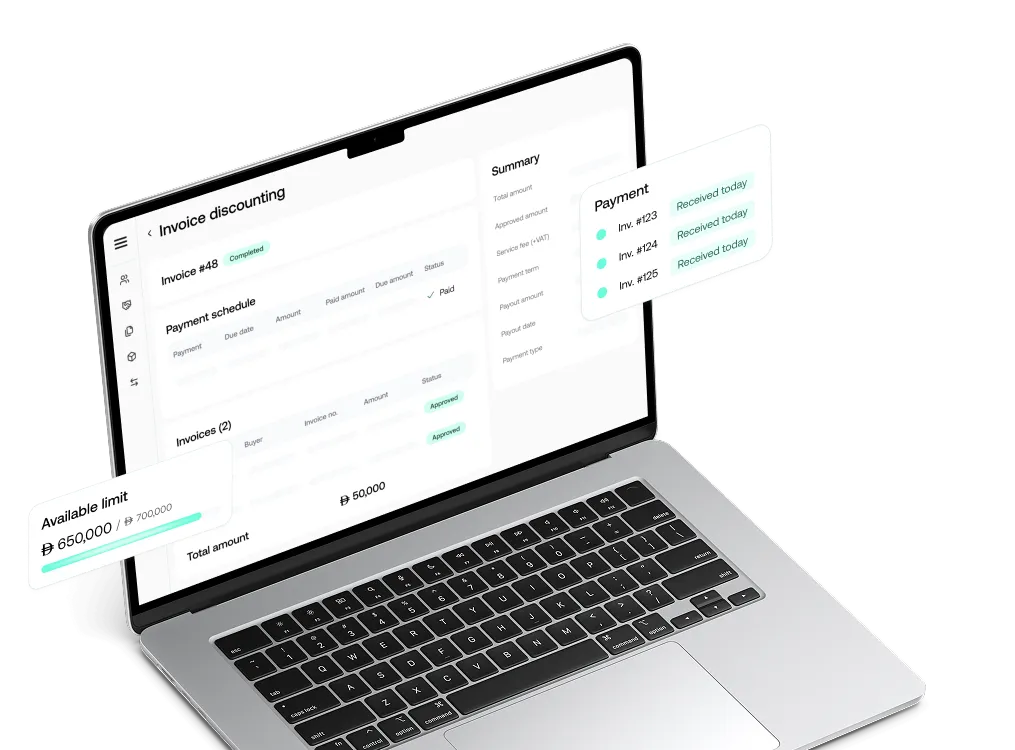
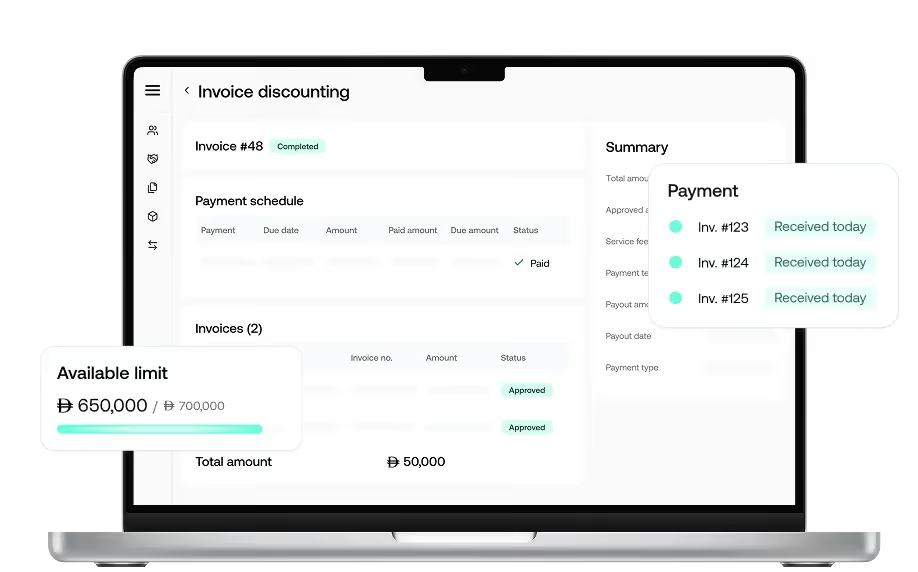
Onboarding required a light set of documents, all submitted online. Capitex received an approved limit the same day, and once documentation was finalized, the facility was live within 24 hours. Since then, the workflow has stayed just as simple: Capitex raises an invoice at month end, uploads it to Comfi's portal, and receives funds the same day — in time to meet its payroll obligations and wave of upfront costs on the first.
<quote>
“Cash flow was the biggest issue in our business. A reliable and seamless solution like Comfi has truly changed the trajectory of our company’s growth.”
https://cdn.prod.website-files.com/68e5ae1f4cc044a7c41c7cb9/6aa939f6b00011f0f287daa4_Tyler%20Sullivan.png
Tyler Sullivan
CEO & Founder, Capitex Global
</quote>
Impact: Growth no longer capped by cash on hand
With funding available on demand against its invoices, Capitex no longer has to size a new mandate around its bank balance or hold a buffer against slow-paying clients. Tyler estimates the business can now take on as much as 200% more capacity than before, since every new engagement can move forward on its own merits, rather than being limited by how much risk the business could absorb upfront.
The timing proved critical. The new payroll rule took effect just as Capitex was onboarding with Comfi, sparing the business from what Tyler describes as a potentially catastrophic situation. What could have been a crisis instead passed without disruption, freeing Capitex to focus on winning and staffing new mandates.
Tyler notes that the same structural cash-flow gap exists for any company that places specialist, contracted staff with client organizations through third-party employment arrangements, across sectors from pharmaceuticals to financial services to insurance, and that smaller, boutique firms in particular struggle to compete with larger players who can self-fund. He sees a clear opportunity for Comfi to support more businesses built the way Capitex is.
Industry
Professional Services
Company size
10 full-time employees
Founder/CEO
Tyler Sullivan
Website
https://capitex-global.com/
Year founded in
2022
Comfi products used
Invoice Discounting
About Capitex: Specialist financial crime expertise, on demand
Capitex is a specialist financial crime consultancy that places vetted consultants with banks and other financial institutions across the UK, the GCC and the US. Clients engage Capitex when they need specialist financial crime capability at short notice.
Because each engagement is staffed through licensed UAE employment partners, with the associated costs funded upfront by Capitex, the business's ability to grow has always been tied directly to its cash position rather than to client demand.
Challenge: Cash locked up before a single invoice is raised
Every Capitex engagement starts with a wave of upfront costs. Before a consultant can begin work, Capitex pays for their work permit, then places a one-month salary deposit with the visa company as a security holding, often totalling well over AED 100,000 per consultant across a single engagement. None of that capital is recovered until the engagement ends, and none of it is invoiced yet.
That timing problem got sharper earlier this year, when they had to comply with the regulation requiring salaries to be paid by the first of each month — down from the 10th. Capitex only raises its client invoice once a month has closed, which left almost no runway between invoicing and paying its own consultants. Even with reliable clients paying within 30 days, the mismatch was structural, not a collections problem.
Unlike the UK and US, where bespoke working-capital products exist for this kind of business from day one of incorporation, Capitex found little fit-for-purpose support in the UAE. The only options available were traditional facilities with slow, manual, largely offline processes, leaving little room to bridge the gap between upfront costs and collections.
Solution: Invoice discounting that keeps pace with Capitex’s operations cycle
What stood out immediately was how simple the process was. Tyler noted it was so straightforward that it initially felt too good to be true.
Onboarding required a light set of documents, all submitted online. Capitex received an approved limit the same day, and once documentation was finalized, the facility was live within 24 hours. Since then, the workflow has stayed just as simple: Capitex raises an invoice at month end, uploads it to Comfi's portal, and receives funds the same day — in time to meet its payroll obligations and wave of upfront costs on the first.
<quote>
“Cash flow was the biggest issue in our business. A reliable and seamless solution like Comfi has truly changed the trajectory of our company’s growth.”
https://cdn.prod.website-files.com/68e5ae1f4cc044a7c41c7cb9/6aa939f6b00011f0f287daa4_Tyler%20Sullivan.png
Tyler Sullivan
CEO & Founder, Capitex Global
</quote>
Impact: Growth no longer capped by cash on hand
With funding available on demand against its invoices, Capitex no longer has to size a new mandate around its bank balance or hold a buffer against slow-paying clients. Tyler estimates the business can now take on as much as 200% more capacity than before, since every new engagement can move forward on its own merits, rather than being limited by how much risk the business could absorb upfront.
The timing proved critical. The new payroll rule took effect just as Capitex was onboarding with Comfi, sparing the business from what Tyler describes as a potentially catastrophic situation. What could have been a crisis instead passed without disruption, freeing Capitex to focus on winning and staffing new mandates.
Tyler notes that the same structural cash-flow gap exists for any company that places specialist, contracted staff with client organizations through third-party employment arrangements, across sectors from pharmaceuticals to financial services to insurance, and that smaller, boutique firms in particular struggle to compete with larger players who can self-fund. He sees a clear opportunity for Comfi to support more businesses built the way Capitex is.
Client Testimonial




.webp)