A Practical Guide for SMEs in UAE: How to Fuel Your Growth


Talk to anyone on the ground here, and they'll tell you that small and medium-sized enterprises (SMEs) are the undisputed engine of the UAE's economy. They're not just a part of the business community; they are the foundation on which the nation’s economic diversification and future growth are being built.
The Powerhouse of the UAE Economy
Look past the gleaming skyscrapers and global corporate headquarters, and you'll find the real economic pulse of the United Arab Emirates. It beats in the local cafes, the neighbourhood auto parts suppliers, the tech start-ups, and the family-owned shops that define daily commerce. These businesses are the threads that weave together a vibrant and resilient commercial fabric.
The sheer scale of their contribution is staggering. In the UAE, SMEs make up nearly 95% of all companies in the country. They’re also responsible for over 85% of jobs in the private sector and contribute a massive 63% to the nation’s GDP. It's simple: the success of individual SMEs is directly tied to the country's overall prosperity.
A Dynamic and Competitive Landscape
Operating an SME in the UAE means you’re navigating a market that’s both rich with opportunity and intensely competitive. Forward-thinking government policies, especially initiatives aimed at diversifying away from oil, have created fertile ground for entrepreneurs across countless sectors.
From tech and logistics to F&B, the barriers to entry are relatively low, which encourages a constant flow of new ideas and ventures. This energetic environment fosters innovation and pushes everyone to be at their best. But it also creates immense pressure, particularly when it comes to managing cash flow. In a market where speed and agility are everything, even the most successful businesses can find their growth capped by liquidity constraints.
Thriving here means being able to act decisively. When a growth opportunity appears—like a large order or a chance to enter a new market—having accessible liquidity is what separates businesses that scale from those that stagnate.
Key Characteristics of the UAE SME Sector
The SME landscape here is anything but monolithic. It’s incredibly diverse, reflecting the multicultural and dynamic nature of the UAE itself. Understanding these traits helps paint a clearer picture of the challenges and opportunities at play.
- Sectoral Diversity: SMEs are active across a huge array of industries, including retail, hospitality, construction, technology, and professional services. This diversity is one of the economy’s greatest strengths.
- An Innovation Hub: Many SMEs are at the forefront of adopting new technology, acting as agile players that can quickly adapt to new market trends and consumer demands.
- Global Connectivity: Sitting at a global crossroads, many UAE-based SMEs are naturally export-oriented or play a crucial role in international supply chains.
To truly get a handle on this dynamic landscape, the guide to Entrepreneurship in Dubai: A Founder's Guide to Building and Scaling offers essential insights. The journey requires not just a great product or service, but a masterful command of your business's financial health.
The Cash Flow Puzzle Every SME Must Solve
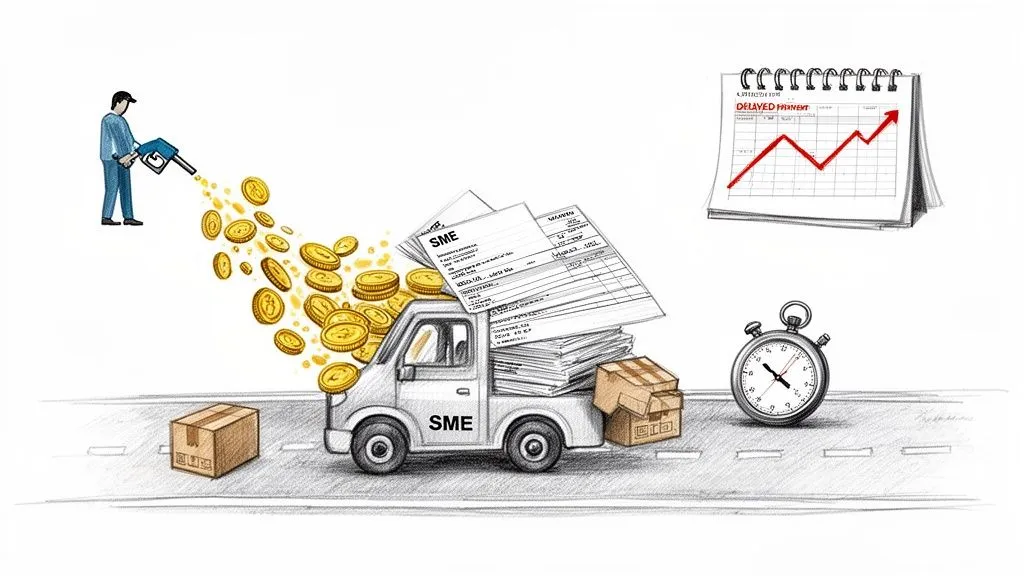
Think of your business’s cash flow as its lifeblood. Without a steady, predictable pulse of cash coming in, even the most profitable company can grind to a halt. For so many SMEs in the UAE, this isn't just a textbook theory—it's a daily battle.
You land a huge contract, deliver the goods or services perfectly, and send off the invoice. Then, the waiting game begins.
While your money is tied up, your own bills don't pause. Suppliers need paying, staff expect their salaries, and the rent is always due. This gap between earning revenue and actually having the cash in your bank account is the core challenge of managing working capital.
It’s like planning a long road trip. You have a powerful engine (your business model) and a clear destination (your growth goals), but you need fuel (cash) to get there. When payments are delayed, it's as if someone has locked your fuel tank, leaving you stranded while opportunities speed past.
The Real-World Impact of Liquidity Gaps
This isn't just an abstract accounting problem; it has very real consequences that can stop a promising business from grabbing its next big opportunity. It's no surprise that a recent study found nearly 50% of SMEs in the MENA region see cash flow management as their number one worry.
These liquidity gaps create a domino effect that can stifle growth and create immense stress for business owners. When cash is tight, you’re forced into difficult choices that limit your potential.
The challenge isn't about profitability. Many businesses are successful on paper but struggle with cash flow. The key is unlocking the value of what you've already earned to fuel what you need to do next.
Common Cash Flow Bottlenecks for SMEs
Several classic scenarios create these critical bottlenecks. Recognising them in your own business is the first step toward solving the puzzle. Let’s look at a few common examples:
- Delayed Client Payments: A B2B electronics supplier in Dubai delivers a massive order of the latest smartphones to a major retail chain. The invoice terms are 90 days. That means they won't see a dirham for three months, yet their international suppliers demand payment within 30 days.
- Inventory Pre-Purchasing: An auto parts business in Abu Dhabi needs to stock up on components ahead of summer when demand for air conditioning repairs skyrockets. They have to invest heavily in inventory upfront, tying up a huge amount of capital long before a single sale is made.
- Seasonal Demand Fluctuations: A local F&B company supplying hotels and restaurants sees a massive spike in orders during the peak tourist season. They must hire extra staff and buy more raw materials to cope, but the payments from their hospitality clients only arrive long after the season ends.
In every case, the business is healthy and growing, but its progress is being held back by a predictable cash flow crunch. Understanding the mechanics of these cycles is critical. To dive deeper, you can learn more about the cash conversion cycle in our detailed guide and see how it impacts your operations. This is the puzzle that successful SMEs in the UAE must solve to unlock sustainable growth.
How Modern Solutions Unlock Business Liquidity
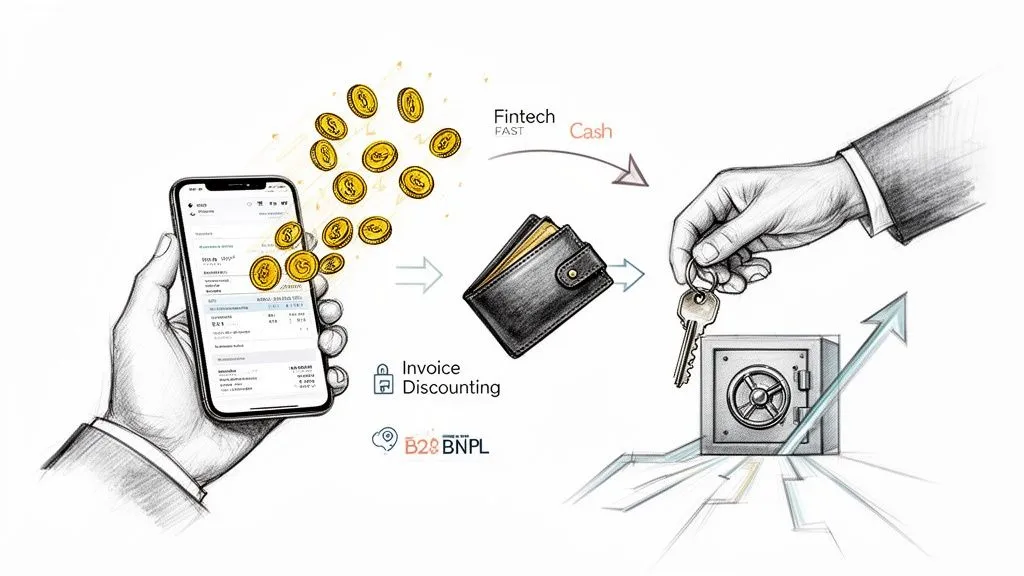
The cash flow puzzle faced by countless SMEs in the UAE isn't a sign of a failing business—it’s a sign that traditional payment cycles are out of sync with the speed of modern commerce. Thankfully, a new generation of solutions is designed specifically to bridge this gap, focusing on simplicity, speed, and accessibility.
These modern platforms do away with the slow, paper-heavy processes of the past. Instead, they use technology to give businesses much quicker access to the money they have already earned, turning outstanding invoices from a headache into a source of immediate strength.
The Power of Invoice Discounting
Imagine you've just delivered a large order and issued an invoice. Traditionally, you'd brace yourself for a 30, 60, or even 90-day wait for payment. Invoice discounting completely changes this dynamic, allowing you to get a huge chunk of that invoice's value almost immediately.
Think of it like getting an advance on your paycheck the moment you've earned it, rather than waiting for payday. You submit your approved invoice to a platform, and within a day or two—often 24 to 48 hours—the cash is in your account. This simple shift empowers you to pay your own suppliers, cover operational costs, and take on new orders without missing a beat.
This isn't about taking on new debt. It's about accelerating your cash flow by unlocking the value of transactions you've already completed. You gain the liquidity you need to run your business today, not months from now.
This process eliminates the uncertainty of waiting for clients to pay. For many SMEs in UAE, this predictability is a game-changer, allowing for better financial planning and more confident decision-making.
How B2B Buy Now Pay Later Drives Sales
Another powerful tool reshaping B2B transactions is Buy Now, Pay Later (BNPL). While most people associate BNPL with consumer shopping, its application in the business world is creating immense value for both suppliers and their customers.
It works by allowing your business customers to purchase goods and inventory now while spreading their payments over a set period. Meanwhile, you, the supplier, get paid upfront and in full. It’s an elegant solution that solves problems for both parties in a single transaction.
This approach directly helps your customers overcome their own cash flow hurdles, which in turn benefits you in several ways:
- Increased Order Sizes: When buyers have flexible payment options, they can often place larger orders than they could with strict upfront payment terms.
- Higher Sales Conversion: Offering BNPL can be the deciding factor for a new customer choosing you over a competitor who demands immediate payment.
- Stronger Customer Loyalty: By providing payment flexibility, you become a more supportive partner to your clients, encouraging repeat business.
Effectively, you remove the payment friction from the sales process. This not only boosts your revenue but also helps your customers grow—creating a positive cycle for everyone in the supply chain. Of course, to effectively manage expenses and unlock liquidity, exploring the best expense management software options can provide additional control over your company's finances.
The Core Benefits of a Modern Approach
The common thread connecting these solutions is their focus on solving the real-world problems that hold back ambitious businesses. They are built for speed and efficiency, offering a stark contrast to the often bureaucratic and time-consuming processes of traditional institutions. To learn more about how technology is changing the business payment landscape, read our overview of the fintech revolution.
By embracing these tools, SMEs in UAE can finally align their cash flow with their growth ambitions.
Winning with Government and Public Sector Opportunities
For any ambitious SME in the UAE, the government isn’t just a regulator; it's one of the biggest and most reliable customers you could ever land. Securing a government contract is a game-changer. It offers incredible stability, opens doors to much larger projects, and creates a powerful, predictable revenue stream that can fuel your growth for years.
These aren't small-time gigs. The UAE government is actively funnelling work to local businesses through dedicated procurement programmes and tenders. This creates a direct path for SMEs to get a piece of the action on major national projects, making public sector work a massive growth engine for the local economy.
But there's a catch. Winning that huge government contract is one thing; delivering on it is another. Suddenly, you have a massive execution gap. You need to buy raw materials, hire more people, or invest in new equipment right now—long before the first payment from the government entity hits your account.
The Scale of the Opportunity
The size of the government procurement market for SMEs is huge and it's growing fast. Recent initiatives have cemented this support, making it a cornerstone of the UAE's economic development strategy. Here are some key statistics that highlight the scale of these opportunities:
- Significant Contract Value: The second National Forum for SMEs and Government Procurement put a staggering AED 2.445 billion worth of contracts and tenders on the table from federal, local, and national companies.
- Impressive Growth: In one year, contracts awarded to national SMEs through this program jumped by 38%, from AED 582 million to AED 806 million.
These figures demonstrate the sheer volume of opportunities available and the government's commitment to supporting local businesses.
This isn't just about winning a single contract. Securing public sector work builds your company's reputation, proves your capability to deliver at scale, and often leads to more opportunities down the line. It's a powerful validator for any growing business.
This massive potential creates an urgent need for a smart liquidity strategy. How can your SME confidently bid on and execute a multi-million dirham project without completely draining your cash reserves or messing up your day-to-day operations? The answer is to get your cash flow in sync with the project’s demands.
Bridging the Execution Gap
This is exactly where modern trade finance solutions come in. Instead of waiting months for the government to pay you after delivering the goods or services, invoice discounting platforms let you unlock the value of your approved government invoices almost instantly.
This simple mechanism turns a future payment into cash you can use today, giving you the resources needed to deliver on the contract flawlessly. It’s the key that unlocks these valuable, large-scale projects.
Here’s how it works in practice:
- Deliver and Invoice: You complete a stage of the project and send your invoice to the government entity, just like you normally would.
- Access Your Funds: Instead of waiting out the long payment cycle, you can have a large chunk of that invoice’s value sitting in your bank account, often within 24-48 hours.
- Execute with Confidence: With cash on hand, you can pay suppliers, cover payroll, and get started on the next phase of the project without any financial friction holding you back.
This approach allows SMEs in UAE to chase and win those lucrative government tenders, knowing they have the financial muscle to deliver successfully. Making the invoicing process itself more efficient is also a big win, and you can explore how to do that in our article on the benefits of e-invoicing. By solving the execution capital challenge, SMEs can fully capitalise on the massive opportunities the public sector has to offer.
Putting Theory into Practice: Real-World Scenarios Across Key Sectors
It's one thing to talk about financial strategies in theory, but what really matters is seeing how they solve the messy, real-world problems businesses face every day. The challenges for SMEs in UAE aren't one-size-fits-all; they change dramatically from one industry to the next. What works for a food and beverage distributor is unlikely to be the right fit for an auto parts supplier.
Let’s walk through a few practical examples across major sectors—Automotive, Electronics, F&B, and Retail—to see how these modern financial tools fix specific, everyday hurdles. These stories bring the strategies to life, showing their direct impact on operations and, ultimately, on growth.
The Automotive Sector: Fuelling the Supply Chain
Picture an auto parts supplier in Sharjah that services a large chain of workshops across the UAE. They’ve just landed a huge order for brake pads and filters—a deal that could make their entire quarter. They deliver the parts, the workshops are happy, and the invoice is sent.
But there's a catch: the payment terms are 60 days. At the same time, their own parts manufacturer in Asia demands payment within 30 days for the next shipment. This is a classic cash flow squeeze, where today's biggest success puts tomorrow’s business in jeopardy.
This is where invoice discounting changes the game. The supplier submits their approved invoice from the workshop chain and gets a huge chunk of its value paid out, often within 24 hours.
This immediate cash injection allows them to:
- Pay their international manufacturer on time, keeping that crucial relationship strong and avoiding any supply disruptions.
- Restock their inventory straight away, making sure they're ready for the next big order that comes in.
- Chase even bigger contracts with confidence, knowing they have a system in place to manage the long payment cycles.
Instead of being held back by their own success, they turn their largest sales into immediate working capital. That's how you fuel continuous, uninterrupted growth.
The Electronics Sector: Powering Up Sales Volume
Now, let's look at an electronics distributor in Dubai. They're trying to help their network of independent retailers stock up on the latest smart home gadgets just before a major shopping festival. The problem is, many of these smaller shops don't have the cash on hand to buy large volumes of new, high-value inventory upfront.
This is a massive bottleneck in the electronics world, where product cycles are lightning-fast and retailers must carry the latest models to compete. The distributor's success is completely tied to the success of its retail partners.
The distributor can roll out a B2B Buy Now, Pay Later (BNPL) solution. This lets their retail customers get the stock on their shelves now and pay for it in easy instalments over 30, 60, or even 90 days.
The best part? The distributor gets the full payment for the order upfront from the platform. This creates a genuine win-win.
- The Distributor: Secures larger orders and boosts overall sales volume, all while building loyalty with its retail network—without taking on any credit risk.
- The Retailers: Can fill their shelves with in-demand products without draining their cash reserves, helping them maximise sales during peak seasons.
Suddenly, the payment process shifts from being a sales roadblock to a powerful sales tool, helping everyone in the supply chain grow together.
The F&B and Retail Sectors: Serving Up Success
Finally, think about an F&B supplier that provides premium ingredients to hotel groups, or a fashion wholesaler supplying boutique shops with the season's new collections. Both industries are driven by seasonal trends and unpredictable consumer demand, which makes managing inventory a constant balancing act.
A hotel group might place a massive order for a special event, or a retailer might need to triple their stock for the holidays. In both situations, the SME supplier has to invest heavily in inventory upfront, but payment often doesn’t arrive for weeks or even months after the goods have been delivered.
This is where a smart mix of trade solutions becomes a real game-changer. The supplier can use invoice discounting to get paid faster on their big invoices from established hotel chains or major retail groups. This gives them the immediate cash they need to cover their own costs.
At the same time, they can offer B2B BNPL to their smaller clients, like independent cafés or boutiques. This helps these smaller businesses manage their own cash flow, which encourages them to place larger and more frequent orders.
For these SMEs in UAE, blending these tools creates a flexible and resilient financial strategy. They can meet the demands of their biggest customers while also supporting the growth of their smaller partners, ensuring a healthy and diverse business for the long run.
Your Action Plan for Unlocking Sustainable Growth
Understanding the challenges and solutions available to SMEs in the UAE is one thing. Turning that knowledge into an effective action plan is another. This is your roadmap—a practical guide for business owners and finance leaders to move from reacting to cash flow problems to proactively managing their liquidity.
The following steps distill everything we've covered into a clear, straightforward framework. By following this process, you can take decisive control of your company’s financial health and ensure you never miss an opportunity to scale.
Step 1: Perform a Thorough Cash Flow Audit
Before you can fix a problem, you need to know exactly where it is. A cash flow audit isn't about getting lost in complex accounting; it’s about tracing the journey of your money from the moment you make a sale to when the cash actually lands in your bank account.
Start by mapping out your average payment cycle. How long does it take your key customers to pay? Identify your biggest bottlenecks—is it one large client with 90-day terms, or a cluster of smaller ones who consistently pay late? Pinpoint exactly how these delays impact your ability to pay your own suppliers and cover operational costs.
The goal here is simple: gain total clarity on where your cash is getting stuck. This audit will reveal the precise pressure points in your business, allowing you to select the right tool for the job.
Step 2: Match the Solution to Your Specific Need
Not all liquidity challenges are the same, so a one-size-fits-all solution rarely works. Your cash flow audit will tell you what kind of problem you have. Now, you can match that problem with the right financial tool to get the best results.
The key takeaway is to choose a tool that solves your most pressing challenge, whether that's unlocking capital from existing sales or enabling future ones.
Here’s a simple way to think about it:
- Problem: Your cash is tied up in unpaid invoices from creditworthy customers.
Solution: Invoice discounting is the ideal fit. It gives you immediate access to the money you've already earned.
- Problem: Your customers want to buy more but are held back by upfront payment terms.
Solution: A B2B Buy Now, Pay Later (BNPL) option is perfect. It removes the payment friction, helping you increase sales while you still get paid on time.
Step 3: Choose the Right Partner
Once you know which solution you need, the final step is choosing the right partner to provide it. The fintech platform you work with can have a huge impact on your experience, so look beyond the headline rates and focus on the factors that truly matter for SMEs in the UAE.
When you're evaluating partners, ask these critical questions:
- What is the approval process like? Look for a platform designed for SMEs, with high approval rates and a focus on the quality of your invoices, not just your company’s age.
- How fast can I get my money? The entire point is speed. Your partner should be able to get cash into your account within 24-48 hours.
- How easy is the platform to use? It has to be a simple, digital process. Avoid partners that require endless paperwork or have a confusing, complicated system.
By taking these deliberate steps, you build a resilient financial foundation that empowers your business to thrive in the competitive UAE market.
Your Questions Answered: Growing an SME in the UAE
When you're running a business, financial questions are always around the corner. We get it. Here are some straightforward answers to the questions we hear most often from SMEs in the UAE who are focused on real, sustainable growth.
What Are the Biggest Financial Hurdles for SMEs in the UAE?
It almost always comes down to one thing: working capital. This is the classic cash flow crunch that even the most profitable businesses face.
The problem usually stems from a few familiar places. You have large clients who take their time to pay, you need to sink a lot of cash into inventory just to stay stocked, or your sales are seasonal, creating big peaks and valleys in your income. It all adds up to a liquidity gap that makes it tough to cover daily bills and even harder to jump on a new opportunity when it pops up.
How Is Invoice Discounting Different from a Traditional Business Loan?
They're fundamentally different beasts. A traditional business loan is new debt. It’s a long, often complicated process that usually involves putting up serious collateral, and it adds a liability to your balance sheet.
Invoice discounting, on the other hand, isn't about borrowing new money—it's about unlocking cash you've already earned. It lets you access the funds tied up in your unpaid invoices. The process is incredibly fast, with digital platforms often getting the money to you within 24-48 hours. It’s a flexible tool that moves at the speed of your business.
Can New or Small SMEs Access These Modern Solutions?
Absolutely. In fact, many modern fintech solutions were built specifically for newer and smaller SMEs in UAE. They've torn up the old rulebook.
Traditional banks often get fixated on a long credit history and years of financial statements. Fintech platforms look at risk differently.
They’re more interested in the quality of your individual invoices and the payment history of your corporate customers. This smart approach means much higher approval rates, giving businesses with shorter track records the liquidity they need to scale.
How Can I Improve My Company's Cash Flow Today?
A great first step is to take a hard look at your payment cycles. Figure out exactly where the delays are happening. Once you’ve identified those bottlenecks, you can use modern tools like invoice discounting to bridge the gap between when you issue an invoice and when you actually get paid.
Using a digital platform turns your approved invoices into cash, quickly and predictably. This gives you the working capital you need to pay your own suppliers, take on bigger orders, and fuel your growth, all without waiting weeks or even months for customers to settle up.
Ready to take control of your cash flow and unlock your business's true potential? Comfi provides fast, simple, and accessible solutions designed to help SMEs in the UAE thrive. Learn more about our SME cashflow solutions and get started today.