Sharjah SME Business Financing: A Quick Guide


A lot of Sharjah business owners run into the same frustrating pattern. Sales are coming in. Buyers want longer payment terms. Your team is doing the work, shipping the stock, issuing the invoice, and then waiting.
Meanwhile, rent, salaries, supplier payments, transport, customs, and replenishment don’t wait.
That’s the trap. Growth looks healthy on paper, but cash is tied up in receivables. A business can be profitable and still feel squeezed every week. In Sharjah’s trade-heavy SME environment, that isn’t a niche problem. It’s a day-to-day operating reality.
The practical answer often isn’t “borrow more”. It’s to access money that already belongs to the business, but hasn’t arrived yet. For many suppliers, distributors, wholesalers, and service firms, invoice discounting is the most direct tool for that job. It turns approved invoices into usable cash without forcing the business into the slow, collateral-heavy structure of a traditional loan.
The Sharjah SME Growth Paradox
A common Sharjah scenario looks like this. A distributor lands a strong order from a reliable buyer. The order should be good news. Instead, the owner opens the numbers and realises the business can’t comfortably restock, cover supplier commitments, and wait through extended payment terms at the same time.
The sale is real. The margin is there. But the cash is stuck.
That’s the growth paradox many SMEs face. The better the sales pipeline gets, the more pressure lands on working cash. A larger customer asks for 30, 60, or 90 days. A wholesaler has to buy stock now. A service business has to pay staff now. A trading company has to clear goods now. The invoice may be solid, but it doesn’t help with today’s obligations until the customer pays.
When success creates pressure
Small firms usually feel this strain before larger firms do because they don’t carry the same cash reserves. One delayed buyer payment can affect three other decisions:
- Inventory decisions: You hold back on reordering because cash is tight.
- Sales decisions: You say no to a larger order because fulfilment would stretch the business too far.
- Supplier negotiations: You lose your advantage because you can’t pay quickly or buy in bulk.
That’s where many owners make the wrong move. They assume the answer must be a bank facility, a shareholder injection, or “waiting it out”. In practice, waiting often creates a second problem. A healthy business starts behaving defensively. It buys smaller quantities, becomes selective on new deals, and stops pushing growth because the timing gap feels too risky.
Practical rule: If your main problem is that customers pay late relative to your supplier cycle, the solution should match that timing problem. It shouldn’t force you into a long-term debt structure built for a different purpose.
A more useful way to think about Sharjah SME business financing
Sharjah SME business financing works best when it matches the underlying use case.
If you’re buying equipment, opening a new site, or funding a long-term expansion, a term facility may make sense. If your problem is that approved sales are trapped in receivables, invoice discounting usually fits better because it deals directly with the invoice cycle.
That’s why many finance teams now separate capital for growth projects from cash generated from receivables. They’re not the same problem, so they shouldn’t be solved with the same tool.
For a Sharjah SME, that distinction matters. It can be the difference between turning down a good order and accepting it with confidence.
The Cash Flow Timing Crisis Holding Back Sharjah SMEs
Sharjah’s SME market includes importers, distributors, wholesalers, service providers, and suppliers that operate on trade credit. That model works until timing breaks.
A buyer receives goods today and pays later. The supplier pays for inventory, labour, logistics, and operations much earlier. If enough invoices sit unpaid at once, the business starts funding customer credit out of its own pocket.
That’s the cash-flow timing crisis. It isn’t just inconvenience. It changes how a company operates every week.
Sharjah SMEs often rely on informal credit or self-funding to manage working capital cycles. Suppliers can’t always stock inventory for larger orders because they must wait 30 to 90+ days for payment, and that gap can block sales growth of over 30-40%.
Why delayed invoices hurt more than owners expect
Most owners first notice the symptom, not the system effect. They say cash is tight. But the deeper issue is that delayed receipts keep forcing operational compromises.
Three examples show how quickly this compounds:
- A distributor buys less than demand requires. The business protects cash, but shelves run thinner and buyers move elsewhere.
- A service firm chases collections instead of delivery. Management time shifts from growth to cash recovery.
- A wholesaler extends terms to keep a key account. Revenue rises, yet the business becomes more fragile because each new invoice increases the amount of money locked away.
That’s why invoice timing can become a hidden brake on expansion. A business may look active, busy, and commercially healthy, while internally it’s rationing every dirham.
Process discipline still matters
Invoice discounting helps, but it doesn’t fix poor invoicing habits. Clean documentation matters. So do due dates, PO matching, buyer confirmations, and follow-up routines. A good finance process reduces disputes before they become payment delays.
If your receivables process needs tightening, these accounts receivable best practices are a useful reference for improving invoice accuracy, collection discipline, and cash visibility.
A late-paying customer creates one problem. A poorly documented invoice creates two.
The real cost is lost optionality
The biggest damage isn’t always the unpaid invoice itself. It’s what the business can’t do while waiting.
You may not take on a new buyer. You may miss supplier discounts. You may avoid larger tenders because fulfilment requires cash before the customer settles. A finance gap then turns into a commercial gap.
That’s why many Sharjah SMEs don’t need a lecture about profitability. They need a way to synchronise cash with sales activity. When money arrives in line with invoices rather than months after them, the business can operate normally again. It can stock, deliver, negotiate, and expand from a position of control instead of caution.
Why Traditional Sharjah SME Business Financing Falls Short
Banks still matter. For the right borrower and the right purpose, they can be a sensible option. But many Sharjah SMEs discover that traditional bank funding doesn’t match the nature of trade and service businesses.
The first mismatch is collateral. A lot of modern SMEs aren’t asset-heavy. They may have strong customers, repeat invoices, and healthy order flow, yet limited physical assets to pledge. That becomes a structural problem, not a minor paperwork issue.
According to Channel Capital’s review of the GCC SME financing gap, banks in the region often require 200% to 250% collateral coverage for SME loans, compared with 140% for corporate lending. That gap is especially punishing for asset-light businesses in sectors such as technology, services, and e-commerce.
The collateral paradox
This is the paradox many owners in Sharjah face. The emirate wants more diversified, growth-oriented SMEs. Yet the businesses most aligned with that model often have the hardest time meeting bank security requirements.
A trading company may have credible buyers and regular turnover but no major fixed assets. A service business may have contracts and receivables but not much property to charge. A digital seller may have strong demand but limited conventional security.
The bank isn’t necessarily saying the business is bad. It’s saying the security package doesn’t fit the bank’s lending model.
On-the-ground view: Banks usually work best when the borrower can present both repayment capacity and a security structure the bank already understands.
Speed and fit are separate issues
Even when a business is eligible, the process can still be too slow for the need at hand. Trade opportunities often move quickly. Inventory windows close. Suppliers want confirmation. Buyers want delivery dates.
Traditional lending tends to focus on:
- Historical records: Past statements, audited accounts, and formal credit history.
- Fixed approval structures: Standard products designed around term borrowing rather than receivable cycles.
- Documentation depth: Extensive review that can make sense for larger facilities but feels heavy for immediate cash needs.
Those features are not wrong in themselves. They’re just often built for a different type of financing problem.
For businesses reviewing this route, it helps to understand bank loan eligibility requirements in the UAE before investing time in a full application. That gives you a clearer sense of whether the bank route is realistic or whether a receivables-based option is the cleaner fit.
Where the bank route still works
Bank finance can still be sensible for some use cases:
- Longer-term capital expenditure
- Facility expansion
- Equipment acquisition
- Structured borrowing against substantial assets
But it often falls short when the immediate issue is simple: you’ve already done the work, issued the invoice, and need access to cash before the customer’s payment date. In that situation, a collateral-driven product can solve the wrong problem, slowly.
Invoice Discounting A Practical Explainer
Invoice discounting is one of the simplest ways to access cash tied up in receivables. It isn’t a term loan. It’s a way to access part of the value of an unpaid invoice before the buyer’s due date.
The easiest analogy is this: it’s like getting paid early for work you’ve already completed, based on an invoice that a buyer is due to settle later.
How the process works in practice
A typical invoice discounting flow looks like this:
- You issue the invoice
Your business delivers goods or services and sends the invoice to the customer under agreed payment terms. - You submit the invoice to a platform
Instead of waiting through the full payment cycle, you upload the invoice and supporting documents for review. - You receive an advance against that invoice
Once approved, you access a substantial portion of the invoice value early. That gives the business usable cash while the buyer remains on the original payment timeline. - The buyer pays on the due date
When the invoice matures, the customer pays according to the agreed arrangement. - The balance is settled after fees
The remaining amount is released after the agreed service fee is accounted for.
That structure is why invoice discounting suits SMEs with real sales but uneven timing. The business isn’t trying to prove future potential. It’s using a current receivable to access cash that would otherwise stay idle.
What lenders and platforms usually look at
With invoice discounting, the focus shifts away from classic hard collateral and towards transaction quality. That usually means attention goes to:
- The invoice itself: Is it valid, clean, and properly documented?
- The buyer: Is the customer credible and expected to pay?
- The underlying trade: Were the goods delivered or services accepted?
- The paper trail: Purchase orders, delivery evidence, and invoice references matter.
Why this is different from a loan
This distinction matters because many owners hear “early cash” and immediately assume debt.
Invoice discounting is different in purpose and structure:
- It’s tied to a specific receivable, not a broad borrowing facility.
- It follows actual trading activity, rather than asking the business to borrow first and deploy later.
- It helps release cash from completed sales, rather than creating a new long-term repayment schedule in the usual sense.
That’s why it works well for businesses with recurring B2B invoices. If the challenge is timing, the solution should sit close to the timing event.
One example in the UAE market is Comfi’s invoice discounting product, which lets suppliers upload invoices digitally and access cash from approved receivables. The core appeal of this type of setup is operational: less paperwork, faster decisioning, and a closer fit with the invoice cycle itself.
Useful test: If your business keeps saying “we’re waiting to get paid”, invoice discounting is usually worth evaluating before you apply for a general-purpose facility.
Where it works best
Invoice discounting is usually strongest when your business has:
- B2B customers on payment terms
- Delivered invoices rather than speculative pipeline
- Regular supplier or payroll obligations
- Commercial opportunities that can’t wait for month-end collections
It’s less about replacing every form of Sharjah SME business financing and more about using the right tool for the operational bottleneck in front of you.
Navigating Sharjah's Support Ecosystem
Sharjah SMEs don’t operate in a vacuum. Sharjah SME financing encompasses government-backed support, development banking, bank lending, and newer receivables-based options. The practical move is to treat these as complementary tools rather than competing camps.
At the national level, SME finance is growing, but access still isn’t broad enough for day-to-day needs. By the end of the first half of 2024, UAE banks had provided $22.1 billion in financial facilities to SMEs, representing 9.5% of the total cumulative balance of facilities to the commercial and industrial sectors, according to the analysis published by International Banker. The same analysis notes a wider GCC SME financing gap exceeding $250 billion, with only 28% of SMEs accessing bank finance.
That context matters. Formal finance is present, but many businesses still sit outside it or only use part of it.
Where Ruwad fits
For early-stage and smaller projects, Sharjah Entrepreneurship Foundation Ruwad remains one of the clearest support mechanisms. According to Ruwad’s financing programme, it offers direct microfinance of up to AED 300,000, with a first-year exemption from instalments, profits, interest, or bank charges, followed by a three-year grace period. The programme enabled 106 projects to secure AED 43.5 million in financing between 2005 and 2024.
That structure can be very useful for startup formation, smaller project launch costs, or businesses that need breathing room in their early operating phase.
But Ruwad isn’t designed to solve every cash-flow problem. If an established supplier has money trapped in invoices from delivered sales, the issue usually isn’t startup capital. It’s timing.
Where EDB fits
Emirates Development Bank addresses a different layer of need. According to EDB’s SME financing overview, it disbursed AED 1.811 billion in 2023 through direct and indirect financing, supporting sectors such as manufacturing, healthcare, renewables, food security, and technology.
That’s useful for businesses looking at broader development priorities, equipment, expansion, or structured sector-focused support. EDB also matters because its credit guarantee approach can help reduce lender hesitation in cases where conventional bank appetite is limited.
The practical way to combine tools
For many Sharjah businesses, the strongest financing stack isn’t one product. It’s a combination of tools with different jobs.
A sensible pattern often looks like this:
- Ruwad for early formation or microfinance support
- EDB for larger development or sector-linked financing needs
- Invoice discounting platforms for operational cash release tied to invoices
That’s also why understanding the wider trade finance environment in Sharjah helps. A trade business may need one solution for setup, another for capex, and another for keeping stock, supplier payments, and customer terms in balance.
The best financing structure usually isn’t the cheapest-looking product in isolation. It’s the one that solves the exact cash problem without creating a second one.
Invoice Discounting vs Bank Loans A Clear Comparison
Business owners don’t need abstract theory here. They need a clean decision framework.
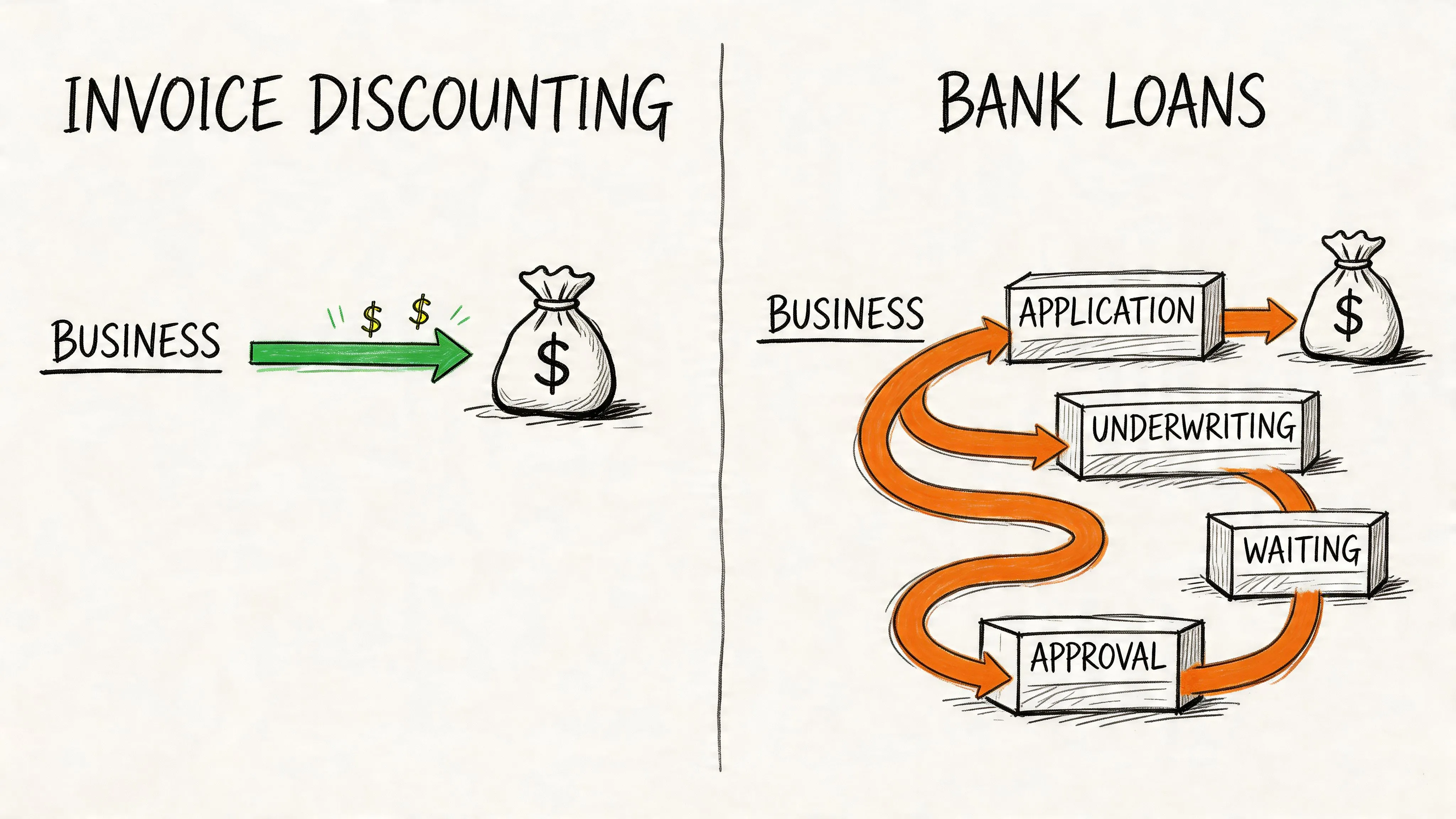
If you’re deciding between invoice discounting and a traditional bank loan, start with the operational question. Are you funding a long-term asset, or are you trying to access cash that’s already sitting in unpaid invoices?
Choose a bank loan when
A bank facility usually makes more sense in situations like these:
- You’re financing a long-term investment: Equipment, fit-out, expansion, or a structured business project.
- You have strong collateral: Property, fixed assets, or a security package a bank will recognise easily.
- Your timing is less urgent: The transaction can wait through a formal approval process.
- You want a broader-purpose facility: The funds aren’t tied to one specific invoice cycle.
Bank finance can be useful when the need is strategic and long horizon. It’s less elegant when the business merely needs access to cash from delivered sales.
Choose invoice discounting when
Invoice discounting is often the better fit when the challenge is operational:
- Your cash is tied up in receivables: The sale is complete, but payment is still pending.
- Your business runs on trade credit: Buyers expect terms, while suppliers want payment sooner.
- You don’t want to pledge hard assets: The value sits in the invoice and buyer relationship.
- Speed matters: You need to restock, pay suppliers, or take a new order before the invoice due date arrives.
The real trade-offs
The biggest differences usually come down to four factors.
- Security basis:
A bank loan often leans on collateral and historical financials. Invoice discounting leans on receivables and transaction evidence. - Use case:
A loan is broad-purpose borrowing. Invoice discounting is tightly linked to a completed commercial transaction. - Cash timing:
Loans fund a business before or beyond the trade cycle. Invoice discounting brings cash forward from the trade cycle itself. - Operational burden:
Bank processes can be document-heavy and slow-moving. Invoice-based facilities usually live closer to the finance operations team and the invoice workflow.
If the issue started with an invoice, solve it with an invoice-based tool first.
A quick decision lens
Ask yourself these questions:
- Is the sale already done?
- Is the invoice valid and due later?
- Is the main pressure caused by waiting for customer payment?
- Would early access to that cash let you fulfil more orders immediately?
If the answer is yes across the board, invoice discounting is usually the cleaner fit. If the need is a major business investment unrelated to current receivables, a bank product may be more appropriate.
That’s the central difference in Sharjah SME business financing. These tools aren’t interchangeable. They solve different problems.
Real Growth in Action How Comfi Empowers Sharjah Businesses
A familiar Sharjah scenario goes like this. A wholesaler lands a larger order from a good customer, sends the invoice, then waits 45 or 60 days to get paid. Suppliers do not wait. Payroll does not wait. The business is profitable on paper and squeezed in the bank account.
That is the growth paradox for many trade and service SMEs in Sharjah. More sales should improve the business, yet each new order can increase pressure if cash arrives after the next supplier payment is due. Asset-light companies feel this most sharply. They may have solid customers, valid invoices, and repeat demand, but still struggle to get quick bank funding because the balance sheet does not offer much collateral.
Consider a Sharjah electronics wholesaler. The buyer is reputable and wants more volume on standard terms. The supplier wants payment much sooner. The owner then has to choose between taking the order and straining working capital, or slowing sales to protect cash.
The same pattern shows up in auto parts distribution. Stock moves, but cash often gets stuck between procurement and customer settlement. A distributor can have active demand and confirmed invoices, yet still miss restocking windows because cash is tied up in receivables.
Where digital receivables tools help
Invoice discounting addresses the actual problem. It brings forward cash from an approved invoice, so the business can pay suppliers, refill inventory, or take the next order without waiting for the buyer's due date.
Used well, that changes day-to-day operating decisions.
- Sales teams can accept larger orders with clearer cash visibility
- Procurement teams can buy at the right time instead of delaying for liquidity reasons
- Finance teams can spend less time patching shortfalls caused by payment terms
- Management can plan around order flow and margin, not only around collection dates
The benefit is not just faster cash. It is better control over timing, which is usually the main constraint.
Different products solve different pressure points
Owners often ask for working capital as if it were one single need. In practice, the bottleneck matters.
Invoice discounting fits businesses that have already delivered and invoiced. B2B Buy Now, Pay Later fits sellers that want to offer buyer flexibility at the point of sale without carrying the full delay themselves. Dealer financing fits businesses, especially in automotive, that have cash tied up in existing stock.
Those distinctions matter because the wrong facility creates new friction. A long-term loan can be too blunt for a short-cycle receivables gap. An inventory product will not fix delayed payment on completed invoices.
A finance operator’s view of what works
The Sharjah SMEs that handle growth best usually separate structural funding from timing support. They do not use one facility for every problem.
What tends to work:
- Using receivables-based funding for completed sales that are waiting for payment
- Keeping invoice records accurate, approved, and easy to verify
- Reviewing customer payment terms as part of finance planning
- Reserving longer-term borrowing for expansion projects, equipment, or broader capital needs
What tends to create stress:
- Using term debt to cover the same cash gap every month
- Accepting longer buyer terms without a plan to release cash earlier
- Assuming revenue growth will solve a collection timing issue
- Waiting for a cash crunch before setting up a receivables process
Comfi's role sits in that practical gap. If a UAE SME has cash locked in unpaid invoices, Comfi provides invoice discounting, B2B Buy Now, Pay Later, and dealer financing through a digital workflow. For suppliers, distributors, and trade businesses in Sharjah, that means a business can match the financing tool to the actual bottleneck instead of forcing every cash flow problem into a bank-loan process.