A CFO's Guide to Reduce DSO and Unlock Cash Flow in the UAE


To effectively reduce DSO (Days Sales Outstanding), a business must shorten the time it takes to get paid after a sale. This involves fine-tuning your invoicing process, establishing crystal-clear payment terms, and implementing a consistent collections strategy to convert your accounts receivable into cash faster.
Why High DSO Is a Major Cash Flow Bottleneck
Days Sales Outstanding isn't just another KPI on a spreadsheet; it's a vital sign of your company's financial health. A high DSO can quietly drain your working capital, creating a significant bottleneck that can stall growth, especially in the competitive UAE market.
When cash is tied up in unpaid invoices, the consequences are tangible and impactful.
Imagine a busy electronics distributor in Dubai, unable to stock the latest smartphones because their funds are locked up with customers. Or picture an automotive parts supplier in Abu Dhabi forced to pass on a valuable bulk discount from a manufacturer. These aren't just abstract scenarios; they're the daily reality for businesses waiting 60, 90, or even 120 days for payment.
The Strategic Impact of Delayed Payments
A high DSO transforms a simple accounting metric into a serious strategic challenge. This isn't just about the numbers on a balance sheet; it's about missed opportunities and the daily operational stress it creates. When slow-paying customers hold your cash, your ability to react and adapt is severely compromised.
This delay impacts your business in several critical ways:
- Stalled Growth: You lack the liquid cash to invest in new inventory, expand into new markets, or hire essential personnel.
- Missed Opportunities: Time-sensitive deals, supplier discounts, and strategic investments become impossible to act upon.
- Increased Financial Strain: Covering essential expenses like payroll and rent becomes a struggle, placing pressure on your entire operation.
A high DSO effectively means you are providing your customers with an interest-free loan at your own expense. It cripples your ability to reinvest in your own company and makes it difficult to plan for the future with confidence.
A high DSO indicates that your capital is stuck in uncollected invoices, which directly harms your efficiency and overall cash flow. It's crucial to understand how effectively your assets are working for you, and minimizing funds tied up in receivables is key to improving liquidity. For a deeper dive into this concept, check out this founder's guide to the asset turnover ratio.
Ultimately, a consistently high DSO is a clear signal that your financial processes are not keeping pace with your growth ambitions. To fully grasp the fundamentals, take a look at our complete guide on the Days Sales Outstanding calculation.
Pinpointing the Root Causes of Your High DSO
Before you can fix a high DSO, you need to investigate its underlying causes. The number itself is just a symptom, indicating a problem but not its source. Is your team slow to send out invoices? Are your payment terms vague? Or are customer disputes getting stuck in limbo? Identifying the real friction points is the only way to implement an effective solution.
Many finance teams focus solely on the DSO number, but that provides only a high-level view. To truly understand the health of your collections process, you must analyze other key metrics. This approach helps you move from knowing you have a problem to understanding exactly where to start fixing it.
Key Accounts Receivable Metrics to Track
To gain a complete picture, you need to look beyond just DSO. Here are other vital signs you should be monitoring:
- Days Sales Outstanding (DSO): This is your baseline, showing the average number of days it takes to get paid after a sale. A high DSO is the classic sign that your cash is tied up for too long.
- Collection Effectiveness Index (CEI): This metric is a direct scorecard for your collections team. It measures how much money you collected against the total amount that was available to collect in a given period, revealing your team's efficiency.
- Average Days Delinquent (ADD): This is a crucial metric. While DSO shows the average collection time, ADD tells you how many days your payments are overdue on average. A decent DSO can sometimes mask a high ADD, indicating that customers consistently pay late.
This decision tree helps visualize the common culprits behind a high DSO, from slow invoicing to unresolved disputes.
The key insight is that payment delays are rarely caused by a single issue. They are usually the result of several interconnected weaknesses in your process.
Once you isolate these root causes, you can apply targeted solutions instead of generic fixes. For example, a high ADD points to a problem with consistently late-paying customers, suggesting a need to revisit credit policies or follow-up procedures. A low CEI, on the other hand, might mean your team is focusing on easy collections while struggling with more challenging accounts.
Your data tells a story about your payment cycle. Slow invoicing might add 5-10 days to your DSO before the customer even sees the bill. Unclear terms can add another 15 days of back-and-forth clarification. Each friction point creates a costly delay.
By analyzing these metrics together, you get a data-driven diagnosis. You can pinpoint whether the real problem lies in your credit policy, invoicing speed, collections strategy, or dispute resolution process. Gaining this clarity is the foundational step to building a plan that will actually reduce your DSO and help your company unlock its working capital.
Fine-Tuning Your Order-to-Cash Process
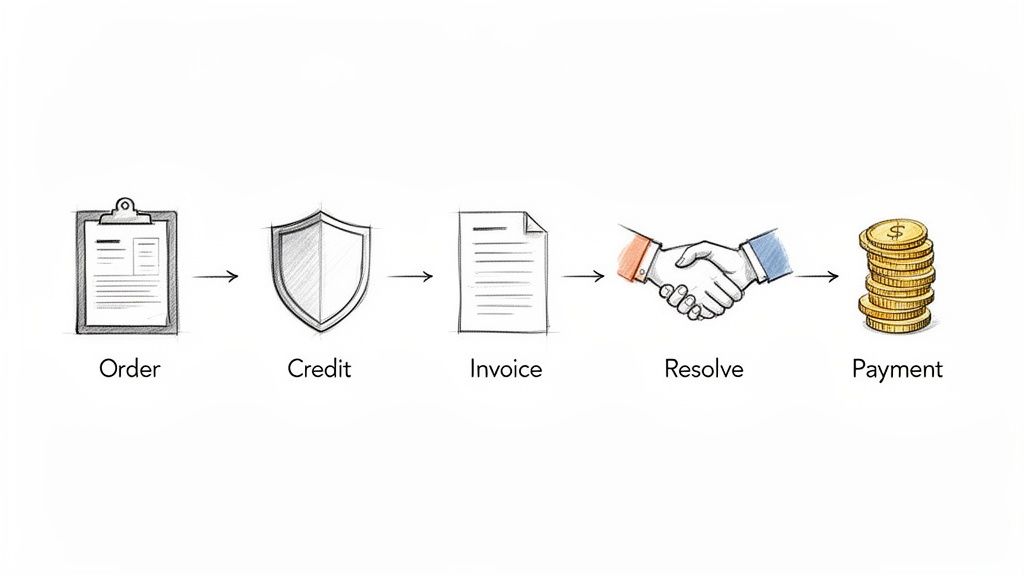
A low DSO is not achieved by aggressively chasing late payments alone. It is the natural outcome of a smooth, efficient, and proactive order-to-cash process. Every touchpoint, from the moment a customer places an order to when the cash hits your bank account, is an opportunity to reduce delays. Optimizing this entire workflow is key to lowering your DSO for good.
This process begins long before an invoice is sent. It starts with a solid and consistently enforced credit policy. This isn't about being overly strict; it's about setting clear expectations from the start to avoid misunderstandings later.
Establish a Clear Credit Policy
Your credit policy is the foundation of a healthy payment cycle. It is your rulebook for who receives credit, how much, and on what terms. A well-defined policy acts as a crucial filter, protecting you from high-risk accounts while ensuring a seamless experience for good customers.
To build a policy that works, you need to:
- Define Creditworthiness Criteria: Set clear, objective standards for vetting new customers. This could involve requesting trade references, pulling credit bureau reports, or conducting a financial statement analysis for larger accounts.
- Set Realistic Credit Limits: Determine appropriate credit limits for different customer tiers based on their payment history and risk profile. Regularly review and adjust these limits as the relationship evolves.
- Communicate Terms Explicitly: Ensure your payment terms (e.g., Net 30, Net 60) are impossible to miss. They should be clearly stated on every quote, contract, and order confirmation to eliminate ambiguity.
A vague credit policy is an open invitation for late payments. If you don't define the rules upfront, customers may create their own—which might not be favorable to you.
Perfect Your Invoicing and Dispute Resolution
Once a sale is made, the clock starts ticking. Delays in invoicing are one of the most common and avoidable causes of a high DSO. An invoice sitting in your "drafts" folder for a week is a week of lost cash flow. The goal should be to send an accurate, clear invoice as soon as goods are delivered or services are rendered.
However, even a perfect invoice can get stuck in a dispute. Unresolved issues are a massive bottleneck, as customers often withhold payment until their query is resolved. A slow or confusing dispute resolution process can easily add weeks, or even months, to your payment cycle.
A streamlined workflow is non-negotiable:
- Acknowledge Immediately: As soon as a customer flags an issue, acknowledge it. Assign a ticket or reference number to show you are addressing it.
- Assign Ownership: Make a specific person or team responsible for seeing the dispute through from start to finish to prevent it from falling through the cracks.
- Resolve Swiftly: Set internal SLAs (Service Level Agreements) for resolving disputes. Aim for a 24-48 hour turnaround. A quick resolution not only gets you paid faster but also builds customer trust.
Optimizing these operational steps is one of the most direct ways to shorten your cash conversion cycle. For a deeper look, you can learn more about how the cash conversion cycle impacts your business's financial health.
Turn Your Collections Process into a Well-Oiled Machine with Automation
Manually chasing invoices is a time-consuming and often frustrating task. It pulls your finance team away from strategic work like financial planning and analysis, bogging them down in repetitive admin. In today's business environment, this is an outdated approach, especially when technology can do the heavy lifting.
By implementing the right automation, you can transform your collections process. It can shift from a reactive, stressful chore to a proactive system that directly helps you reduce DSO.
The easiest and most impactful place to start is with routine tasks like sending invoices and payment reminders. An automated system can send a polite, professional reminder the day an invoice is due and follow up a week later if it's still outstanding. This consistency removes human error and forgetfulness, which alone can significantly reduce late payments.
Work Smarter, Not Harder: Prioritizing Collections
Modern systems go beyond simple reminders by adding a layer of intelligence that makes your entire collections strategy smarter. A good platform can analyze payment histories to automatically flag high-risk or high-value accounts.
This is a game-changer. It allows your team to stop wasting energy on every small, low-risk invoice and focus their time where it really counts: on the accounts with the biggest potential impact on your cash flow.
This data-driven approach ensures your team's efforts are spent on high-value activities, like personally calling a key client to negotiate a payment plan, rather than on administrative tasks.
The E-Invoicing Advantage in the UAE
In the UAE, this shift toward automation is quickly becoming essential. With mandatory real-time e-invoicing on the horizon, businesses struggling with high DSO are finding a powerful ally in accounts receivable automation.
The results are compelling. Automation can slash DSO by up to 45% by providing predictive cash flow insights and ensuring compliance. In fact, many UAE companies that have already switched to digital invoicing and automated reminders have seen a solid 30% DSO reduction, converting their overdue receivables into cash much faster.
Getting ahead of the curve with e-invoicing and collections automation is not just about compliance; it's a significant competitive advantage. It speeds up the entire payment cycle, turning unpredictable receivables into a reliable stream of cash.
When you embrace these tools, you’re not just buying software. You’re freeing up your finance team to become true strategic partners. Instead of being buried in collections paperwork, they can focus on analysis, forecasting, and driving real growth. This shift turns your accounts receivable department from a cost center into a powerful engine for financial health.
Using Commercial Incentives to Speed Up Payments
Sometimes, the most effective way to shrink your DSO is to reward early payments rather than just chasing late ones. By using smart commercial incentives, you can actively shape your customers' payment habits and turn the collection process into a win-win negotiation. The goal is to make prompt payment the most attractive option.
This approach moves beyond sending reminders and into using financial tools to encourage desired behavior. When implemented correctly, these incentives can significantly shorten your payment cycles without eroding profit margins.
Implementing Early Payment Discounts
One of the most direct tactics is the classic early payment discount. The "2/10 Net 30" term, for example, means a customer gets a 2% discount if they pay within 10 days; otherwise, the full amount is due in 30. While giving up margin may seem counterintuitive, the boost to your cash flow can be substantial.
The key is to ensure the discount is financially sound. Consider the cost of that locked-up cash. If offering a small discount frees up capital that you can immediately reinvest in inventory or a new growth opportunity, it often pays for itself many times over.
For example, on an AED 100,000 invoice, a 2% discount is AED 2,000. If receiving AED 98,000 twenty days earlier allows you to take advantage of a bulk purchase discount from your supplier that saves you AED 5,000, you've come out ahead.
An early payment discount isn’t a cost; it’s an investment in your liquidity. You are essentially paying a small, controlled fee to unlock your working capital faster, which is almost always cheaper than the cost of waiting.
Exploring Dynamic Discounting and Late Penalties
For more strategic relationships, dynamic discounting offers greater flexibility. Instead of a fixed discount, the percentage can slide based on how early the payment is made—for example, 2% for paying in 10 days, 1.5% for paying in 15, and so on. This gives your clients more control and incentivizes even slightly earlier payments.
Conversely, you can introduce late payment penalties. This requires a firm but professional approach. To be enforceable, these penalties must be clearly spelled out in your initial contracts and on every invoice. A typical penalty might be a small percentage of the outstanding balance, calculated monthly. The goal is not to generate revenue from fees but to create a clear financial consequence for paying late, pushing your invoices to the top of your customers' priority list.
These commercial levers are effective. In the Middle East, where the average DSO can be 66-81 days, business leaders who combine automated reminders with early payment discounts often see their DSO drop below 60 days. This is part of a broader regional trend where digitization is helping businesses achieve 20% reductions in their DSO. You can find out more about how UAE businesses are tackling DSO in 2025.
Unlocking Immediate Capital with Fintech Solutions
Even with the most streamlined processes, the reality of B2B commerce often involves waiting for payments. The gap between sending an invoice and receiving cash can create serious cash flow challenges. This is where modern fintech solutions come in, designed to bridge that gap and provide access to your revenue almost instantly.
These tools don't replace your existing systems; they enhance them. They provide the liquidity needed to operate smoothly and seize growth opportunities, offering a practical way to reduce DSO by fundamentally changing when you get paid.
From Waiting to Winning with Invoice Discounting
Invoice discounting is a powerful concept that turns your accounts receivable from a static asset into immediate, usable cash. Instead of waiting 30, 60, or even 90 days for a customer to pay, you can submit your approved invoices to a platform like Comfi and receive the bulk of the invoice value, often within 24 hours.
This approach puts you back in control of your cash flow. You no longer have to delay inventory purchases or key projects while waiting for payments to clear. By accessing your earned revenue on your own timeline, you can run your business more proactively. You can discover more in our complete guide explaining how invoice discounting in the UAE works.
Empowering Buyers with B2B Buy Now, Pay Later
Another innovative tool is B2B Buy Now, Pay Later (BNPL). This solution not only helps you get paid upfront but also gives your buyers valuable flexibility by offering them extended payment terms. When you offer BNPL through a partner, you receive payment for your sales immediately, which can eliminate DSO on those transactions.
Simultaneously, your customer gets the benefit of paying over time. This can encourage them to place larger orders and strengthen their loyalty.
- Bigger Order Sizes: Customers with flexible payment options are more likely to increase their purchase volume.
- Stronger Customer Loyalty: Offering convenient terms makes you an easier, more attractive partner to do business with.
- Zero Credit Risk for You: The BNPL provider handles the collections process, removing the risk and administrative burden from your plate.
These fintech solutions fundamentally shift the cash flow dynamic in your favor. Instead of your working capital being determined by your customers' payment cycles, you gain the power to access it when your business needs it most.
This shift is becoming vital. Across the Middle East, Days Sales Outstanding improved in 2024, dropping to 81.1 days from 83.9 in 2023. In the UAE and Saudi Arabia, solutions like invoice discounting have surged as businesses seek ways to accelerate payments. For automotive dealers and electronics distributors, this means following the lead of top performers who use these tools to get their DSO below 60 days, a move through which many clients were able to unlock their working capital. You can read more about these regional working capital trends.
Got Questions About DSO in the UAE? We’ve Got Answers.
When it comes to tightening up your Days Sales Outstanding, many questions arise, especially for finance leaders in the MENA region. Let's tackle some of the most common ones we hear from businesses looking to improve their cash flow.
What's a Good DSO for an SME in the UAE?
This really depends on your industry, but a solid target for a UAE-based SME is anything under 60 days. Top-tier players often achieve a DSO of 30-45 days.
Realistically, the regional average tends to be higher, somewhere in the 66-81 day range. The best approach is not to fixate on a single number. Benchmark against your direct competitors and make continuous improvement your goal. A lower DSO means you’re turning sales into cash faster, which is essential for healthy liquidity.
How Can I Make Our Credit Terms Stricter Without Scaring Off Customers?
Effective communication is key. When you decide to tighten your credit terms, explain the reasoning behind it. Frame it as a necessary step to standardize processes and ultimately provide better service for all customers.
You can soften the transition by offering an early payment incentive—a classic win-win. For new clients, ensure the new credit policy is non-negotiable and clear from day one. With long-term partners, you might consider phasing in the new terms as a gesture of goodwill that shows you value the relationship while moving your policy in the right direction.
The goal isn't to be rigid; it's to be clear and consistent. Open communication and smart incentives will help you maintain strong customer relationships while getting your DSO under control.
Is Invoice Discounting a Smart Move for My Business?
Invoice discounting can be an excellent tool if you are facing cash flow gaps caused by reliable customers on long payment terms.
It’s ideal for businesses that need immediate cash to fund daily operations, purchase inventory, or seize a growth opportunity. It allows you to access the value sitting in your accounts receivable ledger instead of waiting weeks or months for your customers to pay.
At Comfi, we’re focused on helping businesses like yours get paid upfront on their invoices. This helps stabilize cash flow so you can focus on running your business, and our clients have been able to unlock their working capital to fuel their growth. Find out more at https://comfi.ai.
Related Reading
- How Can MENA SMEs Master Working Capital?
- Staffing Agency Payroll Financing UAE: Boost Cash Flow 2026
- SME Cash Flow Management: A Guide for MENA Businesses
- Improve Working Capital for UAE IT Services Business
Looking to improve your cash flow? Explore Comfi's Invoice Discounting solutions. Get started today.