Financial Reporting for SMEs: A MENA Growth Guide

Sales can be up, margins can look respectable, and the business can still feel short of breath every month.
That's a familiar SME pattern across MENA. A wholesaler lands larger orders, extends terms to good customers, brings in more stock, and then realises the bank balance doesn't reflect the apparent success. The business is growing on paper, but cash is always under pressure. Payables are due before receivables arrive. Inventory sits longer than expected. Tax and compliance obligations stop being background admin and start shaping daily decisions.
Financial reporting stops being a back-office routine and becomes the operating system for the business. Clean reports tell you whether profit is real, whether stock is turning, whether receivables are collectable, and whether the balance sheet can support the next growth step. They also determine how seriously external parties take your numbers.
For a new finance manager, that shift matters. Your job isn't just to close the books. It's to turn transactions into decision-ready information that management can trust.
From Sales to Strategy A New Look at Financial Reporting
A common scene in a fast-growing SME looks like this. Sales says the quarter was strong. Operations says demand is healthy. The owner says the company has never had more business in hand. Then finance says cash is tight, overdue balances are creeping up, and several supplier payments need escalation.
None of those people are necessarily wrong. They're often looking at different versions of the business.
That gap is what financial reporting is supposed to close. Done properly, it connects invoicing, collections, stock movement, supplier obligations, tax exposure, and actual liquidity. It gives management one coherent picture instead of separate departmental narratives.
What the numbers should answer
A good reporting pack for an SME should quickly answer a few practical questions:
- Are sales converting into cash: Revenue matters, but collections timing matters more when customers buy on terms.
- Is profit supported by operations: Margin can look healthy while write-offs, discounts, and slow inventory erode quality.
- Where is cash trapped: It may be sitting in receivables, excess stock, prepayments, or poorly timed supplier commitments.
- What can management act on this week: Reports that arrive late or bury the key movements don't help anyone.
Practical rule: If your monthly pack explains what happened but doesn't help the owner decide what to do next, it's incomplete.
Many new finance managers inherit reports that are technically correct but operationally weak. They contain ledger detail, but not insight. In practice, management accounts need to translate accounting into decisions. If you want a useful reference point for structure and presentation, Stewart Accounting's management accounts guide is a sensible practical resource.
What works in real businesses
What works is rarely glamorous. Tight cut-off. Clean customer ageing. Reconciled supplier balances. Stock movements that match commercial reality. A short commentary that explains the movement in cash, margin, and liabilities without accounting jargon.
What doesn't work is relying on sales summaries, unaudited spreadsheets, and month-end adjustments that nobody can fully explain. That approach leaves the business asset-rich, invoice-heavy, and cash-poor.
What Is Financial Reporting Really
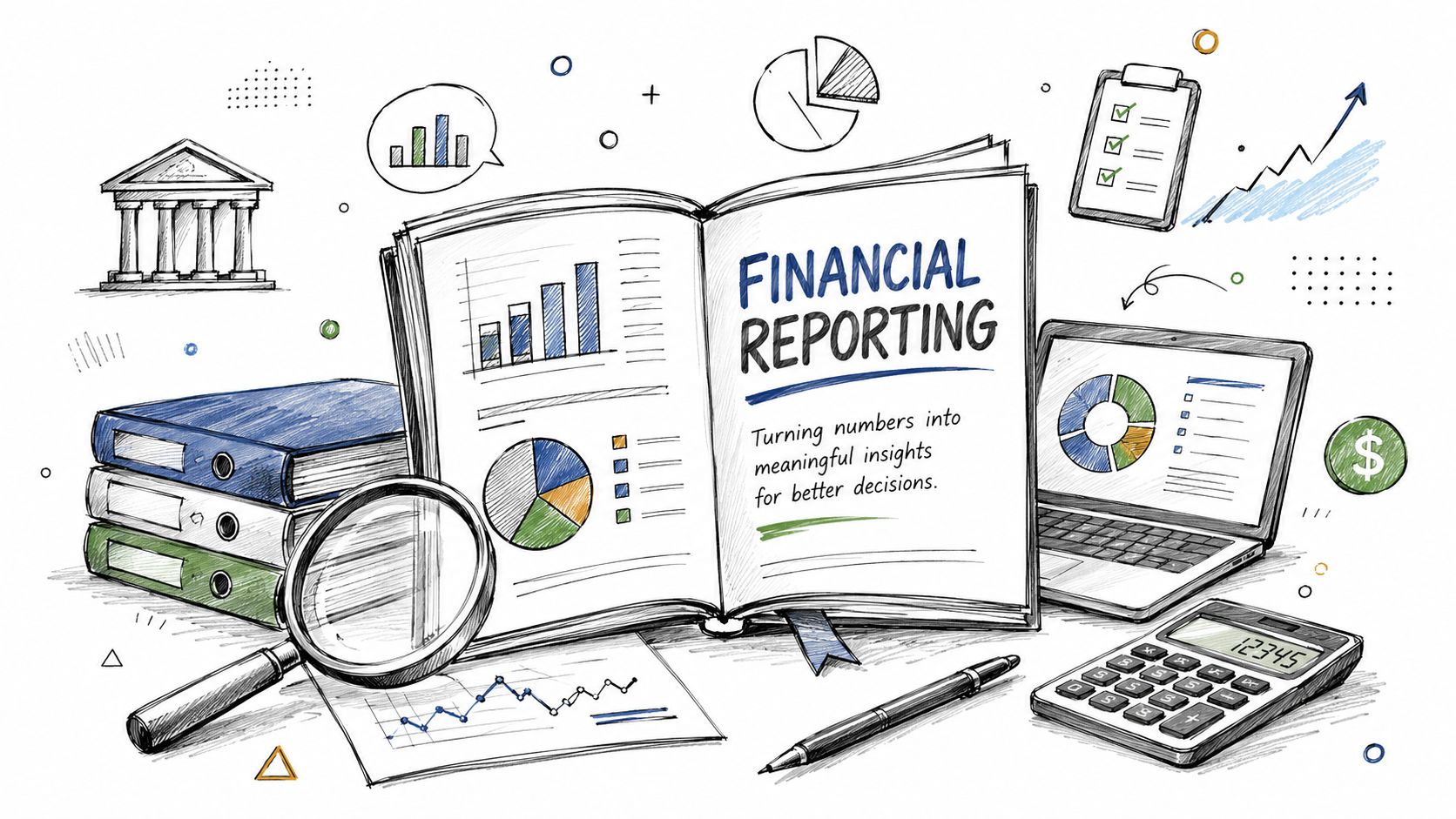
Financial reporting is the process of turning daily business activity into a reliable picture of performance, position, and cash movement. Every invoice issued, supplier bill posted, payment received, payroll run, and inventory adjustment feeds that picture. If the inputs are weak, the reports will mislead management.
For an SME, the simplest way to think about it is as a business health check. The reports tell you what the business earned, what it owns, what it owes, and whether it is generating cash or consuming it. You don't wait for a medical emergency before checking vital signs. Finance should work the same way.
Why it changed in the UAE
In the UAE, financial reporting is no longer something private firms can treat casually. The introduction of Corporate Tax from 1 June 2023 at a standard rate of 9% on taxable income above AED 375,000 means businesses need records that support tax reporting and statutory positions, as explained in NetSuite's overview of financial reporting in the UAE context.
That changes the role of finance in a very practical way. Reports are no longer just for internal review or annual audit preparation. They are part of the evidence base for tax computation, reconciliations, and support for revenue and expense positions.
What financial reporting is not
It's not just printing a profit and loss from your accounting system.
It's not a year-end scramble to organise ledgers for the auditor.
And it's not a dashboard filled with ratios nobody uses.
Useful financial reporting has a few clear characteristics:
- It is timely: Management sees the numbers while action is still possible.
- It is traceable: Material balances can be reconciled back to invoices, contracts, bank movements, and supporting schedules.
- It is consistent: Revenue, costs, accruals, and classifications follow the same logic each period.
- It is readable: Non-accountants can understand what changed and why.
The best reporting packs don't try to impress people with volume. They help a commercial team understand reality quickly.
A finance manager who understands this will spend less time producing decorative reports and more time building reporting discipline. That discipline supports compliance, improves credibility, and gives management a stronger basis for action when cash is under strain.
The Three Essential Financial Statements You Must Master
Every finance manager should know the full set of core statements, but in SME practice, three usually drive the daily conversation. The broader framework of standard statements includes the balance sheet, income statement, cash flow statement, and statement of shareholders' equity, as described in the SEC investor guide to financial statements. In operating businesses, the first three carry most of the day-to-day management burden.
The income statement asks if the business is profitable
Management typically looks here first, and often concludes its review prematurely.
The income statement tells you whether the company earned more than it spent over a period. That matters, but the quality of the earnings matters just as much.
Focus on line items that reveal operating reality:
- Revenue quality: Are sales booked from completed deliveries and valid invoices, or pushed through early to make the month look better?
- Gross margin: Is margin stable, or is it being diluted by discounting, freight leakage, claims, or poor buying discipline?
- Operating expenses: Are payroll, rent, logistics, and overheads behaving in line with the scale of the business?
- Other costs below the line: Financing-related charges, write-offs, and unusual items can distort the story if they aren't explained clearly.
A profitable month can still hide a weak commercial pattern. For example, if sales growth comes from longer customer terms or lower-quality accounts, the income statement may flatter the business while cash risk builds underneath.
The balance sheet asks what the business owns and owes
Strong controllers spend real time on the balance sheet because it exposes whether the P&L is believable.
Pay close attention to these balances:
- Receivables: Which customers are stretching beyond agreed terms, and which balances are disputed rather than collectible?
- Inventory: Is stock moving in line with sales, or sitting too long because purchasing outpaced demand?
- Payables: Are supplier balances current, or is the business informally funding itself through delayed payments?
- Accruals and prepayments: Small classification errors here can steadily distort margins and liabilities.
- Borrowings and lease-related obligations: These matter for covenant conversations, internal debt management evaluation, and external credibility.
A weak balance sheet usually shows up before a cash crisis becomes obvious.
The cash flow statement asks where the money actually went
For SMEs, this is often the most important report. The source above notes that cash flow is especially critical where receivables can stretch across 30, 60, or 90 days, and inventory cycles can exceed 180 days in automotive distribution. That is exactly why profitable businesses still run into liquidity pressure.
Use the cash flow statement to challenge assumptions:
- Operating cash flow: Is the core business generating cash, or absorbing it?
- Working capital movement: Did receivables rise faster than sales? Did inventory build ahead of demand?
- Investing outflows: Are equipment, fit-out, or system spend properly timed and understood?
- Financing movements: Has the business relied on short-term support to compensate for weak collections?
If your team needs a practical starting point for presentation, this resource on how to manage cash flow for UAE businesses can help frame what management should review. If you're still pulling this together through disconnected tools, it's also worth looking at how different accounting software options in the UAE affect report quality, cut-off discipline, and reconciliation workload.
A controller should be able to explain the difference between profit and cash in plain language to sales, operations, and the owner. If that translation isn't happening, reporting hasn't done its job.
The practical takeaway
When a company leases warehouses, delivery vehicles, retail units, or showroom space, IFRS treatment isn't a technical side note. It affects the numbers management uses to judge headroom and commitments. It also affects how others read those same numbers.
If your team is assessing how tax and liquidity interact under the new regime, this guide on UAE corporate tax and SME cash-flow impact is a useful operational companion to the reporting discussion.
Common Reporting Errors That Hurt Your Growth
Most reporting problems in SMEs don't start with fraud or dramatic failure. They start with small habits that go unchallenged. A revenue line pushed early. A stock adjustment delayed. A payable left unreconciled because the supplier statement hasn't arrived. Over time, these habits make the reports harder to trust.
That trust issue has direct consequences. Management makes weaker decisions. Tax positions become harder to support. External parties ask more questions because the numbers don't reconcile cleanly.
Errors you should fix first
These are the mistakes that do the most damage in fast-growing businesses:
- Revenue booked before the earning event is complete: This usually happens when teams post based on commercial expectation rather than delivered performance and valid documentation.
- Capital and operating costs mixed together: A fit-out, system implementation, or equipment purchase gets treated like a normal monthly expense, or the reverse. Both distort performance.
- Receivables ageing that nobody owns: The ledger may show balances by customer, but disputes, unapplied receipts, and long-outstanding items aren't being cleaned actively.
- Inventory records that drift from reality: Stock adjustments posted late, weak SKU discipline, and poor treatment of damaged or obsolete items can make gross margin look better than it is.
- Month-end journals with weak support: If the business relies on manual top-side entries without schedules, the close becomes personality-dependent rather than controlled.
Why automation helps
Manual finance processes fail in predictable ways. They depend on memory, follow-up, and spreadsheet discipline. Once transaction volume rises, those controls break down.
Academic research discussed by The Accounting Review on audit committee IT expertise and reporting quality links technology expertise with more reliable and timely financial reporting. In practice, the implication for SMEs is straightforward. Automated validation, audit trails, and exception reporting reduce manual error and support faster closes.
Clean reporting usually comes from system design, not heroics at month-end.
What to implement instead
You don't need an enormous transformation programme to improve reporting discipline. Start with control points that remove repeat failure:
- Lock cut-off rules: Define when revenue, costs, and stock movements belong to the period, then enforce it.
- Use approval workflows: High-risk journals, credit notes, and master-data changes should leave an audit trail.
- Reconcile subledgers every month: AR, AP, bank, inventory, and tax balances shouldn't wait for quarter-end.
- Build exception reports: Flag overdue balances, negative stock, unmatched receipts, and unusual margin swings automatically.
- Keep one source of truth: The more often finance re-keys data between spreadsheets and systems, the more likely the close will drift.
What doesn't work is asking the team to “be more careful” while leaving the process unchanged.
How Clean Reports Help Unlock Working Capital
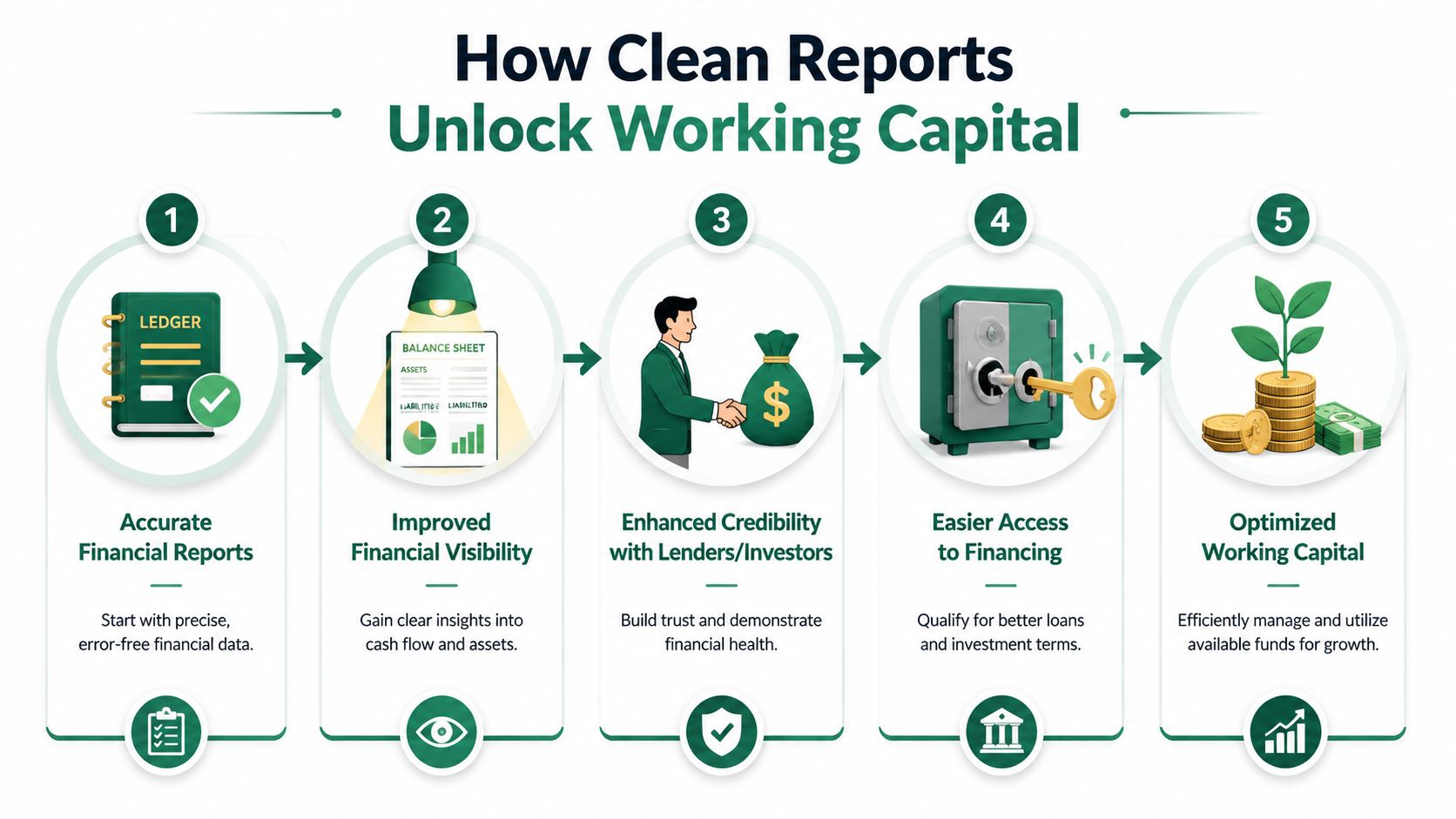
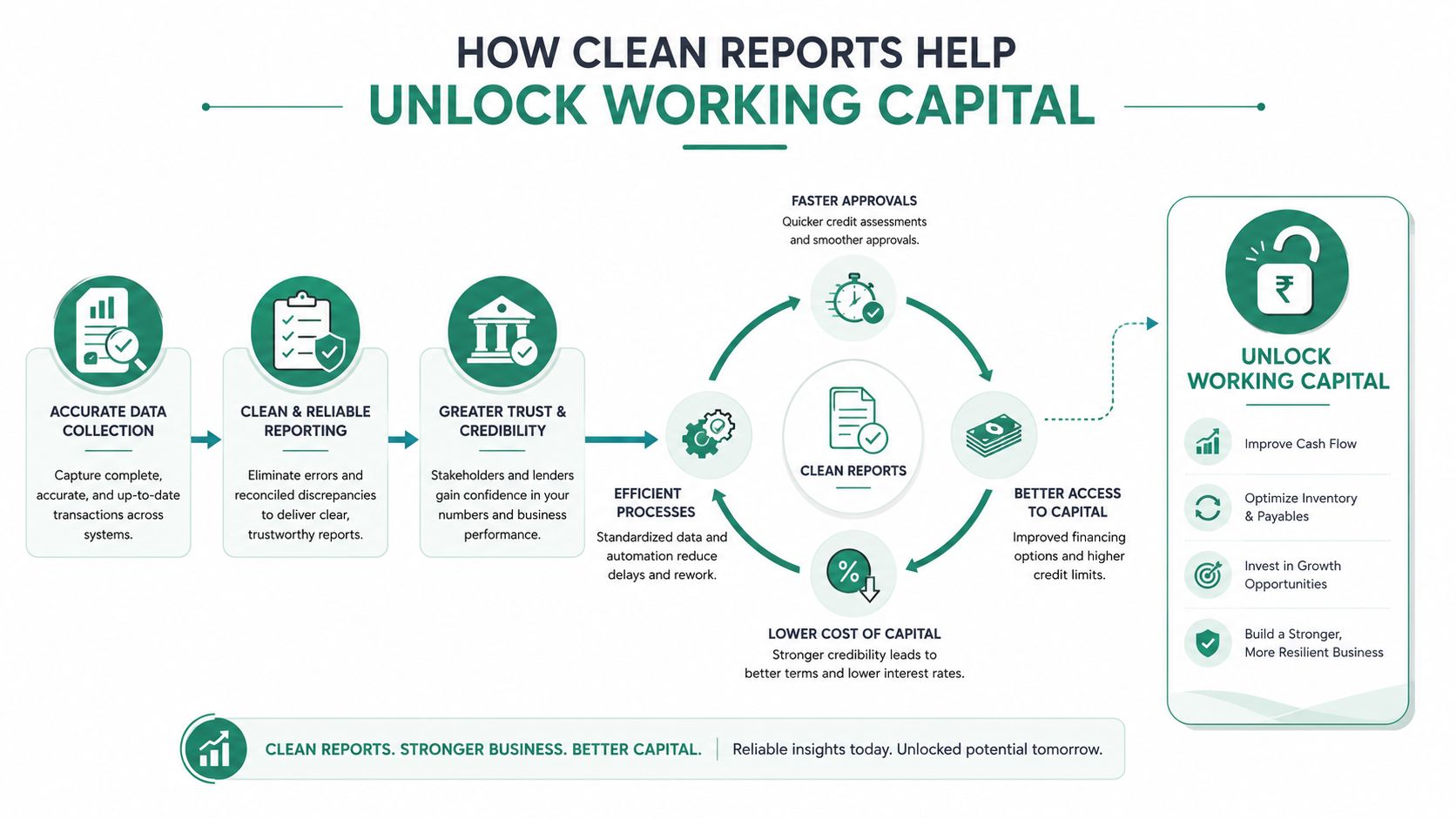
When external providers assess a business for invoice-based or inventory-linked solutions, they don't just look at sales volume. They look for clarity. Clean financial reporting gives them a clearer view of whether receivables are real, whether inventory is properly recorded, and whether liabilities are understood.
That's why reporting quality affects access to working capital solutions in practical terms. The cleaner the records, the easier it is to validate the commercial story behind them.
What external reviewers want to see
For most solutions tied to invoices, purchasing cycles, or stock, three things matter more than presentation polish:
- Receivables that can be traced: Customer balances should tie to issued invoices, agreed terms, and payment history.
- Inventory records that reflect real turnover: Slow-moving stock, aged units, and valuation issues need to be visible, not buried.
- Bank activity that supports the story: Cash movement should align with reported trading, collections, and supplier payments.
If those basics are weak, the conversation becomes slower and more cautious.
Where the statements support the case
Each report contributes something different:
- The income statement shows whether the company is consistently generating commercial activity and margin.
- The balance sheet shows whether receivables, stock, and obligations are under control.
- The cash view shows whether operations are converting activity into liquidity or constantly absorbing cash.
This is especially relevant for businesses using tools such as invoice discounting, structured payment terms on purchasing, or dealer financing models tied to stock movement. In each case, counterparties need confidence that the underlying business records are dependable.
A practical example is invoice-backed workflows. If a provider asks for supporting documents and your team can immediately match the invoice, customer ledger, proof of delivery, and bank movement, the process is smoother. If the invoice sits in one system, the ageing in another, and the customer dispute log in a sales manager's inbox, the process slows down.
Reporting discipline becomes commercial leverage
Through strong reporting, finance stops being seen as the department that says no. Strong reporting gives the business more room to act. It helps sales negotiate terms responsibly, helps procurement plan purchases with better visibility, and helps leadership assess which customers and stock lines tie up too much cash.
If you're reviewing documentation quality, even something as basic as cleaner business bank statement analysis can improve how your cash story reads. And if the business uses invoice-led workflows, providers such as Comfi may rely on uploaded invoices and related records as part of their process, which makes reporting discipline directly relevant to operational speed.
The businesses that unlock working capital efficiently usually aren't the ones with the fanciest reports. They're the ones whose numbers reconcile cleanly when someone asks for proof.
Frequently Asked Questions on SME Financial Reporting
Finance managers usually ask sensible questions once the basics are in place. The challenge isn't whether to report. It's how to make reporting useful without overbuilding it.
How often should an SME produce financial reports
Monthly is the practical baseline for most SMEs. Waiting for quarter-end is usually too slow when collections, payables, and stock levels move every week.
For cash-sensitive businesses, some indicators should be reviewed more frequently than the full close. Bank position, overdue receivables, major supplier exposures, and stock pressure points often need weekly visibility.
What is the difference between management reporting and external financial reporting
Management reporting is for decisions. External financial reporting is for formal review by parties outside day-to-day operations, such as auditors, tax authorities, lenders, or investors.
The mistake many teams make is treating internal packs like miniature statutory accounts. That usually creates volume without clarity. Guidance on reporting quality often misses this practical point, but the CFA Institute view described in this discussion of financial reporting inefficiencies is useful. Quality sits on a continuum where relevance, completeness, and neutrality need balance. More detail doesn't automatically make reporting better.
Do you need expensive software to get started
No. You need discipline before you need complexity.
A smaller finance team can build strong reporting with a solid accounting system, controlled approval flows, monthly reconciliations, and a simple reporting pack used consistently. Better software helps once transaction volume rises, entities multiply, or integrations become necessary. But software won't fix weak ownership, poor cut-off, or missing support.
Which metrics should a new finance manager prioritise first
Start with the measures that expose liquidity pressure and reporting integrity:
- Cash position and short-term obligations
- Receivables ageing and disputed balances
- Inventory movement and ageing
- Gross margin movement by product or channel
- Payables timing and concentration
If those five are clean and current, most SME management teams can make better decisions quickly.
If your business is tightening its financial reporting and wants a more digital way to use invoice records, purchasing terms, or inventory-backed workflows to access working capital, take a look at Comfi. It's a UAE-based platform operating across MENA with products including Invoice Discounting, Buy Now, Pay Later terms for business purchases, and Automotive Dealer Financing.