Your Bank Statement: A Key to Unlocking Business Funding

Your business bank statement is far more than a simple record of transactions. It's the financial story of your company, written in real-time. For SMEs in the UAE, this document is a powerful tool that demonstrates to potential partners and funders exactly how healthy and stable your operations are. A well-maintained statement can be the key to accessing the resources you need for growth.
Your Bank Statement Is a Story, Not Just a Record
Think of your bank statement as a detailed narrative. Every deposit is a plot point, and every withdrawal moves the story forward. This story reveals how consistently your business earns revenue, how well you manage your expenses, and whether you maintain a healthy cash flow day in and day out. It's tangible proof that your company is reliable—a critical factor when you're looking to grow.
For many fintechs and financial partners, this recent story is often more important than historical profit margins on a balance sheet. They analyze your recent activity to understand your company's current operational rhythm. A clean, consistent bank statement shows them a business that is active, disciplined, and knows how to manage its money.
By viewing your bank statement as a strategic asset, you can begin to shape a financial narrative that actively supports your growth ambitions. It’s not about perfection, but about demonstrating consistency and responsible management.
This guide will provide practical insights into how to read, manage, and present this crucial document. We'll show you how to use your bank statements to build a compelling case for your business, helping you improve your chances of securing favorable terms and navigating the modern funding landscape with confidence.
Once you understand what partners are looking for, you can turn an everyday document into the key that opens doors to new opportunities.
Decoding Your Bank Statement: Key Components Explained
A business bank statement is a detailed health report for your company. Think of every line item as a vital sign. Once you know how to read it, you can move beyond staring at the final balance and start to understand the real financial story your business is telling every single day.
Let’s break down the essential pieces you’ll find on any statement. These components are the building blocks of your financial narrative, giving you a clear framework to see exactly how your company performed over a specific period.
Core Statement Components
The layout of a bank statement is designed to clearly show the flow of money into and out of your account. All the main components work together to paint a complete picture of your financial activity.
Here are the key elements you need to get familiar with:
- Opening Balance: This is the money in your account at the very start of the statement period. It’s your financial starting line.
- Deposits and Credits: This section details all the money that came in. It represents your incoming cash flow from sales, customer payments, and any other revenue streams.
- Withdrawals and Debits: Here’s where you’ll see all the money that went out. This includes payments to suppliers, rent, employee salaries, and all your other operational expenses.
- Closing Balance: This is the final amount of money left in your account when the statement period ends. The calculation is straightforward: Opening Balance + Total Deposits – Total Withdrawals.
This simple flow shows how individual transactions come together to build the story of your business, ultimately paving the way for growth.
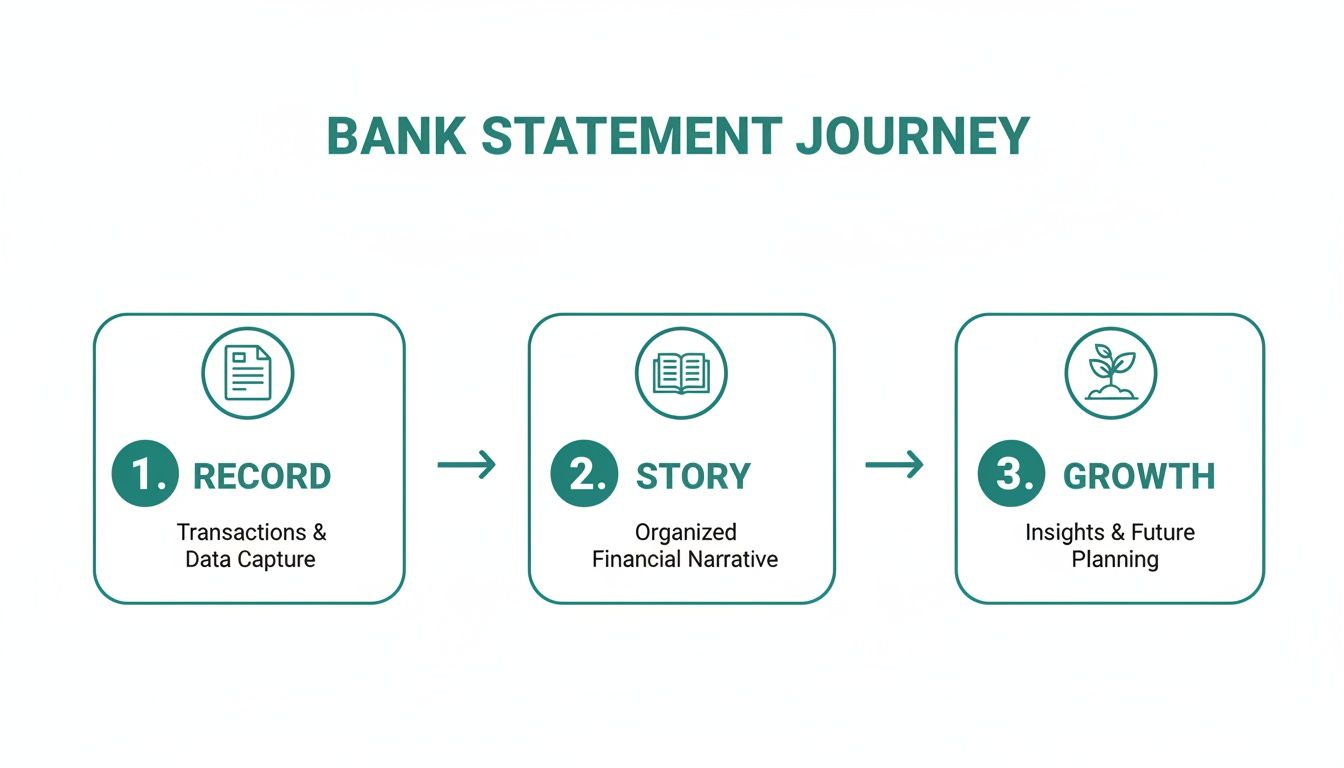
This journey—from simple records to a compelling growth story—is exactly why your bank statement holds so much strategic value. By mastering these basics, you’re building a solid foundation to prove your business's health and unlock new opportunities.
What Fintech Partners Look for in Your Bank Statement
When you provide your business bank statement to a potential partner, they aren’t just looking at a list of transactions. They’re reading the story of your business's day-to-day rhythm and financial health. Unlike traditional lenders who might focus heavily on past profits, modern funders are often more interested in your recent cash flow. It’s the best way for them to see how stable and reliable your company is right now.
They are scanning for specific signals that paint a picture of a well-run business. Once you understand what those signals are, you can make sure your statement clearly showcases your company’s strength, improving your access to better payment solutions and funding opportunities.
Positive Financial Signals
Funders want to see proof of consistent, predictable business activity. It tells them you have a solid operational pulse. A healthy statement usually highlights these positive indicators:
- Steady Revenue Deposits: Regular, predictable deposits are a clear sign that you have consistent sales and a reliable customer base. It shows money is consistently coming in the door.
- Positive Average Daily Balance: Keeping a healthy cushion in your account isn't just good practice; it demonstrates strong cash management and the ability to handle unexpected costs.
- Sensible Spending Patterns: Your expenses should align with your business operations. When outgoing payments are logical for your industry, it signals responsible financial management.
The goal isn’t to show a flawless financial record, but a realistic and consistent one. A bank statement that reflects a steady, healthy heartbeat is far more compelling than one with wild, unexplained spikes and dips.
Financial Red Flags to Avoid
On the flip side, some patterns immediately raise concerns. These red flags suggest potential cash flow problems or shaky financial management, making a potential partner hesitant.
- Frequent Overdrafts or NSFs: Non-sufficient funds (NSF) charges or constantly dipping into overdraft are major warning signs that suggest a struggle to manage cash flow.
- Bounced Payments or Returned Cheques: This indicates difficulty in meeting financial obligations, which is a serious concern for any potential funder.
- Large, Unexplained Withdrawals: Significant cash withdrawals or transfers without a clear business purpose can appear unpredictable and raise questions about financial discipline.
In the UAE, the financial sector is robust, but large institutions can sometimes be slow to serve SME needs. This is where agile fintech partners come in, focusing on your operational story instead of just your history. By paying attention to these details, you can position your business to tell the right story.
How to Keep Your Bank Statement in Shape for Funding
Think of your bank statement as a financial resume. It tells funders, partners, and investors everything they need to know about your company's health and habits. Keeping that story compelling isn't about chasing perfection; it's about building consistent, positive financial routines.
These are practical, everyday actions that build a powerful track record, showing that your business is a reliable and well-managed operation. Master these basics, and you'll find it much easier to access the resources you need to fuel your growth.
A Practical Checklist for Success
Building a strong bank statement is a continuous process. By focusing on a few core habits, you can create a financial history that opens doors.
- Stay in the Black: The single most important habit is keeping your daily balance positive. It’s the clearest signal of healthy cash flow and proves you can handle your day-to-day expenses.
- Draw a Clear Line: Never mix business and personal finances. A dedicated business account is non-negotiable. When funds are commingled, it’s nearly impossible for a reviewer to get a true picture of your company’s performance and raises immediate red flags.
- Show a Steady Flow of Revenue: Consistent deposits—whether daily, weekly, or monthly—demonstrate that your business is active and generating reliable income. This predictability is exactly what funders want to see.
- Reconcile Your Books Regularly: Routinely check your bank statements against your own records. This simple discipline helps you spot errors, catch potential fraud, and keep your financial data accurate. Pairing this habit with the right accounting software in the UAE can make the process nearly automatic.
Think of these actions as more than just good bookkeeping; they're strategic moves. Every positive habit you build strengthens the narrative your bank statement tells, creating a powerful case for your business's stability.
This kind of financial discipline is especially vital in a strong market. The UAE's banking sector is remarkably resilient, posting a Bank Z-score of 22.29 in 2021, which signals a very strong ability to withstand economic turbulence. This stability has paved the way for innovative fintechs to thrive, giving SMEs more flexible ways to manage their operations. You can explore more data on the stability of the UAE's banking system on TradingEconomics.com.
Preparing Your Documents for a Smooth Application
A healthy bank statement tells a compelling story about your business, but presenting that story correctly is just as critical for a smooth application process. When you're getting your documents ready, remember that financial partners need a clean, complete picture of your recent activity to make a confident decision.
It is standard practice to provide several consecutive months of statements—usually between three and six. This window gives funders a reliable snapshot of your current cash flow, revenue consistency, and spending habits. It is absolutely crucial that these documents are complete and legible. Any missing pages or unclear details can bring the entire process to a halt.
Official Documents Versus Screenshots
One of the most important, and often overlooked details is the format. You must provide the official, bank-generated PDF copies of your bank statements.
Why is this a strict requirement?
- Authenticity and Verification: Official PDFs contain metadata and formatting that prove they came directly from the bank, making them trustworthy and tamper-proof.
- Completeness: It’s too easy to crop out important information with a screenshot, such as the business name, account number, or specific transaction dates. This missing context makes them unusable for a proper review.
- Readability: Bank-generated statements follow a standard layout that allows reviewers to analyze your financial data quickly and accurately.
Typically, you'll submit these documents through a secure digital portal. This isn't just about convenience; it’s about protecting your sensitive financial information with high-level encryption. Getting the right documents in the right format does more than just speed up the review—it shows that you’re professional, organized, and transparent. For a deeper dive, check out our guide on securing a small business loan in the UAE.
Common Questions About Bank Statements and Funding
Even with a solid grasp of the basics, the funding process can still feel complex. When it comes to your business bank statement, you’re likely to have questions. We’ve gathered some of the most common queries from SME owners to provide clear answers and help you see your finances through a partner’s eyes.
How Many Months of Statements Are Needed?
Most fintech partners request six to twelve consecutive months of your business bank statements. This time frame is considered the sweet spot.
This specific window provides a clear, current picture of your cash flow, revenue consistency, and the overall financial rhythm of your business. For modern funders, your recent performance is often more telling than financial data from a year or two ago. Six months shows a reliable pattern, while three months gives a solid, up-to-date snapshot of your operational health.
Is One Large Monthly Deposit Better Than Many Small Ones?
Consistency is what truly matters, not the size or number of individual transactions. Whether you receive one large payment from a key client or dozens of smaller ones from various customers, the important thing is to show a regular, predictable flow of income.
A steady pattern of deposits, no matter their value, sends a powerful signal: your business is stable and operational. It proves you have a working sales cycle and dependable revenue streams, which is exactly what a potential financial partner wants to see on your bank statement.
Don't panic over an occasional, isolated negative balance. Reviewers look at the bigger picture. If your account bounces back quickly and stays positive, it’s usually seen as a normal part of doing business, not a sign of instability.
Will an Occasional Negative Balance Hurt My Chances?
While a consistently positive balance is the goal, a single dip into the red isn’t automatically a deal-breaker. Reviewers are trained to look at the context.
If you can explain a brief shortfall—perhaps a client payment was delayed or you made a large but necessary purchase—and your account recovered quickly, it's often understood. What is a major red flag, however, are frequent overdrafts or non-sufficient funds (NSF) events. This pattern suggests a chronic cash flow problem, which will almost certainly raise concerns and could jeopardize your application.
Ready to turn your healthy financial habits into tangible growth? With Comfi, clients have been able to unlock their working capital based on the strength of their business operations. Find out how our flexible payment solutions can help you manage cash flow and seize new opportunities. Visit https://comfi.ai to get started.
Related Reading
- Your 2026 Guide to the 11 Best SME Business Loan Options in the UAE
- Finance Lender: How to Choose the Right Partner for SMEs
- 7 Faster Alternatives to a Traditional Business Loan
- 7 Ways to Access Instant Business Funding in 2026
Looking to improve your cash flow? Explore Comfi's Invoice Discounting solutions. Get started today.