Construction Company Working Capital UAE: A 2026 Guide

If you're running a construction SME in the UAE, this scene is probably familiar. A milestone is completed, the site team has delivered, the client certificate is moving through approvals, and the invoice is technically valid. But payroll still lands this week, suppliers still expect payment, and the next mobilisation cost doesn't wait for your receivable to clear.
That gap is where many otherwise solid contractors get trapped. Not because the work is poor, and not because demand is weak. The issue is timing. In construction company working capital UAE planning, timing often matters more than reported profit.
The Hidden Cash Flow Trap in UAE Construction
A small contractor can finish real work and still feel broke.
One job is waiting on certification. Another needs steel, transport, and subcontractor deposits. The office is juggling supplier calls, not because the company lacks projects, but because cash is stuck in the middle of the chain. Large firms usually survive this better because they negotiate harder terms, carry stronger buffers, and have better internal controls.

The disparity is not small. Research on UAE construction firms found small firms had a net trade cycle of 1486.31 days, versus 440.84 days for large firms, which shows how severely smaller players are underserved in terms of cash-cycle efficiency in the sector (study on UAE construction working capital efficiency).
Why this hurts smaller contractors first
A larger contractor can often absorb delayed receipts for longer. A smaller one usually can't. One late payment can spill into several problems at once:
- Supplier strain: You start paying late, and suppliers tighten terms or stop prioritising your orders.
- Tender pressure: You hesitate to bid on new work because current projects are already draining cash.
- Operational drag: Your finance team spends more time chasing approvals than planning.
- Pricing mistakes: You underprice jobs just to keep cash moving, even when the margin risk is obvious.
Practical rule: If one delayed invoice affects payroll, procurement, and your next bid, you don't have a profit problem first. You have a working capital design problem.
This is also why process matters as much as funding access. If invoice approvals are unclear, purchase requests sit in email threads, and supplier payments go out with no visibility, cash gets tied up longer than necessary. Even basic workflow discipline helps. Teams that automate accounts payable processes usually gain clearer control over when cash leaves the business.
Where modern tools change the game
Traditional sources of SME capital often assess smaller contractors through the lens of balance sheet strength and long underwriting cycles. That doesn't match how construction works on the ground. What matters in many cases is the quality of the completed work, the approved invoice, and the buyer behind it.
That's why more SMEs are looking at tools built around receivables rather than fixed borrowing lines. If you want a practical look at that model in this sector, this guide to invoice financing for construction companies in the UAE is a useful starting point.
How to Accurately Assess Your Working Capital Needs
Most owners look at the bank balance and ask one question: do we have enough cash this month? That's too late.
A better question is this: where exactly does cash slow down between buying materials and getting paid for work completed? Once you can answer that, your working capital decisions become far more precise.
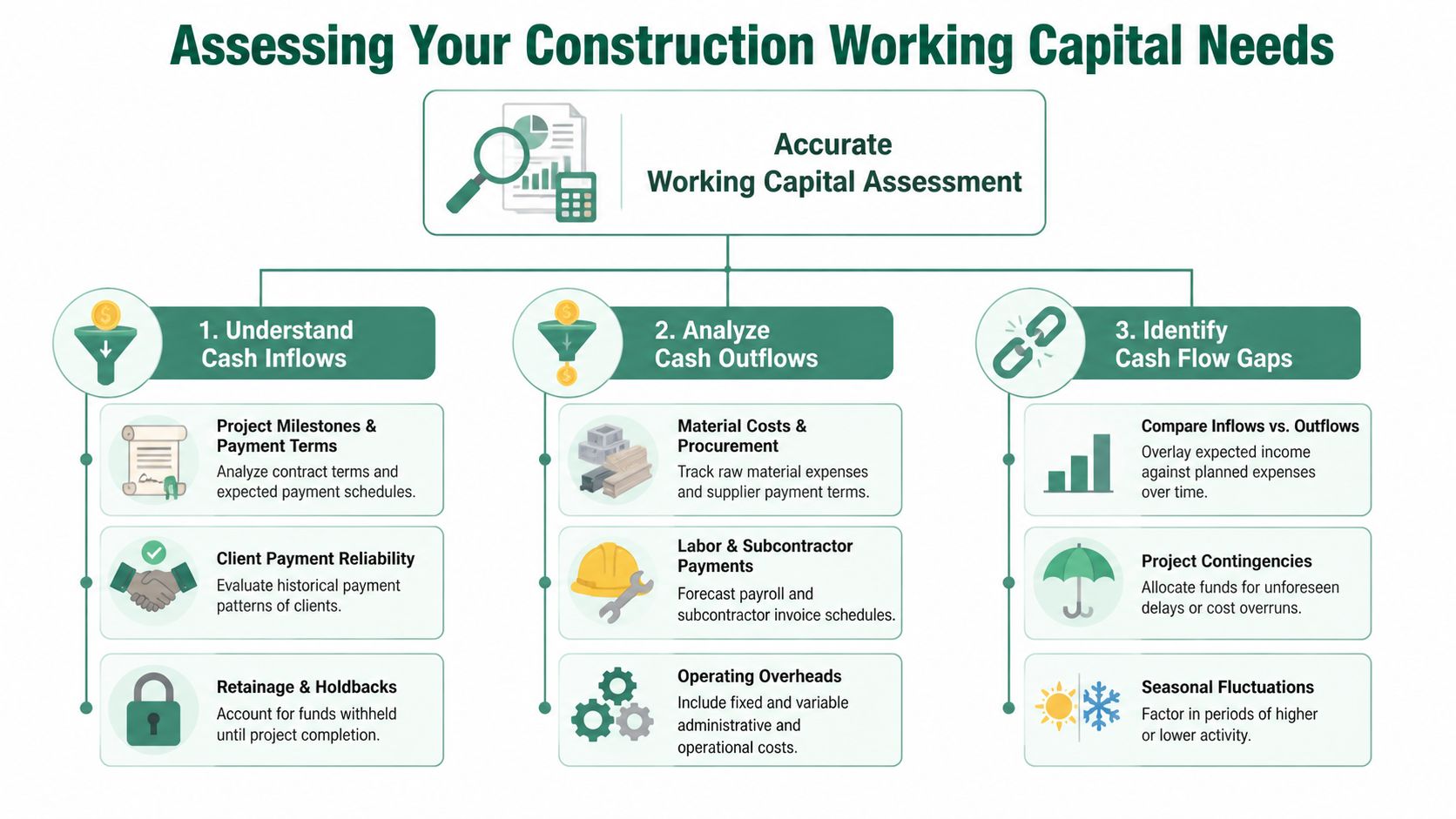
In the UAE, this matters even more because the sector's cycle worsened in 2023, with a 15% increase in Days Inventory Outstanding to around 107 days and a 2% deterioration in Days Sales Outstanding to about 87 days (PwC Middle East working capital study).
Start with the three numbers that actually matter
You don't need a complicated model to get useful answers. Track these first:
- DSO or Days Sales Outstanding: How long it takes clients to pay after you invoice.
- DIO or Days Inventory Outstanding: How long materials, stock, or project-linked inventory sit before being used or converted.
- DPO or Days Payables Outstanding: How long you take to pay suppliers.
These three numbers tell you where your cash is being held. In construction, DSO often gets the attention, but DIO can become a major issue when materials are bought early, projects stall, or procurement is not aligned to site progress.
A simple way to assess your position
Take one live project, not the whole company, and review it in order.
- Map your inflows
List contract milestones, expected invoice dates, certification requirements, and realistic payment dates. Use realistic dates, not hopeful ones. - Map your outflows
Add labour, subcontractor bills, materials, transport, equipment hire, and overhead tied to that same period. - Mark holdbacks
If part of an invoice is certified later, disputed, or tied to final sign-off, treat that money as unavailable. - Compare timing, not just totals
A project can look profitable overall and still create a cash hole for months. - Repeat this monthly
Construction cash flow changes fast. A delayed approval this month can create a supplier problem next month.
The strongest project forecast isn't the one with the nicest spreadsheet. It's the one that reflects what the client actually pays, when the site actually consumes material, and how long approvals really take.
What a high DSO or DIO really means in practice
A high DSO doesn't just mean money is late. It means your cash is doing nothing while your business still has to operate. You may delay purchases, stretch payables, or avoid taking on a profitable project because the earlier one hasn't converted to cash.
A high DIO creates a different problem. You already paid for stock, but the site hasn't turned it into billable progress yet. In practical terms, your money is sitting in a yard, warehouse, container, or partially mobilised job.
This is why estimating quality matters more than many owners think. Better forecasting improves buying discipline before the cash leaves your account. If your estimating team still relies on rough spreadsheets and inconsistent assumptions, a tool like Exayard construction estimating software can help bring more structure to job costing and procurement planning.
A quick self-check for SME owners
Ask these questions about your last three projects:
- Did invoicing slip? If milestone billing went out late, the payment delay probably started inside your business.
- Did procurement run ahead of need? Buying too early often inflates DIO.
- Did supplier terms match client terms? If you pay in weeks and collect in months, the gap is built in.
- Did one project fund another? That's common, but it hides which contract is really draining liquidity.
If you want a cleaner method for the maths behind this, this breakdown of how to calculate working capital gives a useful formula-led view.
Comparing Modern Capital Solutions for Construction
Once you've identified where cash gets stuck, the next step is choosing the right tool for that specific blockage. Many contractors then make expensive mistakes. They use one broad facility for every problem, even when the cash issue is tied to a particular invoice, a procurement cycle, or equipment-heavy operations.
The better approach is to match the solution to the moment in the project.
Invoice discounting
This works when you've already delivered work, the invoice is approved or moving through a clear payment process, and you're waiting to be paid.
In plain terms, invoice discounting helps you release cash tied up in receivables instead of waiting through the full payment cycle. For a contractor, this is often most useful after a milestone certificate is accepted but before the buyer settles.
Best fit scenarios include:
- Certified project milestones
- Large receivables from reputable buyers
- Periods when site costs continue before collections arrive
For contractors evaluating this route, Comfi's invoice discounting product is one example of a receivables-based option in the UAE market.
B2B buy now pay later
This is useful earlier in the cycle, when you need materials or business purchases now but want to spread payment over agreed terms.
Think of it as using structured supplier terms more intelligently. Instead of paying immediately for procurement, you preserve cash while keeping the project moving. In construction, that can help when procurement must happen before your client payment lands.
Where it fits best:
- Material purchases for confirmed work
- Urgent replenishment without draining operating cash
- Situations where supplier relationships matter and prompt supplier payment helps
Preparing Your Business for Fast Application and Integration
Speed only helps if your records are clean.
I've seen many construction SMEs assume that digital access means instant approval regardless of their internal data. It doesn't. Modern platforms move quickly when your documents, invoicing trail, and buyer records are organised. If they're scattered across email chains, WhatsApp messages, and half-complete spreadsheets, the delay starts inside your own business.
What to prepare before you apply
Keep a digital folder ready with the basics most platforms will ask for:
- Trade license and company documents: Make sure the latest versions are valid and easy to upload.
- Recent bank statements: These help show operating activity and payment patterns.
- Outstanding invoices: Use invoices that are complete, accurate, and linked to real delivery.
What slows the process down
Most delays come from avoidable issues, not from the platform itself.
- Mismatched documents: The contract says one buyer name, the invoice shows another, and the bank statement shows a third variation.
- Unclear invoice status: Your team says an invoice is approved, but there is no evidence of certification or buyer confirmation.
- Fragmented records: Operations holds the completion note, finance has the invoice, and commercial holds the purchase order.
- Manual dependency: One person in the office knows where everything is. If they're unavailable, the process stops.
Field lesson: Treat invoice readiness the same way you treat site readiness. If the paperwork is incomplete, the next stage slows down.
Digital integration matters more than people think
A paper-heavy bank process often asks you to re-explain the business every time. A modern digital workflow is different. You upload once, keep records current, and reduce repeated back-and-forth. If your ERP, invoicing system, or accounting tool can connect through an integration or API, your finance team spends less time reformatting data and more time managing cash decisions.
This also improves control after setup. You can monitor which invoices are submitted, which buyers are moving slowly, and where cash is likely to be released next. That visibility matters just as much as speed.
A practical readiness standard
Before using any working capital tool, check whether your business can answer these questions in minutes, not days:
- Which invoices are approved and still unpaid?
- Which buyers pay predictably and which ones drift?
- Which projects are cash-negative this month even if profitable overall?
- Can finance retrieve the full invoice pack without asking three departments?
If the answer is no, fix the data flow first. The fastest application is usually built on the slow work of getting your internal discipline right.
Measuring the Impact on Your Cash Flow and Growth
The true test isn't whether you accessed cash. It's what changed after that.
Consider a fictional example. ABC Contracting is a UAE subcontractor doing decent work, winning repeat orders, and constantly under pressure between milestone billing and supplier payments. The business isn't failing. It's just always one payment cycle behind its own workload.
Before the change
ABC finishes a certified package on one project and issues the invoice. Payment won't land soon enough to cover material orders for a new opportunity. The owner has two choices: slow down procurement and risk losing the next job, or stretch supplier relationships and create stress across the operation.
This is the part many owners know too well. The business can see growth in front of it, but can't touch it because cash is still locked in yesterday's work.
After using receivables more strategically
ABC starts treating approved invoices as operational tools rather than passive paperwork. Instead of waiting the full cycle, it frees up part of that trapped value and uses the cash to secure materials for the next project, keep subcontractor payments orderly, and bid without panic.
Nothing magical happened. The company didn't become a different business overnight. It shortened the delay between delivering value and using that value to keep growing.
That matters because for UAE construction firms, research found a negative and significant relationship between Net Trade Cycle and profitability, confirming that shorter cash conversion cycles directly boost returns on assets (SSRN study on UAE construction profitability and NTC).
What to measure after implementation
Don't stop at "cash arrived". Track the operational effect.
- Bid capacity: Were you able to take on work you would have declined before?
- Supplier stability: Did payment behaviour improve enough to preserve trust and terms?
- Invoice velocity: Are receivables moving through approval and collection with more control?
- Project continuity: Did fewer jobs stall because one payment came in late?
- Management focus: Is your finance team spending less time firefighting and more time forecasting?
Shorter cycles don't just improve liquidity. They give owners room to make better decisions instead of urgent ones.
The growth signal to watch
The strongest sign that your working capital setup is improving is not just a calmer bank balance. It's confidence in forward planning.
When a business can buy materials at the right moment, pay critical parties on time, and pursue new work without destabilizing current projects, growth becomes more deliberate. That's the point of improving construction company working capital UAE strategy. Not to chase cash for its own sake, but to remove timing friction that keeps a good contractor playing smaller than its actual capability.
Frequently Asked Questions
Is invoice discounting the same as a loan
No. It is generally tied to your receivables, meaning cash is released against invoices you've already issued for completed work. In practice, that makes it different from taking a general-purpose loan based only on balance sheet borrowing capacity.
How quickly can a construction SME get set up
That depends mostly on document quality and internal readiness. If your trade documents, invoice pack, buyer details, and proof of completion are organised, digital onboarding can move far faster than a traditional paper-heavy process. If records are inconsistent, setup slows down quickly.
Will a smaller contractor qualify if a bank has already said no
In many cases, eligibility for receivables-based solutions isn't assessed in the same way as a conventional bank facility. Providers may look closely at the invoice, the buyer, and the supporting documentation. That can make these tools more accessible for SMEs that are operationally sound but don't fit a bank's usual credit profile.
If your construction business keeps delivering work but cash still feels stuck, Comfi is one option to explore. It offers receivables-based products and digital workflows that can help UAE SMEs release cash tied up in invoices and reduce payment-cycle pressure without relying on a traditional loan process.
Related Reading
- How Can MENA SMEs Master Working Capital?
- Staffing Agency Payroll Financing UAE: Boost Cash Flow 2026
- SME Cash Flow Management: A Guide for MENA Businesses
- Improve Working Capital for UAE IT Services Business
Ready to improve your business cash flow? Get started with Comfi today.