What Is Average Order Value and How B2B Businesses Can Improve It

Ever wondered what a typical sale at your checkout really looks like? That's your Average Order Value (AOV) in a nutshell. It's a simple yet powerful metric for your business, telling you exactly how much your clients spend in a single transaction.
This one number provides significant insight into their buying habits and whether your sales and marketing efforts are hitting the mark. A clear understanding of AOV is the first step toward strategically increasing your revenue per customer.
What Average Order Value Tells You
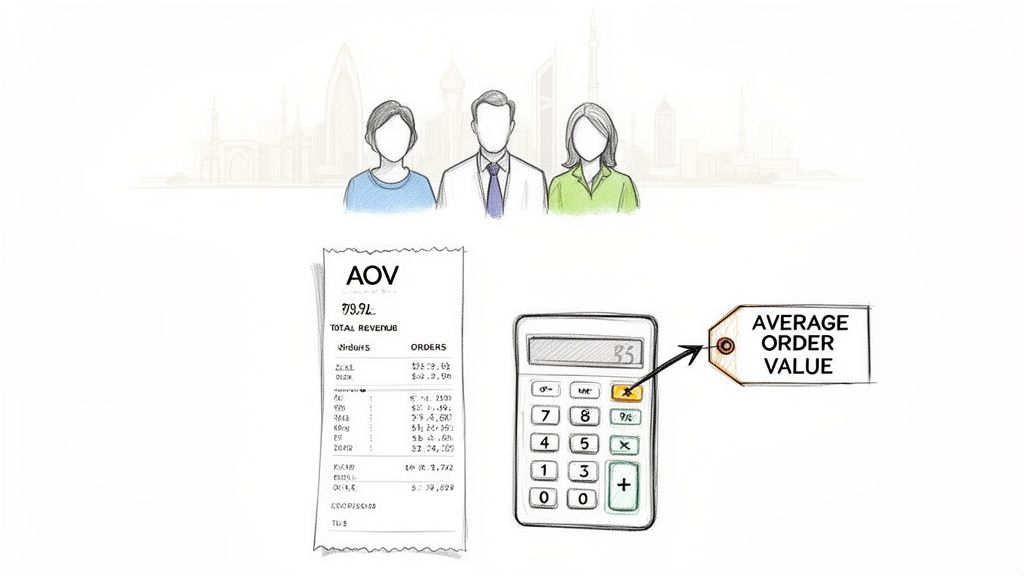
The calculation is straightforward: divide your Total Revenue by the Number of Orders. But don't let that simplicity fool you. For B2B suppliers and wholesalers, a rising AOV is a fantastic sign. It means each sale is becoming more profitable, which directly improves your cash flow and creates new opportunities for growth.
Think of it as a clear signal from the market. It tells you if your pricing, product bundles, and special offers are truly resonating with your clients. To really get a handle on it, it's worth understanding the AOV meaning marketing professionals rely on to drive e-commerce growth. Tracking this key performance indicator (KPI) is how you measure the health of your customer relationships and their long-term value.
Why AOV Is More Than Just a Number
Keeping a close eye on your average order value is fundamental to making smart, informed business decisions. If your AOV is consistently low or starting to dip, it’s a warning sign that something needs a closer look. On the other hand, steady growth confirms your strategies are paying off.
Here’s what AOV reveals about your business:
- Customer Purchasing Behavior: It shows you how much capital your clients are willing—and able—to commit in one go.
- Strategy Effectiveness: A rising AOV is proof that your upselling, cross-selling, and product bundling tactics are working.
- Profitability Insights: A higher AOV almost always leads to better profit margins. You're making more money from the customers you already have without increasing acquisition costs.
Ultimately, a strong AOV helps you forecast revenue with more confidence and build a more resilient business. If you're looking to better manage your incoming funds, check out our guide on best payment gateways in the UAE.
By offering your clients flexible payment solutions, like Comfi’s Buy Now, Pay Later, you help them overcome their own budget hurdles. This makes it easier for them to say "yes" to the larger, more frequent orders you're aiming for.
Why AOV Is a Critical Metric for MENA Suppliers
For any small or medium-sized supplier in the UAE and across the MENA region, monitoring your Average Order Value isn't just good practice—it's essential for survival and growth. Think of it as a financial health check. This single metric helps you make smarter, data-backed decisions on everything from managing warehouse inventory to setting ambitious yet achievable sales targets.
In a fast-paced market where digital adoption is soaring, a healthy AOV is a clear signal that you’re maximizing the value of every customer transaction. Tracking this metric over time lets you spot opportunities and threats as they emerge. For instance, if your AOV is steadily climbing, it's a great indication that your upselling strategies are effective.
Conversely, a sudden drop could be an early warning that a competitor is undercutting prices or that your customers' spending power has diminished. AOV serves as a direct pulse check on your business, guiding you toward strategies that build your bottom line.
The Regional AOV Advantage
The UAE’s booming e-commerce scene is a perfect example of why this metric matters so much. The average order value for online purchases in the country recently hit an impressive USD 102, which significantly surpasses the wider Middle East regional average of just USD 35.6.
This jump, fueled by higher discretionary spending, shows just how much economic growth and digital habits are changing the landscape. For SMEs like automotive parts dealers or electronics distributors, this higher AOV translates directly into larger deal sizes and much healthier cash flow. You can get a fuller picture of these trends by checking out the latest insights on the Middle East e-commerce industry from Grandview Research.
By embracing flexible payment solutions, you can empower your clients to place larger orders without straining their cash flow. This creates a win-win scenario where their business grows, and your average order value increases as a direct result.
How to Actually Measure and Analyze Your AOV
Knowing your Average Order Value is one thing, but truly understanding it is where the opportunity lies. While the simple Total Revenue ÷ Number of Orders formula gives you a starting point, the real insights emerge when you start segmenting that data. This is how you turn a basic metric into a powerful strategic tool.
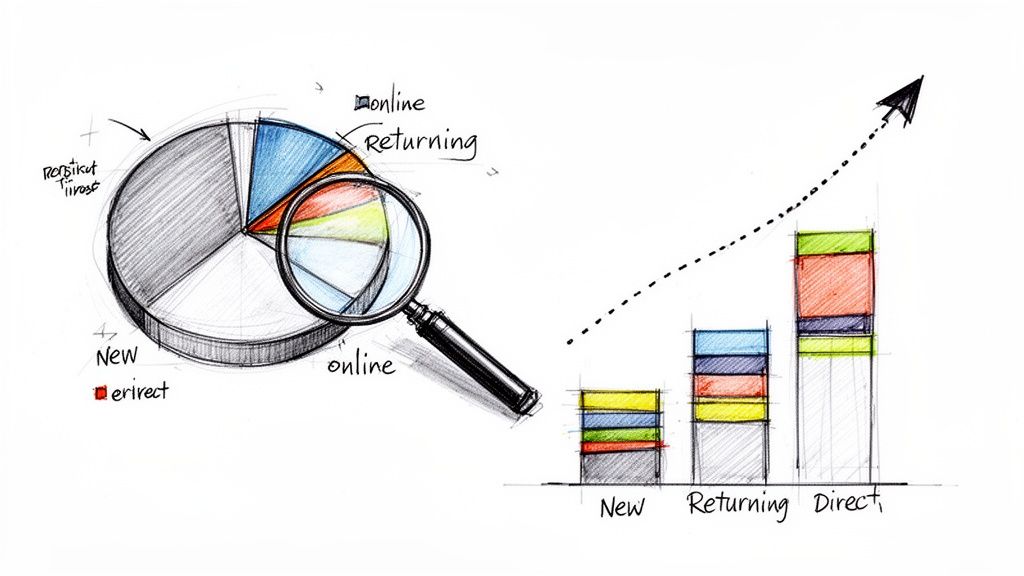
By digging a little deeper into your AOV, you can see exactly what’s driving bigger purchases and which customers are your most profitable. This lets you focus your energy and resources where they’ll make the biggest impact.
Key Segments to Look At
To get started, break your business down into smaller components and see how the AOV for each one compares to your overall average. This immediately shows you who your champions are and where you have room to grow. A detailed analysis like this is a core part of improving financial efficiency, just as understanding your accounts receivable turnover ratio is essential for managing cash flow.
Here are a few critical segments you should be tracking:
- Customer Groups: Calculate AOV separately for new vs. returning customers. You’ll often find that returning clients spend more per order because you’ve already earned their trust.
- Sales Channels: Is the AOV from your B2B e-commerce site different from orders placed by your direct sales team or distributors? This can tell you which channel is best at securing high-value orders.
- Product Categories: Pinpoint which product lines consistently achieve a higher AOV. That’s a huge clue for what you should be stocking and promoting.
- Time Periods: Track your AOV during different seasons or sales events. This shows you how your promotions are really affecting buying habits.
By consistently tracking these segmented AOV figures, you can spot trends early, identify your most valuable customers, and make data-driven decisions that lead to sustainable growth and healthier profit margins.
This detailed view turns raw numbers into an actionable roadmap. From there, you can start tailoring everything—from marketing campaigns to payment options—to encourage larger orders across your entire customer base.
Proven Strategies to Increase Your Average Order Value
Turning insights into action is where real growth happens. It's one thing to track your average order value; it's another to actively make it grow. The right strategies can gently nudge your B2B clients toward placing larger orders, transforming your AOV from a dashboard metric into a powerful growth engine. The idea is simple: add more value to every transaction, creating a win-win for both you and your customer.
Implementing a few core techniques can make a surprisingly big difference. Think of these as the fundamental plays in your AOV-boosting playbook, each designed to make bigger purchases a more attractive and logical choice for your buyers.
Foundational AOV-Boosting Tactics
Simple adjustments to how you sell can deliver impressive results. You don't need to reinvent the wheel; just start by exploring these powerful methods:
- Product Bundling: This is a classic for a reason. Combine complementary items into a convenient package. For an automotive parts supplier, this could mean bundling brake pads with rotors and calipers at a slight discount. It’s convenient for the buyer and a bigger sale for you.
- Volume Tiers: Reward your best customers for buying in bulk. An electronics distributor, for instance, might offer a 5% discount on orders of 50+ units and increase that to 10% for orders of 100+ units. This incentivizes a larger upfront commitment.
- Upselling and Cross-Selling: It's all about making helpful suggestions. Encourage clients to choose a more advanced product (the upsell) or add related items to their cart (the cross-sell). Suggesting premium cables to go with a high-end monitor is a perfect example of a smart, value-add cross-sell.
One of the easiest wins is setting a minimum purchase amount to qualify for perks like free shipping. That small nudge is often all it takes to persuade a buyer to add just one more item to their cart to hit the threshold.
Market trends in the MENA region highlight the potential here. During Ramadan, for example, the UAE hit the highest average online order value in the entire Middle East, largely driven by seasonal demand and strong mobile shopping habits. This trend shows a massive opportunity for B2B suppliers, especially when flexible payment solutions remove cash-flow barriers for buyers looking to stock up. You can discover more insights about regional e-commerce growth on ystats.com.
For a deeper dive into boosting this critical metric, check out this fantastic guide on How to Increase Average Order Value: A UK Merchant's Playbook. By strategically applying these tactics, you can systematically lift your AOV and build a much stronger financial foundation for your business.
How Flexible Payments Supercharge Your AOV
One of the surest ways to encourage customers to place bigger orders is to remove their single biggest roadblock: cash flow constraints. For most B2B buyers, the decision to hold back isn’t about a lack of need—it’s about a lack of available funds. This is where modern payment solutions can completely change the game.
When you offer flexible terms, like Buy Now, Pay Later for business, you give your clients the power to buy what they actually need, not just what their bank balance allows for today. Suddenly, they can secure more inventory or upgrade to premium products and pay over 30, 60, or even 90 days. Their order size naturally grows because you've solved their core problem.
A Win-Win for You and Your Customers
A platform like Comfi makes this incredibly simple. You get paid upfront—which means your cash flow is secure and your risk is eliminated—while your customer gets the breathing room they need to grow their business. It’s a powerful advantage that translates directly into a higher AOV and builds serious long-term loyalty.
The strategies in this flowchart are all amplified when you add flexible payment options into the mix.
Upselling, cross-selling, and bundling all become much easier conversations when the buyer isn’t worried about an immediate cash crunch.
The impact can be massive. During the pandemic-driven e-commerce boom, the UAE market’s AOV hit an incredible USD 695.241, proving just how high order values can climb. While things have normalized, the current AOV of USD 102 is still well above the MENA average. For regional SMEs, predictable liquidity allows them to chase these larger sales. In fact, Comfi clients have seen sales jump by up to 30% just by offering 30/60/90-day terms while still getting paid immediately. You can see more UAE e-commerce transaction data on ceicdata.com.
At the end of the day, integrating flexible payment plans isn’t just a nice-to-have feature at checkout. It's a core growth strategy that unlocks your customers’ true purchasing power.
Your AOV Questions, Answered
Let's tackle a few common questions B2B owners and finance managers usually have about average order value and how to get it moving in the right direction.
What’s a Good AOV for a B2B Business Anyway?
There’s no magic number here. A “good” AOV is completely relative to your industry. A wholesaler shipping high-end industrial machinery will naturally have a much higher AOV than a distributor selling office supplies. The comparison is not useful.
Instead of getting hung up on an industry benchmark, the smartest move is to benchmark against yourself. Focus on achieving steady, quarter-over-quarter growth. A consistently rising AOV is the clearest sign that your sales strategies and customer value initiatives are working.
How Does Offering “Buy Now, Pay Later” Actually Increase My AOV?
Buy Now, Pay Later (BNPL) directly addresses the biggest reason your customers hesitate to place larger orders: cash flow. When buyers know they can defer payment for 30, 60, or even 90 days, they gain the confidence to buy in bulk or upgrade to premium product lines, as clients can unlock their working capital.
This financial breathing room allows them to get what they need, right when they need it, which naturally bumps up the average order value for your business. With solutions like Comfi, you still get paid right away, so you see the benefit without taking on any risk.
Will Chasing a Higher AOV Damage My Customer Relationships?
Not if you approach it strategically. The most effective ways to increase AOV are the ones that deliver genuine value to your buyers.
Think about it: creating useful product bundles, offering better pricing for volume purchases, and providing flexible payment terms are all strategies designed to help your customers’ businesses run more smoothly. These moves show that you understand their challenges and are invested in their success, which is a surefire way to strengthen your relationships, not damage them.
Ready to give your customers the flexibility they need and watch your AOV climb? With Comfi, you can offer flexible 30, 60, or 90-day payment terms to your B2B clients while you get paid upfront within 24 hours. Learn how you can unlock growth today.