3PL Payment Terms UAE Your Guide to Cash Flow & Growth


Orders are coming in. Your sales team is happy. Your warehouse partner is moving stock. Then the invoice lands, and a key question emerges: who gets paid first, and from what cash?
That’s where 3PL payment terms UAE becomes more than contract wording. For most SMEs in Dubai, the pressure isn’t demand. It’s timing. Customers often pay on one cycle, marketplaces settle on another, and your 3PL expects payment on its own schedule. If those rhythms don’t line up, growth starts to feel expensive instead of exciting.
A lot of owners focus on freight rates, pick fees, and storage charges. Those matter. But payment terms often decide whether your business can keep reordering, keep marketing, and keep delivering without draining cash reserves. A cheap headline rate with awkward terms can hurt more than a slightly higher rate with a cleaner invoice cycle.
That’s why this topic deserves a practical lens, not a legal one. If you’re trying to grow in Dubai, your 3PL terms should support sales velocity, not choke it. The cash flow issues logistics businesses face are similar to the pressure covered in this guide on managing logistics company cash flow in the UAE, but for suppliers and wholesalers the problem usually starts with one contract and one missed assumption about when cash leaves the account.
The Hidden Brake on Your Business Growth
Growth rarely fails because the order volume is too high. It fails because the business has to fund that volume before it collects enough cash back.
A 3PL invoice is one of the clearest examples. Your provider stores the stock, picks the orders, hands them to last-mile couriers, and bills on a schedule that may not match your receivables. If your buyers settle later than your logistics bills fall due, you end up financing your own growth from working cash.
That’s the hidden brake. Not the operational cost itself. The timing mismatch.
Where the pressure starts
For a Dubai SME, the pattern is familiar:
- Sales expand first: More orders mean more handling, more delivery volume, and more replenishment pressure.
- Costs move immediately: Warehousing and fulfilment costs don’t wait for your customer to pay.
- Cash arrives later: If your customer terms stretch beyond your 3PL terms, the gap lands on your balance sheet.
- Management gets cautious: The business starts delaying stock purchases, trimming ad spend, or saying no to larger deals.
None of that shows up in a basic quote comparison.
Practical rule: Don’t assess 3PL terms as an admin detail. Assess them as a cash conversion issue.
Many businesses only realise this after they’ve signed. They negotiate hard on storage and delivery rates, then accept a payment structure that subtly locks up liquidity every month. Once volume rises, the same terms that felt manageable at low order levels become restrictive.
What actually works
The businesses that handle this well usually do three things early:
- Map customer inflows against 3PL outflows
- Push for transparent billing cycles
- Treat payment terms as a growth lever, not a back-office detail
If you do that, you can decide whether a term is workable before it starts creating pressure. If you skip it, every new order can make the cash position tighter.
Decoding Common 3PL Payment Terms in the UAE
Most 3PL contracts use familiar terms. The problem is that familiar doesn’t mean harmless. The wording can sound simple while the bank account impact is anything but.
Here’s the easiest way to read these terms: don’t ask what they mean legally. Ask when cash leaves your account.
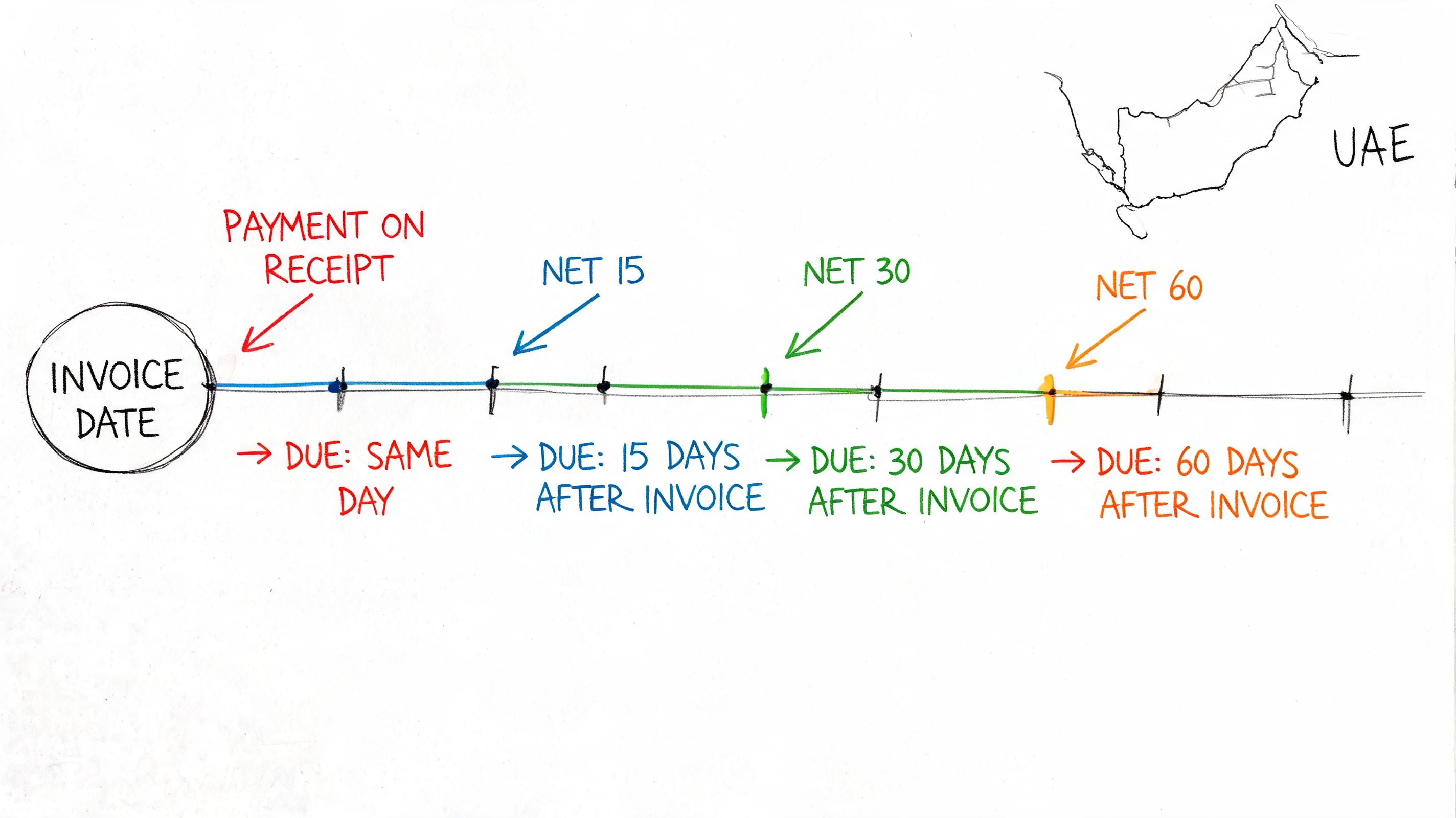
A useful companion to this is understanding the broader idea of a credit period in business payments, because 3PL terms are just one part of that wider timing puzzle.
Payment on receipt
This is the tightest structure. The invoice arrives and payment is expected immediately or very quickly.
For an SME, that gives the provider certainty but puts the burden on your own cash reserves. It can work if your customer collections are fast and predictable. It becomes painful if your receivables are uneven.
Net 15
This is often the most workable middle ground for e-commerce fulfilment in Dubai. You receive the invoice, and payment is due within 15 days.
It sounds short because it is short. But it also keeps the commercial reality clear. The provider gets paid fast enough to avoid building financing cost into the service rate, and you still get a defined payment window rather than an immediate hit.
Net 30
This is common and often presented as generous. Sometimes it is. Sometimes it merely delays the pain without improving the economics.
What matters is this: Net 30 doesn’t mean your cost disappears for 30 days in operational terms. The services have already been delivered, and your cash planning still needs to account for them. If your own buyers pay later than that, the mismatch remains.
Net 60 and beyond
Longer terms can help a buyer conserve cash in the short run. They can also come with trade-offs that aren’t obvious at proposal stage.
Providers often compensate for slower inflows by protecting their margin somewhere else. That may show up in higher variable rates, stricter conditions, or less flexibility when issues arise.
Longer terms can feel helpful in month one and expensive by month six.
What to ask yourself before accepting any term
- Does this term match how quickly my customers pay me
- Is the billing date clear, or is it open to interpretation
- Are there penalties for late payment
- Will the provider price differently because of the payment window
- Can I survive a seasonal spike under this cycle
If you can’t answer those clearly, the term isn’t really understood yet.
Typical 3PL Fee Structures and Billing Cycles
Before you negotiate payment terms, you need to know what the invoice is built from. Most UAE 3PL invoices are not one fee. They’re a stack of variable charges, and each one scales with activity.
What usually appears on the invoice
A typical structure includes:
- Storage fees: Usually charged by space used, often per CBM or pallet over a monthly cycle.
- Pick-and-pack fees: Charged per order, and sometimes shaped by complexity.
- Last-mile delivery: The transport charge that usually becomes the biggest line item for active e-commerce sellers.
- Additional service fees: Returns handling, inspections, relabelling, peak season surcharges, or other operational extras.
For a concrete Dubai example, a typical SME with 8 CBM of inventory and 200 orders a month can expect an all-in 3PL cost of AED 7,080 before 5% VAT, made up of AED 680 storage at AED 85 per CBM, AED 600 pick-and-pack at AED 3 per order, and AED 5,800 last-mile delivery at AED 29 per shipment, according to SamVertex’s Dubai 3PL pricing breakdown.
That same source notes that leading fulfilment providers often offer 15-day payment terms on a monthly invoice, and positions shorter terms as a way to keep pricing more transparent rather than hiding the cost of delayed payment inside higher service rates.
Why billing cycles matter as much as rates
A lot of SMEs focus only on unit cost. That’s incomplete. Billing design changes behaviour.
If the charges are mostly variable, your invoice rises directly with order volume. That’s good for flexibility because you’re not trapped in heavy fixed overhead during slower months. It also means growth can create a cash squeeze very quickly if the payment cycle is too tight.
Operator’s view: Variable pricing is useful when it scales cleanly. It becomes dangerous when the invoice cycle is shorter than your collections cycle.
That’s why invoice design and warehouse design often go together. If you’re evaluating future expansion, this piece on planning flexible storage for logistics is worth reading because space configuration affects how storage and handling costs evolve as volume changes.
What to inspect before you sign
Use the invoice structure itself as a checklist:
- Storage basis: Is it clearly charged per CBM, pallet, or another unit?
- Order handling logic: Is pick-and-pack charged per order, per item, or by exception?
- Delivery charging: Is last-mile billed per shipment with any conditional extras?
- Billing frequency: Monthly billing is common, but the exact cut-off date matters.
- Fee language: If a line item isn’t defined well, it can become a dispute later.
If you want to sharpen this review, it also helps to understand how a processing fee affects transaction economics, especially when multiple service charges stack on one customer order.
Navigating 3PL Contracts and Legal Considerations
The quote gets attention. The contract decides what happens when operations get messy.
That’s why I treat the 3PL agreement as a financial protection document first and an operations document second. If the contract is vague, the provider has room to invoice loosely, interpret service failures generously, and push unexpected charges through at the worst time.
Pricing clauses need precision
In the UAE, 3PL contracts must detail pricing and payment clauses, and that matters because monthly charging often combines several operational units on one invoice. If those units aren’t defined properly, your finance team ends up debating every billing period instead of approving cleanly.
The strongest contracts don’t just list categories. They spell out how each fee is triggered, how it is measured, and when it is billed.
Look for clear language around:
- Storage charging method
- Order handling fees
- Delivery billing basis
- VAT treatment
- Invoice issue date and due date
- Dispute windows
According to Third Person’s guidance on 3PL contracts in the UAE, SMEs should ensure all potential charges are itemised, including returns fees and peak surcharges, and include a clause allowing disputes within 7 days of invoicing.
SLAs are not optional
A service level agreement is where commercial protection becomes real. If payment terms are strict but service expectations are soft, you’re carrying too much risk.
That same guidance highlights the importance of tying payments to performance metrics such as 99% order accuracy, with enforceable penalties for failures. In practice, this means your contract should say what happens if the provider misses agreed standards. It shouldn’t rely on goodwill.
If a provider wants disciplined payment, you should want disciplined performance.
Useful SLA clauses often cover:
- Order accuracy
- Dispatch timing
- Returns turnaround
- Inventory variance handling
- Credit or discount remedies for service failure
Longer terms can hide a higher total cost
There’s another legal and commercial point many SMEs miss. Extended terms are common, but they are not neutral.
Third Person notes that Net 30 to Net 60 terms often increase total variable rates by up to 15% compared with Net 15 benchmarks because providers price in their financing burden. That means a contract can look more flexible on timing while becoming more expensive on the actual unit economics.
So don’t ask only, “Can I pay later?” Ask, “What does paying later cost me across the full contract?”
A clean agreement does three things at once. It defines fees precisely, links payment to measurable service delivery, and leaves very little room for surprise invoicing.
The Hidden Cash Flow Risks SMEs Often Overlook
Most SMEs think the main risk is paying too early. That’s only one part of the problem.
The deeper risk is assuming your 3PL partner’s pricing and operating model are stable just because the contract says they are. In reality, a provider can be under pressure long before it becomes visible to customers.
The published rate is not the whole story
A provider that offers attractive pricing under a multi-year contract still has to absorb real operating costs every month. If those costs rise and the contract doesn’t adapt, pressure builds somewhere.
That pressure usually shows up in one of four places:
- Service quality slips: Orders go out less cleanly, more slowly, or with weaker exception handling.
- Renegotiation starts mid-term: The provider reopens a deal you thought was settled.
- Operational focus narrows: Lower-value clients may get less attention.
- The relationship destabilises: In the worst case, the provider cannot sustain the contract.
Labour inflation is a real contract risk
One issue that doesn’t get enough attention in UAE 3PL discussions is labour cost inflation. A critical risk flagged in the UAE 3PL market is provider instability driven by rising wage costs. Recent federal labour reforms have increased 3PL wage bills by up to 12%, while many contracts still lock pricing for long periods, according to Mordor Intelligence’s UAE 3PL market analysis.
That combination matters. Fixed pricing sounds safe for the buyer, but it can weaken the provider over time if margin gets squeezed. Once that happens, the SME client is exposed even if it has paid every invoice on time.
A weak 3PL partner is a finance risk, not just an operations risk.
What buyers should watch for early
You won’t always see provider stress in a formal notice. You’ll usually see it in behaviour first.
Watch for signals like:
- Response times getting slower
- More debate over small charges
- Greater resistance to SLA credits
- Repeated requests to review commercial terms
- Service inconsistency during busy periods
These signs don’t automatically mean failure is coming. They do mean you should review dependency, backup options, and contract protections before the issue becomes urgent.
A lot of SMEs focus heavily on customer concentration risk and ignore logistics partner concentration risk. That’s a mistake. If one provider holds too much of your fulfilment operation and that provider becomes unstable, your sales pipeline won’t matter much.
How to Negotiate Better 3PL Payment Terms
Better terms usually go to the customer who asks clearly, documents expectations well, and looks operationally organised. A lot of SMEs lose their advantage because they negotiate late, vaguely, or only on price.
You’ll get better results if you approach payment terms as part of the operating model, not as an afterthought during contract review.
Start in the RFP, not at the end
If you wait until final contract markup to discuss payment structure, the provider has already priced and scoped the deal around its own assumptions.
Put your requirements in writing from the start. Practical wording can be simple:
- Ask for a Net 30 maximum: If the provider can’t agree, ask it to explain how billing works during high-volume months.
- Request a deposit option: A phrase such as “50% deposit on dispatch” can create flexibility without leaving the provider exposed.
- Require itemised extras: Say that returns fees, peak surcharges, and exceptional handling must be listed separately.
This does two things. It forces a clearer proposal, and it shows the provider that your finance function pays attention.
Negotiate the whole package
Payment terms don’t sit alone. They interact with pricing, service commitments, volume expectations, and contract length.
That means you have options beyond merely asking for more days. You can trade across issues:
- Offer forecasting discipline in exchange for cleaner billing treatment.
- Accept a shorter review cycle if you want tighter control over changing rates.
- Tie improved terms to performance consistency so both sides have something to protect.
- Use faster approvals internally as a bargaining chip if your provider values predictable collections.
The strongest negotiation position is not “we want more time”. It’s “we are a predictable customer, and the contract should reflect that”.
Check for red flags in the payment clause
Before signing, review the wording with the same seriousness you’d give a customer contract. If you want a practical checklist, this guide on how to spot contract payment red flags is useful because it highlights the types of wording that create disputes later.
Pay particular attention to:
- Undefined extra charges
- Automatic rate changes
- Weak dispute rights
- Late fee language that triggers too quickly
- Service obligations that are vague while payment obligations are strict
A fair 3PL contract protects both sides. If the payment language is precise and balanced, you’ll spend less time arguing and more time moving goods.
Bridging the Gap with Modern Fintech Solutions
Some payment problems should be negotiated. Others should be engineered out of the workflow.
That’s where modern fintech tools change the conversation. Instead of forcing your business to live inside whatever timing mismatch the contract creates, you can build a payment structure around how your cash actually moves.
Where fintech like Comfi helps most
There are three pressure points where SMEs usually need support:
- Customer invoices are outstanding, but 3PL invoices are due
- Buyers want terms, but the supplier needs immediate cash flow
- Inventory is sitting in stock, and cash is trapped inside it
Modern platforms can help businesses release working capital from those points without forcing the operations team to slow down fulfilment.
If you sell to business buyers, extended payment options at checkout or during invoicing can support sales while keeping your own cash flow more predictable. If your challenge is receivables timing, invoice-based tools can turn approved invoices into immediate liquidity so logistics bills don’t squeeze the month. For automotive businesses, tools linked to in-stock vehicles can release cash tied up in inventory so warehousing and distribution expenses don’t freeze the next purchase cycle.
This is about control, not just convenience
The true value isn’t just faster payment. It’s control over timing.
Once you can separate customer payment timing from supplier payment timing, your 3PL contract stops dominating your cash position. You can choose the provider that operates well, negotiate from a position of strength, and keep logistics moving even when receivables are slower than expected.
This matters even more in sectors with layered payment complexity. Businesses dealing with variable payment channels and approval flows can learn something from broader payment strategies for high-risk merchants, because orchestration thinking helps reduce friction across multiple counterparties, not only in high-risk categories.
Good payment infrastructure doesn’t remove logistics cost. It removes the cash timing strain around that cost.
The practical result is simple. You stop treating 3PL invoices as emergencies and start treating them as scheduled operating outflows that fit a larger growth plan.
If your business is growing faster than your cash cycle can comfortably support, Comfi can help you access working capital from invoices, buyer payment terms, and automotive inventory so you can pay suppliers on time, reduce cash-flow bottlenecks, and keep scaling with more confidence.
Related Reading
- How Comfi’s B2B Buy Now Pay Later Solution Enhances Cash Flow for Businesses in the UAE
- How Can MENA SMEs Master Working Capital?
- Deferred Payment for Business Purchases UAE: A Guide 2026
Looking to improve your cash flow? Explore Comfi's Buy Now Pay Later and Invoice Discounting solutions. Get started today.