Rejected Loan Approval? A Guide for SMEs on What to Do Next

.webp)
A "rejected approval" notification is a frustrating setback, especially when you’re counting on that capital to grow your business. If this has happened to you, know you’re not alone. It’s a common experience for small and medium-sized enterprises (SMEs) in the UAE, and it often says more about outdated systems than it does about your business's potential.
Understanding why these rejections happen is the first step toward finding a smarter path forward. This guide will walk you through the common reasons for rejection from traditional sources and explain what an SME owner can do about it, highlighting how emerging Fintechs like Comfi are making capital more accessible with inclusive eligibility criteria.
Why Traditional Institutions Reject SME Applications
For decades, the financial world has operated on rigid, slow processes not designed for the speed of modern business. A rejection is often the result of a system that sees risk where there's actually a healthy, growing company.
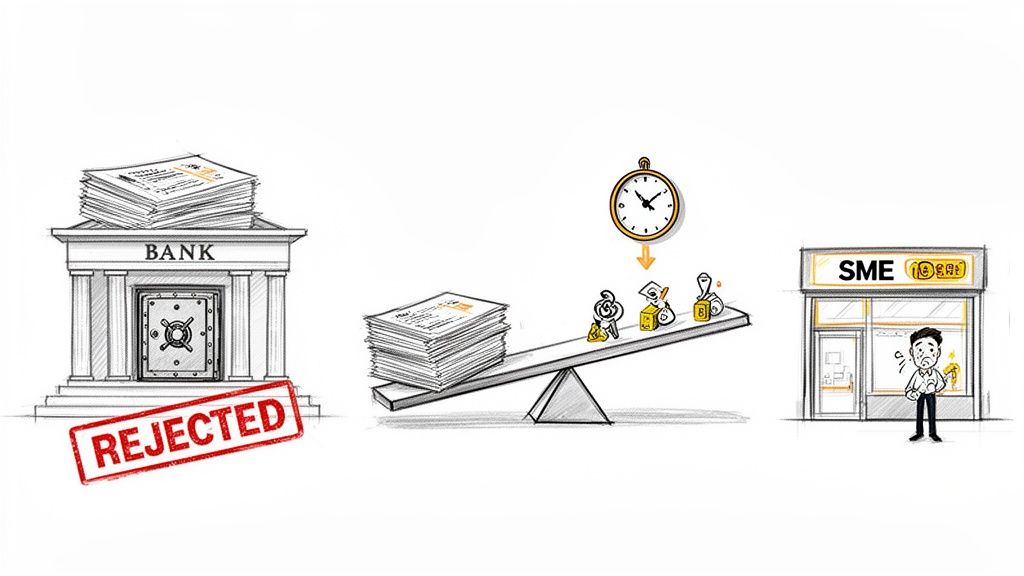
This creates a significant gap between the capital SMEs need to thrive and what traditional institutions are willing to offer.
The Hurdle of High Collateral and Slow Timelines
One of the biggest roadblocks is the relentless demand for collateral. Many traditional institutions won't consider an application unless you can secure the funds with significant physical assets. This is a major problem for new businesses, service-based companies, or any SME that is asset-light. Your revenue could be strong, but if you don't own a building or heavy equipment, you might receive an automatic "no."
This is a particularly sharp issue in the UAE, where rejection rates for SMEs can be as high as 50-70%. It’s not uncommon for traditional providers to demand 200-250% collateral coverage. On top of that, the approval process can drag on for a grueling 8-12 weeks—a timeline most businesses cannot afford.
Inflexible Criteria and Paper-Based Systems
Beyond collateral, old-school playbooks are full of inflexible rules that trip up perfectly healthy businesses. They tend to focus on:
- A long business history: Just getting started? Even with incredible early traction, you’re often labeled as too risky.
- A flawless credit score: A single old hiccup on your credit report can be enough for a flat-out disqualification.
- Mountains of paperwork: The entire process is often manual and paper-based, making it slow, cumbersome, and prone to human error.
This approach means a traditional provider might never see the real health of your business. They're so focused on historical data and physical assets that they completely miss your strong customer relationships and future potential.
This is exactly where fintech platforms like Comfi are changing the entire conversation. We’re moving away from these rigid, outdated requirements to offer a much more realistic path for businesses to unlock their working capital. Instead of focusing on what you own, we look at the strength of your actual business operations and the quality of your client base. You can get a better sense of these differences in our guide to understanding bank eligibility criteria.
Your Approval Was Rejected. What Are Your Next Steps?
Getting a "rejected" notice can be disheartening, but it’s rarely the end of the road. It's an opportunity to understand what happened and take corrective action. The first step is to diagnose the reason for the rejection, not to assign blame, but to regain control.
Many rejections are not a final judgment on your business's potential. They are often a red flag triggered by an automated system or an inflexible internal policy. Your task is to identify what raised that flag.
Pinpointing the Common Culprits
A rejection often comes down to data. A simple mismatch in your documents or an incomplete financial picture is frequently the root cause. For instance, a small discrepancy between the legal company name on an invoice and the name on your trade license can be enough to halt an automated approval process.
Unstable cash flow is another major trigger. If your bank statements show erratic balances, large unexplained transfers, or frequent overdrafts, it signals a lack of predictability. For any service provider, such patterns make it incredibly difficult to get a clear read on your business's day-to-day financial reliability.
A rejected approval isn't a dead end. It’s a data point. It tells you exactly which part of your financial story needs clarification or improvement before you reapply.
The Role of Your Financial Track Record
Your business's financial history is a critical piece of the puzzle. In the UAE, your Al Etihad Credit Bureau (AECB) report provides a quick snapshot of how you've handled payments in the past. A history of late payments or defaults is a significant warning sign.
In fact, some research suggests that over 60% of SME application rejections are directly tied to inconsistent banking behavior. Providers look for consistency in how you manage your accounts and a predictable cash flow to gauge your reliability. A poor credit history, especially with an unresolved payment, can seriously damage your chances of approval. You can get more local insights on the common reasons for business application rejections in the UAE.
How Emerging Fintechs Are Helping SMEs
This is where a different perspective can make all the difference. Traditional providers often get stuck on historical data and collateral. But what if you’re a new business without a long credit history? Or an asset-light company that doesn't own significant physical property?
This is the gap that modern fintech platforms like Comfi were built to fill. We deliberately designed our eligibility criteria to be more inclusive because we understand the reality of running an SME today. Instead of an automatic disqualification, we assess your application based on what really matters in the here and now:
- Invoice Quality: Is the invoice clear, valid, and issued to a reputable buyer?
- Buyer Strength: Is your customer a reliable and established business with a good payment history?
- Transactional Health: Does your recent business activity show you’re operating consistently?
This model opens doors for countless great SMEs that are unfairly shut out by outdated, rigid systems. By focusing on the strength of your current business relationships—not just what’s on your balance sheet—we make it possible for healthy, growing businesses to get the capital they need without hitting an immediate wall.
What to Do When Comfi Rejects an Invoice
If you receive a notification that your invoice was rejected on Comfi, don't worry. This is almost always a minor issue, not a hard "no."
Think of it less as a rejection and more as a request for clarification. We've designed the process to be transparent, so you can see exactly what’s wrong, fix it, and get back on track without long delays. Most of the time, the issue is something simple and administrative that you can fix in minutes.
This chart gives you a quick visual breakdown of the most common reasons an approval might get held up, from simple documentation errors to cash flow checks.
Find Out Why in Your Dashboard
Your Comfi dashboard is your command center. We won’t leave you guessing. When an approval is rejected, we provide a clear, specific reason so you know exactly what to do next.
You’ll typically see one of a few common reasons:
- Invoice Data Mismatch: This is the most frequent reason we see. It simply means a detail on your invoice (like your company name, the buyer’s address, or the invoice total) doesn't perfectly match supporting documents like your trade license.
- Unclear Documentation: This happens when a scanned invoice or proof of delivery is blurry, faded, or cut off. Our system needs a crisp, clean document to read and verify all the details automatically.
- Buyer Not Eligible: This means your buyer doesn’t currently meet the eligibility criteria. It’s important to remember this isn't a reflection on your business; it’s strictly related to the buyer's profile with us.
Once you know the why, the how is straightforward.
Correct and Resubmit Your Invoice
After you've identified the issue in your dashboard, fixing it is usually a simple matter of updating the document and resubmitting it.
If you’re dealing with an Invoice Data Mismatch, compare your invoice and your trade license side-by-side. Look for tiny differences, like "Ltd" versus "Limited." Once you spot it, correct the invoice in your accounting system, save it as a new PDF, and upload the fixed version. Our guide on crafting a perfect business invoice has some great tips to help you get this right from the start.
For Unclear Documentation, the fix is even easier. Just re-scan or re-export the document, making sure it’s high-resolution and perfectly legible. A good rule of thumb is to check the file on your own computer first. If you can read every letter and number clearly, our system can too.
What if the Issue Is With Your Buyer?
If the rejection is about your customer, such as a "Buyer Not Eligible" status or an incorrect buyer detail, you may need to have a quick chat with them. It can feel a bit awkward, but a professional approach makes it an easy conversation.
Pro Tip: Keep your message short, polite, and focused on the solution. Frame it as a quick administrative check needed to process their invoice.
Here’s a simple template you can adapt:
"Hi [Buyer's Name],
Hope you're having a good week.
We're processing your invoice [Invoice Number] and just need to confirm a small detail. Could you please double-check that your registered trade name and address on the invoice are current?
Updating this will help us process the payment right away.
Appreciate your quick help with this.
Best,
[Your Name]"
This direct but friendly approach gets you the information you need without causing friction. Once they confirm, you can update the invoice and resubmit it for a speedy approval.
How Fintech Platforms Create New Opportunities for SMEs
A "no" from a traditional institution can feel like a dead end, but this is where the story gets interesting. Modern fintech platforms are rewriting the old rules, opening up new pathways for businesses that were previously locked out.
The difference isn't just about speed; it's a fundamental shift in mindset. To understand how these new options work, it helps to look at the broader financial services landscape they operate in. Fintechs thrive by being agile and making data-driven decisions instead of relying on outdated, rigid criteria.
Shifting Focus from Collateral to Cash Flow
The biggest change is the move away from asset-based models. Traditional institutions often focus on one question: "What physical assets can you offer as collateral?" This model immediately puts service providers, digital businesses, and young startups at a disadvantage.
Fintech platforms like Comfi look at things differently. We don't get bogged down in collateral. Instead, we focus on the actual health of your day-to-day operations. Our model is built on two simple pillars:
- The strength of your invoices: We look at the quality of your invoices and the validity of your transactions.
- The reliability of your buyers: Your customers' ability to pay is a much better signal of your business's health than the resale value of your office furniture.
This approach is a game-changer for businesses with high potential but few physical assets.
A rejection from a bank often says more about their outdated system than it does about your business's potential. Fintechs succeed by looking at the health of your current operations, not just your historical balance sheet.
Inclusive Criteria and Digital Speed
This modern approach directly addresses the problems that lead to rejections from traditional sources. Consider the UAE startup scene, where a staggering 77% rejection rate for unsecured business applications is common simply because the traditional collateral model doesn't work for them.
Platforms like Comfi offer a real alternative with more inclusive and realistic eligibility criteria. Our process is fully digital, allowing for instant eligibility checks and resulting in an 85% approval rate that’s built for the realities of a modern SME.
By looking at the right data, we open doors that were previously shut, helping businesses unlock their working capital and pursue growth without being held back by yesterday’s rules. You can learn more about how fintech is transforming SME operations in our in-depth guide.
Proactive Steps to Boost Your Approval Success
A rejected approval is an opportunity to strengthen your business's financial foundation. This isn't just about fixing one issue for one platform; it's about making your business more appealing to all potential partners.
The goal is simple: present a clean, organized, and professional financial story. When your core business documents are always up-to-date and perfectly aligned, you make your company’s value clear and undeniable.
Cultivate Strong Financial Habits
Your day-to-day financial management has a massive impact on your ability to get approvals. Simple, consistent habits are often the difference between a fast "yes" and a frustrating "no."
Here's where to focus your energy:
- Maintain Pristine Financial Records: Every invoice, receipt, and bank statement needs to be meticulously organized. Clean books signal professionalism and control.
- Keep Legal Documents Current: Ensure your trade license and other essential legal documents are always valid and reflect your current business details. An expired license is an instant red flag.
- Build a Solid Transaction History: Consistently work with reputable buyers and document every transaction cleanly. A track record of successful deals is powerful proof of your business's stability.
Embrace Modern Digital Tools
If you are still using manual bookkeeping, switching to modern accounting software is a powerful move. Digital tools save time and create the clear, professional documentation that platforms like Comfi require.
Software like Xero or QuickBooks automatically generates consistent, accurate invoices and financial reports. This alone eliminates the common data mismatch errors that are a top reason for rejections.
By digitizing your finances, you’re not just improving efficiency; you're building a verifiable track record that speaks for itself. It allows platforms to assess your health based on real-time data, not outdated paper trails.
This digital-first approach means that when you need to provide documentation, you can pull it instantly and without errors. It aligns your business with the data-driven models that fintechs use, making your application much easier to evaluate and approve. For those looking to strengthen their financial profile even further, understanding options like specialized credit repair for auto approval can offer valuable insights into improving your standing across the board.
Got Questions? We've Got Answers
SME owners often have the same questions when an invoice approval hits a snag. Here are some straightforward answers to help you navigate the process.
What's the Number One Reason an Approval Gets Rejected?
Hands down, the most common roadblock we see is a simple documentation mismatch. It sounds minor, but it's a big deal for automated systems.
This could be anything from the supplier's name on the invoice not perfectly matching their trade license, a typo in the buyer's details, or a blurry document upload. Platforms like Comfi rely on automated checks to keep things moving fast, so making sure every detail on your documents is crisp, clear, and perfectly aligned is the single most important thing you can do for a speedy approval.
Can a Brand New Business Get Approved by Comfi?
Absolutely. In fact, this is one of the biggest reasons platforms like Comfi exist.
Traditional institutions focus on how long you've been in business. We look at things differently. Our model focuses on the quality of the specific invoice you're submitting and, most importantly, the creditworthiness of your buyer. If you're working with established, reliable customers, your new business can get paid early, allowing you to unlock crucial working capital to fuel your growth from day one.
The takeaway here is simple: your business's potential isn't measured by its age. In modern finance, the strength of your customer relationships and the quality of your invoicing are what really open doors.
I Was Rejected by a Bank. Does That Hurt My Chances with Comfi?
Not necessarily. A rejection from a traditional bank usually comes down to their rigid criteria—like high collateral demands or a long credit history requirement. Fintech platforms like Comfi were built specifically to solve that problem for SMEs.
We use a more practical set of eligibility criteria that focuses on the health of your business right now:
- Invoice Quality: We're looking at the validity and clarity of the invoice itself.
- Buyer Reputation: The strength and payment history of your customer is a key factor.
- Transactional Health: We consider your recent business activity as a strong sign of stability.
Because our way of assessing risk is fundamentally different, a past rejection from a bank doesn't automatically close the door to getting approved with us.
How Fast Can I Get Approved After I Fix an Issue?
Comfi is built for speed. Once you’ve addressed the issue flagged in your dashboard and resubmitted the invoice, our eligibility checks run again instantly.
If the correction solves the initial problem, you should see your approval status update almost immediately. We designed the system this way to ensure a small, fixable error doesn't snowball into a long and costly delay for your cash flow.
Ready to move past the roadblocks of traditional systems? With Comfi, you can get your invoices approved and get paid in as little as 24 hours. Learn more and get started today.
Related Reading
- Your 2026 Guide to the 11 Best SME Business Loan Options in the UAE
- 7 Faster Alternatives to a Traditional Business Loan
- Your Bank Statement: A Key to Unlocking Business Funding
Looking to improve your cash flow? Explore Comfi's Invoice Discounting solutions. Get started today.