Turn Late Payments Into Cash Flow: A Guide to Payment Delays


A late payment is never just a line item on a spreadsheet; it’s a roadblock that can bring your business momentum to a screeching halt. For small and medium-sized enterprises (SMEs), a single payment delay acts like a stalled car in a single-lane tunnel—it creates a traffic jam of problems, from strained supplier relationships to missed growth opportunities.
The Real Impact of Payment Delays
For SMEs, especially in the MENA region, the consequences of a late payment go way beyond a simple accounting entry. This isn't just an inconvenience; it's a genuine threat to your operational health. It hits you right where it hurts the most: your cash flow, which is the absolute lifeblood of your business.
A single delayed payment can set off a disastrous domino effect. Without that expected cash, you might find yourself struggling to pay your own suppliers, restock your inventory, or even cover payroll. This kind of disruption can tarnish your reputation and slam the door on new opportunities. Understanding the full scope of these hidden costs is the first step toward building a more resilient business. This is why managing financial risk and stopping revenue leakage is so critical for survival and growth.
Let's look at a real-world scenario. In the UAE, it’s not uncommon for cross-border payments to take 2–5 business days to clear. Imagine a Dubai-based electronics distributor waiting on a big payment from a buyer in Saudi Arabia. That delay might cause them to miss out on a 30% potential sales uplift simply because they didn't have the cash on hand to seize an opportunity. It’s these kinds of cash flow bottlenecks that can really sting, making it difficult for business owners to unlock their working capital when it's needed most.
Ultimately, a high Days Sales Outstanding (DSO) metric is a clear red flag highlighting these payment challenges. If you're looking to get a better handle on this critical number, check out our guide on how to improve your Days Sales Outstanding calculation.
Getting to the Root of Late Payments
To fix a late payment, you first have to figure out why it’s happening. Instead of just chasing an overdue invoice, it’s far more effective to step back and diagnose the real problem. Once you understand the “why,” you can stop reacting to every delay and start building a smarter, more proactive payment strategy.
A late payment is almost never personal. Think of it as a symptom of a bigger issue happening on your customer’s end. Your client might be caught in their own cash flow crunch, waiting for their customers to pay them. Or, the hold-up could be purely procedural, with your invoice stuck in a maze of internal approvals before it can get the final sign-off.
So, Why Are Payments Actually Late?
Sometimes the reason is frustratingly simple, like a lost invoice or a minor dispute over the delivered goods. But other times, it's a sign of a deeper issue. The key is figuring out if you’re dealing with a simple oversight or a systemic problem. It’s the difference between sending a friendly reminder and needing a serious conversation about payment terms.
Most of the time, the delay comes down to one of these buyer-side issues:
- Their Own Cash Flow is Tight: Your client is often waiting on their own customers to pay up, creating a domino effect that hits everyone down the line.
- Complex Approval Workflows: In bigger companies, an invoice might need to pass through multiple departments and get several signatures, which can slow things down to a crawl.
- Invoice Discrepancies: Even a small error or a disputed line item on an invoice can bring the entire payment process to a dead stop until it’s sorted out.
- Simple Human Error: It happens. The invoice got sent to the wrong person, buried in an inbox, or just plain forgotten.
A late payment is a signal. It could be signaling a problem in your client’s business, a weak spot in your own invoicing process, or even a wider economic trend that’s squeezing your entire industry.
Here in the MENA region, you have to factor in another layer of complexity. Economic pressures tend to hit SMEs the hardest. For instance, major project delays caused by skill shortages in the UAE can have a ripple effect on payment timelines for everyone in the supply chain. Construction bottlenecks in Dubai often mean distributors wait weeks longer for their invoices to get paid.
Your Action Plan for Overdue Invoices
When an invoice slips past its due date, having a clear, professional game plan is your best defense against a crippling payment delay. A structured approach not only boosts your chances of getting paid but also protects valuable customer relationships by keeping the conversation respectful and predictable. The goal here is to build a repeatable collections process that puts you back in control.
Your plan should kick in even before an invoice is technically late. A gentle, automated reminder sent a few days before the due date can head off a lot of late payments that are just due to simple oversight. But once that deadline passes, it’s time to start a more structured sequence of communications.
What to Do When a Customer Doesn't Pay
Your follow-up process needs to slowly dial up the firmness while never losing its professional tone. This multi-step approach gives your client plenty of chances to sort things out before you have to take more serious action.
A typical sequence looks something like this:
- Day 1-3 Overdue: Send a polite email to remind the client about the overdue invoice. It's smart to attach a copy and ask them to confirm it landed with the right person or department.
- Day 7 Overdue: If you haven't heard back, it's time for another email and a friendly phone call. The goal is to make direct contact, find out what’s causing the delay, and show you’re serious about a resolution.
- Day 15 Overdue: Now, your tone should become more direct. Clearly state that the payment is significantly overdue and ask for a specific date when you can expect the payment.
- Day 30+ Overdue: At this point, you have to escalate. This might mean pausing any ongoing work or services and formally letting the client know their account is on hold until the outstanding balance is cleared.
When chasing payments turns into a constant, resource-draining chore, that’s a massive red flag. Your process just isn't working. Protecting your cash flow shouldn’t be completely at the mercy of your customers’ payment schedules.
This is where alternative solutions can completely change the game. Instead of waiting around and chasing debts, you can partner with a platform like Comfi to get your approved invoices paid almost immediately.
This simple shift allows clients to unlock the working capital that’s tied up in their receivables, making sure that one customer’s payment delay doesn't derail your own financial commitments or grind your growth to a halt. You get the steady cash flow you need, while the platform handles the collection based on the original terms you set.
How to Prevent Payment Delays Before They Start
The best way to deal with a late payment is to make sure it never happens in the first place. This means shifting your mindset from chasing down overdue invoices to proactively building a system that prevents delays. It’s a crucial move for protecting your cash flow and building a more resilient business.
This process starts way before you even think about sending an invoice. It begins the moment you draft a contract or a new client agreement. Vague terms are an open invitation for confusion and late payments. Your agreements need to spell everything out in black and white: the exact due date, all the ways a client can pay, and what happens if they don't pay on time.
Building a Strong Financial Foundation
Beyond having iron-clad contracts, you need to be smart about who you work with. Setting up a simple client vetting process can help you spot potential red flags before they hit your bank account. Adding sensible payment terms based on a client’s payment history or their reputation in the industry gives you another solid layer of protection.
Here are a few more proactive strategies to consider:
- Offer Early Payment Incentives: A small discount, maybe 1-2% off for paying an invoice within 10 days, can be a surprisingly powerful nudge. It encourages clients to bump your invoice to the top of their payment pile.
- Automate Your Invoicing: Doing invoices by hand is slow and full of opportunities for mistakes. An automated system gets accurate invoices out the door on time, every time, kicking off the payment cycle without a hitch. You can learn more about dialing this in by checking out how an automated invoice system can sharpen your operations.
- Maintain Open Communication: Don't just send an invoice and hope for the best. A quick follow-up to confirm they’ve received it can stop it from getting buried in a crowded inbox. Keeping the lines of communication open makes the whole process smoother.
Your goal is to design a payment process that is so clear, simple, and professional that paying on time becomes the easiest option for your customer.
To really get this right, you need the right tools. Exploring the best accounting software solutions is the logical next step for streamlining invoicing, tracking payments, and sending out proactive reminders. These platforms are fundamental for minimizing the time you waste chasing money you've already earned.
Unlock Your Cash Flow Without Waiting for Customers
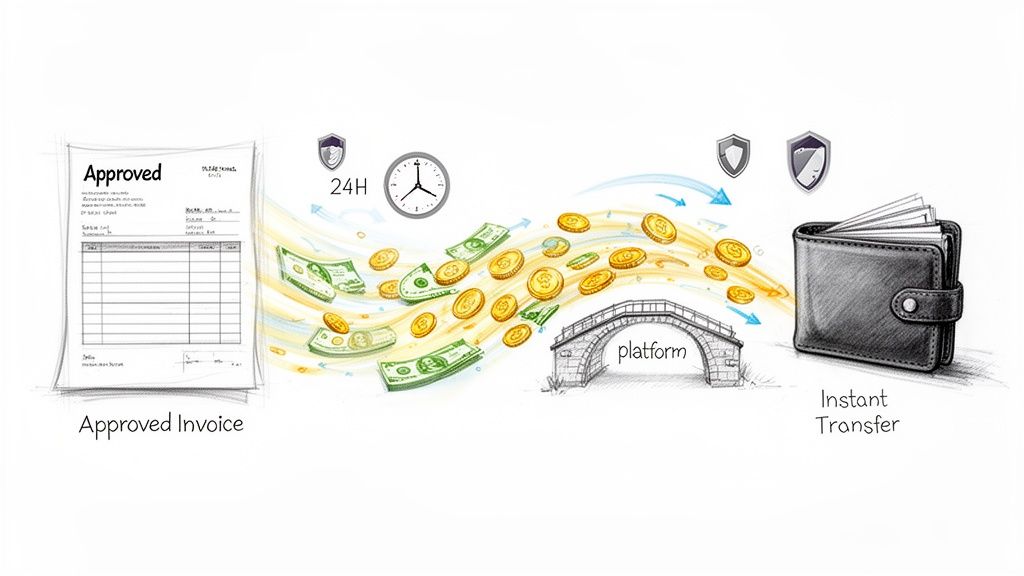
What if you could completely sidestep the financial stress of a payment delay? The constant cycle of chasing invoices and dealing with unpredictable cash flow is a massive drain on your time and energy. But there’s a modern approach that lets you get out of the waiting game entirely, ensuring your business never hits the brakes because of someone else's payment schedule.
Platforms like Comfi offer a powerful alternative, giving you immediate access to the cash that’s locked up in your approved invoices. Instead of waiting the typical 30, 60, or even 90 days for a client to pay, you can get your funds upfront—often within just 24 hours.
This model completely flips the script on how you manage your business's capital. The process is refreshingly simple: you submit an approved invoice, and the platform advances you the cash. The partner then handles the collection from your buyer based on the original payment terms. You get paid, and they handle the wait.
The Strategic Advantage of Immediate Payments
This isn't just a quick fix for a temporary cash crunch; it’s about building genuine predictability and stability into your financial operations. When you know exactly when you’re getting paid, you can confidently jump on growth opportunities without a second thought.
That kind of stability is especially critical here in the MENA region, where regulatory fragmentation often complicates payment cycles and creates serious liquidity problems for SMEs. Solutions that provide early payouts are proving to be a true game-changer. In fact, some platforms report their clients see a 30% sales uplift and 20% customer growth after putting these systems in place. You can find more insights on how immediate funding solutions are transforming MENA's SME landscape.
By converting your receivables into immediate cash, you regain control over your financial destiny. You are no longer held back by a customer’s payment cycle.
This freedom allows you to pay your own suppliers on time, invest in more inventory, or launch that new marketing campaign you’ve been planning. When you start to explore your options, you'll find that invoice discounting is a direct route to healthier cash flow, liberating your business from the old constraints of B2B payment terms.
Frequently Asked Questions
When it comes to late payments, you're not alone in having questions. It’s a tricky part of running a business, so we’ve put together clear answers to some of the most common things business owners want to know.
When Is the Right Time to Follow Up on an Unpaid Invoice?
Honestly? Before it's even late. The best approach is to send a polite, professional reminder a few days before the due date hits. It's a simple nudge that keeps your invoice top of mind.
The day it officially becomes overdue, however, your more formal follow-up process should kick in. Staying proactive and consistent is far more effective than waiting until the situation becomes a stressful, urgent cash flow problem.
Could Using a Platform for Early Payment Affect My Customer Relationships?
It can actually make them better. Think about it: when your cash flow is steady and you aren't constantly worried about chasing payments, you can put all your energy into delivering great service.
Platforms like Comfi are designed to be completely seamless and professional. From your customer’s perspective, nothing changes—they still pay on their normal schedule. But for you, the funds are unlocked almost immediately. This removes all the financial tension from the relationship, meaning you never have to make another awkward collection call.
A stable cash flow transforms customer interactions from transactional to relational. When you're not worried about a payment delay, you can invest more energy into partnership and growth.
What Is the First Step to Avoid Payment Delays with a New Client?
The single most important step happens before you do any work at all: get crystal-clear payment terms into your contract.
This agreement needs to be unambiguous. It must spell out the exact due date, all the ways they can pay, and what happens if a payment is late. Setting this professional tone from day one prevents the kind of misunderstandings that so often lead to payment delays down the road.
How Is This Different from a Traditional Business Loan?
This is a key difference. A business loan creates debt that sits on your balance sheet. In contrast, services that give you an early payout on your invoices are based on an asset you already own—your accounts receivable.
You're not borrowing money; you're simply accessing the value of work you've already completed. There's no loan to repay because the platform collects the original invoice amount directly from you or your customer (in the case of Buy Now, Pay Later) on the agreed-upon date. It’s your money, just made available sooner.
Ready to stop waiting and take control of your cash flow? With Comfi, you can get your invoices paid in as little as 24 hours. Learn more about how Comfi can help you eliminate payment delays today.
Related Reading
- B2B Payments
- Solve Creative Agency Late Payment UAE Issues
- How Payment Default Dents Small Business Growth and Survival
- A Guide to B2B Payment Solutions for MENA Businesses
Ready to improve your business cash flow? Get started with Comfi today.