Finance Lender: How to Choose the Right Partner for SMEs


For any SME owner in the UAE, managing cash flow is a constant juggling act. A modern finance lender doesn't operate like a traditional bank. Instead of rigid institutions, think of them as specialized financial partners. They offer smart, technology-driven ways to turn assets like your unpaid invoices into immediate working capital. This approach helps businesses grow without getting tangled up in the red tape of conventional funding channels.
Understanding the Modern Finance Lender
In the fast-paced MENA market, almost every small and medium-sized enterprise (SME) runs into the same wall: the gap between making a sale and actually getting paid. That delay can stifle momentum, making it tough to buy inventory, pay your own suppliers, or jump on a new opportunity. This is the exact problem a modern financial partner is built to solve.

Unlike large, traditional banks with their steep requirements and slow approval processes, a finance lender offers something far more agile and accessible. They are more interested in your business's operational health—like the value of your accounts receivable—than just fixating on years of financial history or a pile of fixed assets. This shift in perspective is a game-changer for many growing businesses that might otherwise be shut out from traditional financing routes.
The core role of a specialized financial partner is to provide efficient access to working capital. By using technology to analyze real-time business data, they can make faster decisions, giving you the power to act on time-sensitive opportunities.
Key Characteristics of a Modern Financial Partner
Instead of a one-size-fits-all approach, these platforms provide targeted solutions designed for specific business pain points. Their key characteristics usually include:
- A Focus on Specific Needs: They solve distinct cash flow problems, whether it's the classic delayed invoice payment or the need to offer flexible payment terms to your own business customers.
- Technology-Driven Assessments: By using digital platforms, they can vet eligibility and process applications in days, not weeks. That speed is absolutely critical for any business trying to move fast.
- Accessibility for SMEs: The eligibility criteria are a much better fit for SMEs. They look at the quality of your customers and invoices rather than demanding significant collateral you might not have.
This modern approach completely changes how businesses can manage their finances. For a closer look at the different options out there, you can explore our detailed guide on small business lending solutions. It's no longer just about getting your hands on funds; it's about building a financial strategy that actually fuels sustainable growth.
How a Finance Lender Works for Your Business
So, what’s the real difference between a modern finance partner and the bank you’ve known for years? Think of it this way: a traditional bank is like a general doctor. They offer a huge range of standard services for just about everyone. A specialized platform, on the other hand, is more like a cardiac specialist who focuses on one critical area with deep expertise—in this case, your business's cash flow.
Their main function is to give SMEs like yours faster, more direct access to the funds you need to keep things running smoothly. Instead of getting bogged down in years of financial statements or fixed assets, a tech-forward finance lender looks at dynamic factors like your accounts receivable. This lets them make much quicker decisions, giving you the power to pay suppliers, stock up on inventory, or simply bridge the gap while you're waiting for customers to pay.
Focusing on Your Business Operations
The key difference really comes down to what they’re looking at. A finance lender is more interested in the health of your day-to-day operations than your historical balance sheet. This approach is a much better fit for growing SMEs, whose real value is tied up in current business activities, not just property or equipment.
This operational focus allows them to solve immediate needs with modern solutions. For example, instead of going through a long, drawn-out process for a business loan, you can work with a partner who helps you unlock the value that’s already sitting in your unpaid invoices. It’s all about turning existing assets into liquid cash you can use right away.
The core advantage of working with a modern finance lender is turning your operational strengths—like a strong client list and consistent invoicing—into immediate financial flexibility. It’s a model built for the speed of modern business.
This model has really taken off in the UAE for a clear reason. Even with a strong banking system, many SMEs still struggle to get traditional funding. Market data shows that while domestic bank credit is substantial, it often flows to larger corporations, leaving a gap. This is where specialized platforms come in, using technology to assess receivables and transaction data instead of just fixed assets. You can get more insights into this credit growth in the UAE and its impact on invoice financing solutions.
The Practical Process
So what does this actually look like in practice? The process is typically digital and refreshingly straightforward:
- Application: You submit basic information about your business and your specific need, like an outstanding invoice you want to get paid on faster.
- Assessment: The platform uses its technology to quickly evaluate your request, often focusing on the creditworthiness of your client (the one who owes you the money).
- Payment: Once approved, the funds are usually sent to your account in a very short timeframe—sometimes in as little as 24 hours.
This kind of speed and efficiency ensures you never have to miss a time-sensitive opportunity just because of a temporary cash flow delay. It gives you the predictability and stability you need to scale your operations with confidence.
Exploring Key Financial Solutions for SME Growth
Modern financial platforms offer a toolkit of solutions built specifically to solve the cash flow headaches that plague growing businesses. Let's break down the most common models and see how a finance lender can help you hit your goals, whether that's smoothing out daily cash flow or boosting your average order size.
Invoice Discounting
This is one of the most straightforward ways to fix cash flow gaps created by long payment cycles. Instead of waiting 30, 60, or even 90 days for a customer to pay up, invoice discounting lets you get a significant portion of that invoice's value almost right away.
Think of it as unlocking the money you've already earned. You do the work, send the invoice, and your financial partner advances you the cash. Suddenly, clients have unlocked the funds to pay suppliers, make payroll, or grab new inventory without missing a beat. It's a powerful tool for keeping business moving forward.
Buy Now Pay Later for Business
Another game-changer is Buy Now, Pay Later (BNPL) built specifically for B2B sales. This solution lets your business customers make bigger purchases by offering them flexible payment terms, but the best part is, your company still gets paid upfront and in full.
This model is a fantastic way to increase your average order value and bring in new customers who might have been hesitant due to cash flow constraints. It takes the payment friction right out of the sales process, helping you close bigger deals, more often.
By offering flexible terms to buyers and ensuring suppliers are paid immediately, businesses can strengthen relationships on both sides of a transaction. It’s a strategic way to foster loyalty and enable growth throughout your entire supply chain.
Dealer Financing
This is a more specialized solution, tailored for industries that deal with high-value inventory, like automotive or electronics. This type of arrangement helps businesses keep their showrooms and warehouses stocked without tying up all their cash in merchandise.
For instance, an automotive dealer can use this model to fill their lot with the latest models. This ensures they have the products ready to go when customers walk in, which is absolutely critical for staying competitive. For a closer look at how this applies in other sectors, this ultimate guide to restaurant equipment financing offers a great overview of the options out there. Each of these models shows how a finance lender provides targeted, practical support to solve real-world business challenges.
Real-World Examples of Financial Solutions in Action
Theory is one thing, but seeing how these financial tools actually perform in the real world is another. For SMEs across the MENA region, finding the right finance lender isn’t just about staying afloat; it’s about opening up real opportunities for growth that would otherwise be completely out of reach.
Let's walk through a common scenario. Picture an electronics distributor in Dubai who just fulfilled a huge order for a large, reliable corporate client. The good news? They landed a major sale. The bad news? They were stuck with a 90-day payment term. This single invoice tied up a massive chunk of their working capital, stopping them from even bidding on another time-sensitive contract.
By using an invoice discounting platform, they were able to get paid on that invoice in just 24 hours. That immediate liquidity gave them the firepower to pursue—and win—the new business.
Boosting Sales with Flexible Terms
Here’s another situation we see all the time. A B2B software supplier in the UAE wanted to increase its average deal size, but many of its SME clients were balking at the upfront cost of annual packages. To solve this, the supplier integrated a Buy Now, Pay Later (BNPL) option right into their sales process.
This allowed them to offer flexible 30, 60, or 90-day payment terms to their customers, while they still got paid the full subscription amount upfront from their financial partner.
The result was powerful. It removed the biggest barrier for their clients, leading to a 30% boost in their average deal size. The right financial solution turned a sales hurdle into a serious competitive advantage. You can see more powerful success stories by exploring these detailed business case studies.
The core takeaway from these examples is that a strategic finance lender helps businesses do more than just manage cash flow. They provide the tools to actively increase revenue, improve operational stability, and seize growth opportunities without delay.
The business environment in the United Arab Emirates has become especially fertile ground for this kind of financial innovation. The lending landscape for SMEs has transformed. CEIC data shows that total loans in the UAE shot up from around USD 327.7 billion in December 2013 to a record high of USD 552.4 billion by October 2023—a nearly 69% increase.
This incredible growth doesn't just show the scale of the market; it highlights a clear demand for specialized partners who can move faster and more flexibly than traditional banks. As Funding Souq has noted, this expanding market is what allows a modern finance lender to offer solutions precisely engineered for the working capital headaches of today's SMEs.
How to Choose the Right Financial Partner
Picking a financial partner is a strategic decision that goes way beyond a simple transaction. For any SME in the UAE, this choice directly impacts your ability to scale, manage operations, and jump on new opportunities when they appear. The key is to look past the flashy promises and dig into the factors that really matter for your company's long-term health.
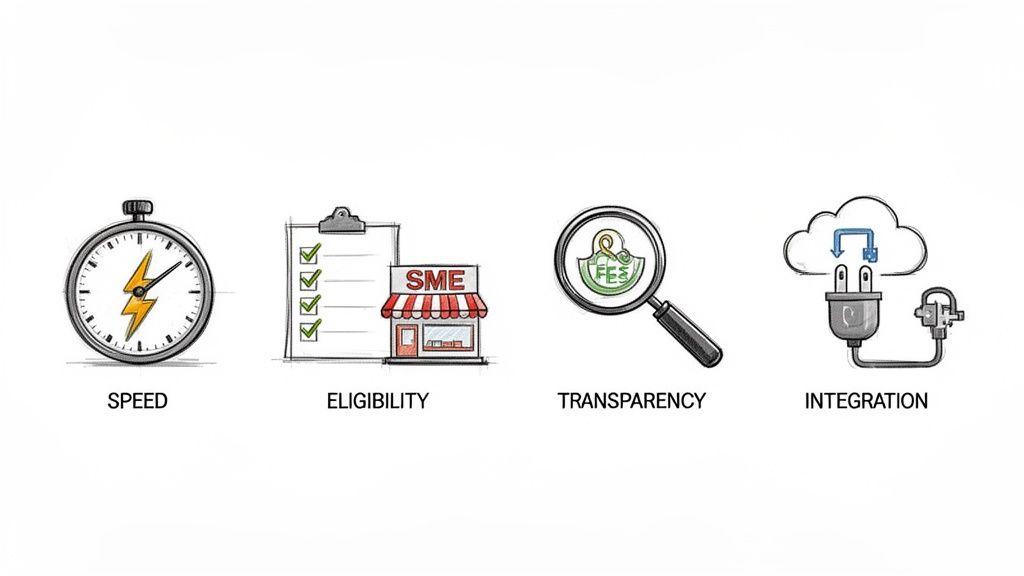
This evaluation process doesn’t have to be a headache. If you focus on four critical areas, you can quickly find a finance lender that actually fits your operational needs and growth plans. It’s all about making sure the solution slots right into your workflow instead of creating another administrative nightmare for your team.
Speed and Efficiency in Decision-Making
When a cash flow gap suddenly opens up or a time-sensitive opportunity lands on your desk, waiting weeks for a decision just isn’t an option. A modern financial partner gets this. They should be able to provide an approval and facilitate access to funds with incredible speed.
Look for platforms that can deliver a decision in a matter of days—or even hours—not weeks. This kind of efficiency comes directly from their tech-driven approach. Instead of old-school, paper-heavy processes, they use digital tools to assess your business fast, a clear sign of a partner built for the pace of modern business.
SME-Friendly Eligibility Criteria
Too many growing businesses get turned down for traditional funding because they don't have years of financial history or a mountain of fixed assets. The right kind of finance lender understands this and has built its eligibility criteria around the realities of running an SME.
They should be looking at your operational health, like the quality of your invoices and the creditworthiness of your customers. A partner who evaluates your real-world business activity, not just your balance sheet, is far more likely to be a true ally for growth.
A key sign of a supportive financial partner is their focus on your business's real-world performance. They prioritize your active contracts and customer relationships over rigid, outdated metrics that often exclude perfectly healthy SMEs.
Upfront Transparency on Fees
Hidden charges and confusing fee structures can quickly eat away at the value of any financial solution. One of the most important things to look for when choosing a finance lender is total transparency. You need to know the exact cost of the service before you commit to anything.
Steer clear of any partner who isn't crystal clear about their fees. A trustworthy platform will give you a simple, upfront breakdown of all costs, making sure there are no nasty surprises down the road. This transparency builds confidence and lets you make a fully informed decision for your company.
Seamless Technological Integration
Finally, you have to consider how a partner’s platform will fit into the systems you already use. A user-friendly digital dashboard is a must, but the best solutions go a step further with powerful integration capabilities. When you’re vetting a partner, it's also crucial to understand their commitment to data security; you can learn more about how to evaluate a finance lender's SOC 2 compliance.
Look for platforms that offer:
- Low-code plugins for an easy connection with your e-commerce or accounting software.
- Developer-friendly APIs that allow for deeper, customized integrations.
This technical compatibility saves a huge amount of time, cuts down on manual data entry, and minimizes the risk of human error, making the entire process that much smoother.
Untangling the Technical and Regulatory Knots
There are two final, critical pieces to this puzzle that every finance manager has to solve: compliance and integration. It goes without saying that any reputable fintech platform in the UAE operates within established financial frameworks, ensuring every transaction is secure and above board. When you partner with a technology provider, you're trusting them with sensitive data, which makes their strict adherence to regional regulations a non-negotiable part of your checklist.
But the real magic happens with seamless integration. The best platforms don’t ask you to change how you work; they fit right into your existing systems. They use low-code plugins or simple, developer-friendly APIs to connect directly with the tools you already rely on, whether that’s your accounting software or your e-commerce storefront. This connection is the secret to unlocking true operational efficiency and accuracy.
The Power of a Connected System
A well-integrated system completely eliminates the error-prone process of manual data entry. Instead of flipping back and forth between different platforms to manage your invoices and payments, all that crucial data flows automatically between them.
This creates a smooth, automated workflow for the entire process, from the initial application to the final reconciliation. The goal is to make accessing working capital a simple, digital part of your daily routine, not a disruptive task that grinds everything to a halt. It turns financial management from a reactive chore into a proactive strategy.
Choosing a finance partner is about more than just getting funds. It’s about adopting a technology that strengthens your operational backbone, slashes your admin burden, and gives you a clear, live view of your cash flow.
Favourable Conditions for Innovation
For any finance lender building solutions in the UAE, the timing couldn't be better. The big-picture credit trends are lining up perfectly with a regulatory environment that champions innovation. The data speaks for itself, showing a steady climb in total loans to over USD 552 billion.
With gross credit jumping 9.4% year-on-year to AED 2.24 trillion in March and non-resident lending soaring by 37%, the market is primed for serious growth. Platforms that can digitize their onboarding process and underwrite quickly against invoices are perfectly positioned to capture fast-growing SME segments in trade, automotive, electronics, and B2B e-commerce. You can explore more of these UAE credit market trends on CEIC Data.
Got Questions About Finance Lenders? We Have Answers.
Stepping into the world of modern business finance can feel like learning a new language. As you start exploring how a finance lender or a specialized platform could help your SME, it's totally normal to have questions. Getting clear, straightforward answers is the key to moving forward with confidence and making the right call for your company.
Let’s tackle some of the most common questions we hear from business owners just like you.
Bank Versus Specialized Finance Platform
So, what’s the real difference between walking into your traditional bank and partnering with a modern fintech platform? It really boils down to three things: speed, flexibility, and focus. A fintech platform is built from the ground up with the specific headaches of an SME in mind.
They use technology to slash approval times and offer much more accessible eligibility criteria. This is a world away from the broad, often rigid, and painfully slow processes that are pretty standard with traditional banks.
How Invoice Discounting Actually Fixes Cash Flow
How does invoice discounting turn a stack of receivables into cash in your account? The process is refreshingly simple. It takes your unpaid invoices—which are basically just a promise of future payment—and turns them into cash you can use right now.
- First, you do the work, deliver the goods, and send an invoice to your customer, just like you always do.
- Next, a platform advances you a huge chunk of that invoice’s value, often within 24 hours.
- Finally, your client pays the platform directly when the invoice is due. That’s it.
This gives you immediate access to working capital instead of having to wait 30, 60, or even 90 days for your customer to pay.
By bridging that gap between invoicing and getting paid, you get the stability to pay your own suppliers, stock up on inventory, or jump on a new growth opportunity without missing a beat. It’s about being proactive, not reactive, with your cash flow.
Am I Eligible for These Modern Solutions?
This is a big one: is my business actually eligible for this stuff? You might be surprised. Eligibility often hinges more on the quality of your invoices and the creditworthiness of your B2B customers, not how many years you’ve been in business or the value of your physical assets.
This modern approach opens the door for a lot of growing SMEs that might not tick the boxes for a traditional bank loan. The focus is on your current business activity and the strength of your customer relationships—not just a dusty old financial statement.
Ready to see how you can improve your business's cash flow without the traditional hurdles? Comfi helps suppliers get paid instantly while offering flexible payment terms to business buyers. Learn more at https://comfi.ai.
Related Reading
- Your 2026 Guide to the 11 Best SME Business Loan Options in the UAE
- 7 Faster Alternatives to a Traditional Business Loan
- UAE Loan Eligibility Unlocked: How SMEs Get Capital in 2026
- Your Bank Statement: A Key to Unlocking Business Funding
Looking to improve your cash flow? Explore Comfi's Invoice Discounting solutions. Get started today.