Your Guide to E-Invoicing in the UAE for 2026

Electronic invoicing, or e-invoicing, is much more than just emailing a PDF. It’s the fully automated, system-to-system exchange of invoices in a structured digital format. Think of it as a complete digital conversation between accounting systems that gets rid of manual data entry, cuts down on mistakes, and dramatically speeds up the payment cycle. This guide offers practical insights to help your business navigate this important transition.
What E-invoicing Really Means for Your Business
Remember the jump from sending a letter by post to sending an email? That’s the kind of change we’re talking about with e-invoicing. It’s a fundamental shift in how businesses manage their financial transactions. A traditional invoice, even a slick-looking PDF, is just a digital picture of a paper document. Someone on the other end still has to look at it and manually punch the details into their accounting system—a process that’s slow and a magnet for human error.
A true e-invoice, on the other hand, is born as structured data. Imagine it as a universal language for financial transactions. Instead of a static image, it’s a smart digital file, often in a format like XML. Both your system and your customer’s system can instantly read and understand it without anyone having to lift a finger. This machine-to-machine communication is what makes modern e-invoicing so powerful. For a deeper dive into the mechanics, this guide clearly answers the question of what is e-invoice and its function.
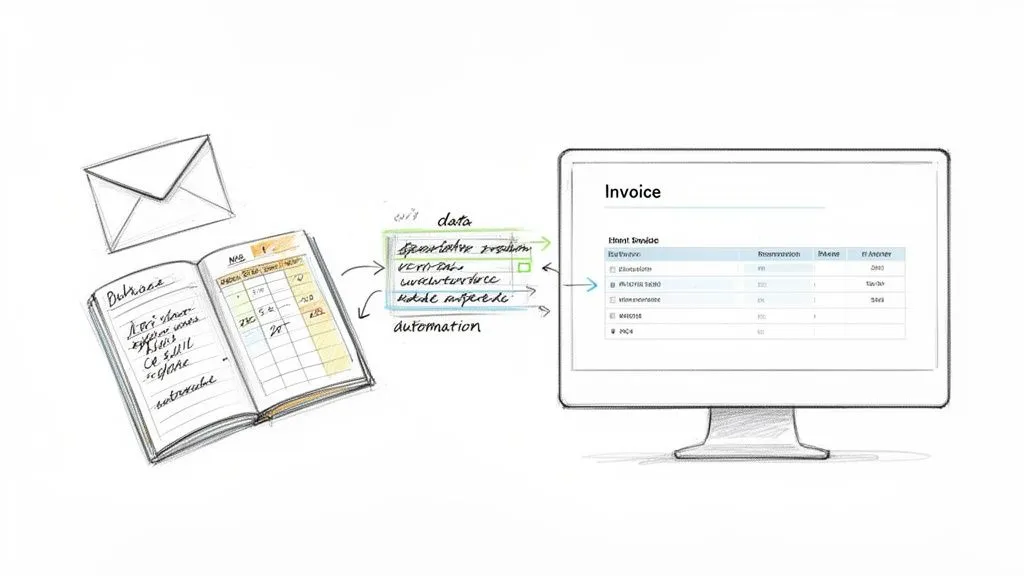
The Purpose of Automation
At its heart, the goal of e-invoicing is to put the entire invoicing process—from creation to sending to processing—on autopilot. This automation delivers benefits that go way beyond just convenience. For small and medium-sized enterprises (SMEs) here in the UAE, this is a game-changer.
By taking manual work out of the equation, businesses can:
- Slash processing errors: When systems talk directly to each other, typos and data entry mistakes simply disappear. This means fewer payment delays and frustrating disputes.
- Accelerate payments: Automated processing gets invoices approved and paid much, much faster. This has a direct, positive impact on your cash flow. We’ve seen that when our clients adopt such systems, they are able to unlock their working capital more effectively.
- Boost financial clarity: With real-time data, you get a much clearer, more accurate snapshot of your company's financial health at any given moment. You can learn more about how this works in our guide on building an automated invoice system.
This digital foundation isn't just a nice-to-have anymore; it's becoming a necessity. With the UAE government preparing to mandate e-invoicing by 2026, understanding this technology is no longer optional. For SMEs, now is the perfect time to get ahead of the curve and turn what will be a compliance requirement into a real strategic advantage for growth and efficiency.
The E-Invoicing Wave Sweeping Across MENA
The move to e-invoicing isn’t some niche trend—it’s a powerful wave crashing over the entire Middle East and North Africa (MENA) region. This massive shift is being driven by governments looking to modernise their economies, inject more transparency into trade, and make tax collection far more efficient. For businesses, this means the end of slow, paper-based invoicing and the start of a new digital standard.
And the momentum is undeniable. The Middle East and Africa e-invoicing market, valued at US$ 568.78 million in 2023, is forecast to explode to US$ 2,087.30 million by 2031. That’s a compound annual growth rate (CAGR) of 17.6%, which tells you just how serious governments and tax authorities are about digitising financial operations.
While this regional push is creating a more unified digital fabric for commerce, the specific rules and deadlines differ from country to country. Getting a handle on these local nuances is critical for any business operating across MENA.
Governments Are Leading the Charge
Governments are the main engines behind this e-invoicing push. They have a few key goals: closing the VAT gap, stamping out tax fraud, and building more competitive digital economies. By forcing invoices into a structured, digital format, tax authorities get a real-time window into business transactions, which cuts down on both fraud and tedious administrative work.
Countries like Saudi Arabia and the UAE are at the forefront, but others are quickly launching their own frameworks. Each nation is rolling out a model that fits its own economic structure and policy aims.
- Saudi Arabia (KSA): The Kingdom was a true regional trailblazer with its phased e-invoicing system, Fatoorah. Phase one kicked off in December 2021, making it mandatory for businesses to generate and store tax invoices electronically. Phase two, the "integration phase," requires businesses to connect their systems directly to the Zakat, Tax and Customs Authority (ZATCA) for real-time invoice clearance. Millions of transactions have already been digitised through this system.
- Egypt: Egypt also went with a clearance model for its B2B e-invoicing mandate. The rollout started in phases and now covers all taxpayers. The system requires businesses to get real-time validation from the Egyptian Tax Authority (ETA) before an invoice is even sent to the buyer, giving the government total oversight.
- Jordan: Following the regional trend, Jordan launched its own national platform, "JoFotara." It’s being rolled out in stages to businesses that meet certain revenue thresholds, requiring them to issue compliant e-invoices for B2B, B2C, and government transactions.
The message is the same across the region: unstructured PDFs and paper invoices are on their way out. Governments are laying down clear rules for machine-readable, structured data to build a more transparent and efficient business landscape.
A Golden Opportunity for SMEs
While these mandates might feel like just another compliance headache, they’re actually a huge strategic opportunity—especially for Small and Medium-sized Enterprises (SMEs). For years, SMEs have been bogged down by manual, paper-heavy workflows that are slow, riddled with errors, and create serious cash flow bottlenecks.
Embracing e-invoicing is a chance to finally break free from those outdated methods. The switch leads to faster invoice processing, which means quicker payments from buyers and a lot less administrative overhead. This isn't just about ticking a compliance box; it's about building a foundation for real financial stability and operational efficiency. It’s what will empower SMEs to compete more effectively in an increasingly digital world.
Understanding the UAE's 2026 E-Invoicing Mandate
The regional e-invoicing wave is heading straight for the UAE, and the government has officially put a date on it: 2026. This isn't just another tweak to the tax code. It's a complete overhaul of how business-to-business (B2B) transactions will be handled, reported, and checked. For business owners, understanding the upcoming changes now is the most important first step you can take.
The new system is designed to create a direct, digital pipeline between your business and the Federal Tax Authority (FTA). We're moving away from old-school periodic VAT filings and into a world of near real-time transaction reporting. It’s time to start thinking about invoicing in a whole new way.
What is the Peppol-Based Five-Corner Model?
At the heart of this new system is something called the Peppol-based five-corner model. It sounds a bit technical, but the concept is actually quite logical and built for security and interoperability.
Think of sending an invoice the old way: a straight line from you (the supplier) to your customer (the buyer). The five-corner model adds three crucial intermediaries to ensure every transaction is compliant and secure.
Here’s how an invoice will travel:
- Corner 1: The Supplier (you).
- Corner 2: Your Supplier's Accredited Service Provider (ASP).
- Corner 3: The Central Government Platform (run by the FTA).
- Corner 4: The Buyer's Accredited Service Provider (ASP).
- Corner 5: The Buyer (your customer).
Essentially, your invoice data travels through a secure, pre-approved network. Your ASP sends the e-invoice to the central FTA platform for validation, after which it's forwarded to your customer’s ASP, who delivers it to their system. It's a decentralized network where all points are connected for maximum security and speed.
The big idea here is that you'll no longer send invoices directly to your customers. Instead, you'll exchange them through a certified network that gives the FTA instant visibility for compliance.
Accredited Service Providers Explained
This brings us to a critical new player in the game: the Accredited Service Provider (ASP). Think of an ASP as a government-certified tech partner that will act as the bridge between your business and the central e-invoicing platform. You won’t have a direct line to the FTA’s system; you must go through an ASP.
These providers have a big job. They're responsible for making sure your e-invoices are created in the exact right format, contain all the mandatory information, and are sent securely. Picking the right ASP will be one of the most important decisions you make in this entire process.
The UAE is preparing for this massive shift in 2026, kicking things off with a pilot phase this July. The current plan requires large taxpayers to be fully compliant by January 2027, and many businesses will need to have their ASP appointed by July 31st, 2026. This Peppol-based model will change everything about how SMEs handle B2B deals. For suppliers, it means you can upload invoices digitally and report to the FTA in almost real-time, filling in over 50 mandatory data fields. It turns a compliance chore into a potential goldmine of data for growth. To see how this fits into global trends, you can find more details in this analysis of recent e-invoicing rollouts.
Your Compliance Roadmap and Key Dates
The UAE government is rolling this out in phases, giving businesses some breathing room to adapt. While the full, detailed schedule for every type of business is still in the works, the initial timeline gives us a pretty clear roadmap.
Here are the key dates to circle on your calendar right now:
- July 2026: The pilot phase is set to launch. A select group of businesses will get to test the system and work out any kinks.
- July 31, 2026: This is a huge deadline. Many businesses will be required to appoint their Accredited Service Provider (ASP) by this date. Don't let it sneak up on you.
- January 2027: The first official wave of mandatory compliance begins, most likely starting with large taxpayers.
- Future Phases: After that, the mandate will be gradually extended to other businesses, probably segmented by annual turnover.
Keeping a close eye on these dates and figuring out which phase your business will fall into is absolutely essential for a smooth, stress-free transition.
How E-Invoicing Improves SME Cash Flow
For any Small and Medium-sized Enterprise (SME), managing cash flow can feel like a high-wire act. The long wait—30, 60, or even 90 days—for an invoice to get paid can squeeze your resources, put the brakes on growth, and cause a huge amount of financial stress. E-invoicing tackles this head-on, transforming a slow, manual chore into a fast, automated process.
Instead of an invoice getting lost in the mail or buried in an email inbox, a true e-invoice is delivered instantly and without errors, directly into your customer’s accounting system. This immediately kicks off their internal approval and payment workflow, slashing the time it takes to get paid from weeks down to just days. The impact is both immediate and powerful.
Accelerating the Invoice-to-Cash Cycle
The "invoice-to-cash" cycle is the entire journey an invoice takes, from the moment you create it to when the payment finally lands in your bank account. A shorter cycle means healthier cash flow. Plain and simple. E-invoicing shortens this journey at every single stage.
This is all possible because of the structured data format of a true e-invoice. Unlike a PDF, which is just a digital picture of a document, a structured e-invoice is machine-readable. It allows different systems to talk to each other without anyone needing to lift a finger, which dramatically cuts down on processing time. The UAE’s adoption of the Peppol model standardizes this communication, making the whole network even more efficient.
The diagram below shows how e-invoicing data flows through the UAE's Peppol framework, connecting your business, your access point service provider, and the Federal Tax Authority (FTA).
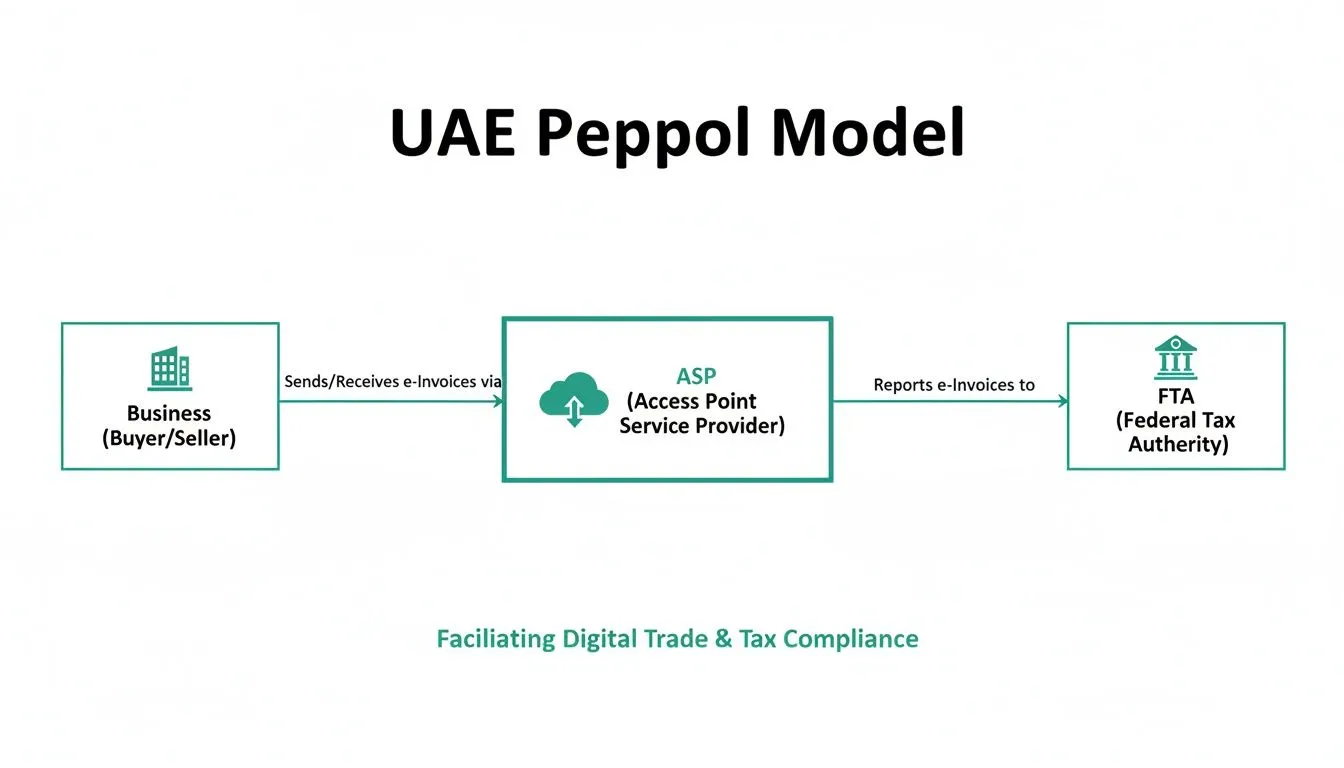
This model guarantees that every e-invoice is sent and validated securely, building a trusted and efficient network for every business involved.
Turning Compliance into Opportunity
Government-backed mandates in Saudi Arabia and the UAE are accelerating e-invoicing adoption across the wider MENA region. It's all part of a larger push towards a digital payments market where online channels are growing at a 14.45% CAGR. This regional shift allows fintechs like Comfi to build solutions that turn this new digital data into a real competitive edge. For instance, some of our clients have seen a 30% sales uplift by using their e-invoicing data to access better payment options. You can dive deeper into this trend in this digital payments industry report.
By digitizing your invoices, you aren't just ticking a regulatory box. You're creating a digital asset that can unlock the cash tied up in your receivables, often much faster than traditional methods.
The Power of Predictable Payments
When you get paid faster, you gain predictability. This newfound certainty gives you the confidence to make business decisions without hesitation. Instead of anxiously waiting for payments to land, you can put your energy into growth.
Take an automotive parts supplier in the UAE, for example. Before e-invoicing, they were stuck with unpredictable payment cycles that made it nearly impossible to manage inventory. After switching to an e-invoicing system, their invoices are now processed and paid in a fraction of the time. This consistent cash flow has enabled them to:
- Purchase more inventory to meet growing demand without a second thought.
- Invest in new marketing campaigns to attract a wider customer base.
- Negotiate better terms with their own suppliers, knowing they can pay on time.
This is a perfect example of how e-invoicing does more than just simplify paperwork; it genuinely fuels growth. When you pair it with modern payment solutions like invoice discounting, the impact is magnified, giving you the power to put your business development on the fast track.
Pairing E-Invoicing with Modern Fintech Solutions
Getting your business set up for e-invoicing is a smart, forward-thinking move. It’s a great first step towards compliance. But its true power is unlocked when you connect it to modern fintech solutions.
Think of it like this: your e-invoicing system is a brand-new, perfectly paved highway. It makes getting from A to B faster and more reliable. But the real value comes when you use that highway to connect to vital destinations—like platforms that can turn your invoices into immediate cash flow.
The structured, verified data from your e-invoices is more than just a digital record; it’s a trusted asset. Because this data is standardized and often validated in near real-time by tax authorities, it carries a level of certainty that old-school paper invoices just can't match. This reliability is exactly what makes your approved e-invoices so valuable to fintech platforms like Comfi, which use this trusted data to offer streamlined payment solutions.
This turns a simple regulatory task into a powerful tool for growth. You’re not just ticking a box for the government; you're building a pipeline of verifiable financial data that opens up a world of new possibilities.
Creating a Seamless Invoices-to-Cash Workflow
The good news is that connecting your e-invoicing system to a fintech platform is designed to be incredibly straightforward. You won't need a complex technical overhaul to start seeing the benefits. The goal is to create a seamless workflow where financial data flows automatically, cutting out manual steps and speeding everything up.
There are usually a few simple ways to make this connection happen:
- API Connection: For businesses with custom-built systems or those wanting a really deep integration, an Application Programming Interface (API) is the way to go. It lets your e-invoicing or accounting software talk directly to the fintech platform, completely automating the data exchange.
- Low-Code Plugins: Already using popular accounting software? Perfect. Pre-built plugins for platforms like Xero or Zoho can be installed with just a few clicks, instantly linking your accounts. To see which options work best, you can check out our guide to the best accounting software in the UAE.
- Dashboard Upload: For the simplest approach of all, you can often just export your approved e-invoices from your system and upload them directly to the fintech’s secure dashboard. It’s quick, easy, and gets the job done.
This streamlined connection means that as soon as an e-invoice is approved, you’re just a couple of clicks away from accessing its value.
Imagine submitting an approved e-invoice and seeing the funds become available within 24 hours. That’s the power of pairing compliant e-invoicing with a modern payment solution—turning a digital file into a direct boost for your business operations.
A Practical Use Case: An Electronics Distributor
Let's ground this in a clear, real-world example. Picture an electronics distributor in Dubai that supplies components to various retailers. They adopt e-invoicing to get ready for the upcoming 2026 UAE mandate—a necessary step for their business.
However, they’re still stuck dealing with long payment cycles of 60 to 90 days from their buyers. This ties up a huge amount of their funds and puts a brake on their ability to grow.
By integrating their e-invoicing system with Comfi, they completely transform this situation. When they issue a large e-invoice to a major retailer, the structured and verified data is instantly shared. The distributor can then choose to have that invoice paid out by Comfi almost immediately.
This simple integration provides two massive advantages. Firstly, the distributor gets the cash they need upfront, allowing them to purchase more inventory and snap up larger orders without delay. Secondly, they can continue to offer their buyers the attractive 60- or 90-day payment terms they expect, all without straining their own resources. It’s a win-win that strengthens their buyer relationships and gives them a serious competitive edge.
Navigating Common E-Invoicing Challenges
Let's be honest: switching to any new technology can feel daunting. While the benefits of e-invoicing are clear, it’s completely normal to have questions about the transition. By tackling the common worries head-on, you can create a practical plan that ensures a smooth rollout without hitting pause on your business.
Many SMEs get hung up on the initial cost of new software, the time it will take to train everyone, and the headache of connecting it to the systems they already have. These are all valid points. But modern solutions are built specifically to make this shift painless and affordable. The trick is to see this not as another expense, but as a strategic upgrade.
Overcoming Implementation Costs and Complexity
One of the first questions that comes up is about the price tag. The good news is that the days of expensive, custom-built systems are long gone. Today’s market is dominated by cloud-based e-invoicing providers that offer flexible, subscription-based models, which completely lowers the barrier to entry. This means you can start small and only pay for what you use, avoiding a massive upfront investment.
The right cloud solution turns e-invoicing from a costly project into a predictable operational expense. This approach makes advanced technology accessible even for small businesses, delivering a rapid return on investment through reduced administrative costs and faster payments.
On top of that, modern platforms are designed to be user-friendly. With intuitive dashboards and guided setups, employee training is usually quick and straightforward. The focus is on getting your team comfortable and productive fast, not bogging them down with complicated software.
Managing System Integration and Data Security
Another common concern is getting a new e-invoicing platform to play nicely with the tools you already rely on, like your accounting software or ERP. This is where Application Programming Interfaces (APIs) become so important. A good provider will offer solid APIs and pre-built plugins that create a seamless bridge, letting data flow automatically between your systems without anyone needing to lift a finger.
As you navigate the transition, you'll also need a plan for handling different document types, especially older or non-standard ones. Learning how to manage these with tools for OCR PDF invoices can be a lifesaver for making the switch complete.
To sidestep the usual hurdles, focus on these practical solutions:
- For High Costs: Choose a scalable, cloud-based provider with a flexible subscription. This dodges the big upfront investment and lets you scale as you grow.
- For Integration Issues: Prioritise solutions with well-documented APIs and pre-built connectors for your existing software. This guarantees a smooth, automated workflow from day one.
- For Employee Training: Select a platform with an intuitive interface and great customer support. This flattens the learning curve and empowers your team to adapt quickly.
- For Data Security: Partner with a provider that is compliant with international security standards and local rules, like the UAE's framework. This ensures your financial data is always locked down.
Got E-Invoicing Questions? We’ve Got Answers
Switching to a new system like e-invoicing always kicks up a few questions. To help you feel completely confident about making the move, we’ve put together some straightforward answers to the queries we hear most often from businesses across the UAE. Let’s clear the air so you can move forward.
Is an Emailed PDF an E-Invoice?
This is a critical point, so let's be clear: no, sending a PDF by email is not e-invoicing. Think of a PDF as just a digital photo of a paper invoice. Your customer’s accounting system can’t read it, which means someone on their end still has to manually type in all the details.
A true e-invoice is different. It’s a structured, machine-readable data file (like an XML file) that systems can process instantly without a human touching it. The upcoming 2026 UAE mandate requires this structured format to make genuine system-to-system automation possible and guarantee compliance.
What Is an Accredited Service Provider?
An Accredited Service Provider (ASP) is a company that has been officially certified by the UAE's Federal Tax Authority (FTA). Their job is to manage the creation and transmission of your e-invoices, making sure they tick every technical and legal box.
Under the new mandate, using an FTA-certified ASP isn’t optional—it’s a requirement. An ASP is the secure bridge connecting your business systems to the government’s central platform, making them an essential partner in your compliance strategy.
You must appoint an ASP to connect to the government’s network and exchange compliant e-invoices. This makes picking the right one among the most important decisions you’ll make in this entire transition.
How Does E-Invoicing Help Beyond Compliance?
While ticking the government's boxes is non-negotiable, the real win with e-invoicing comes from the business benefits. When you get rid of manual data entry, you slash invoice processing costs and time. This automation leads directly to faster payments from your clients, giving your cash flow a significant boost.
E-invoicing also practically eliminates the human errors that cause payment delays and frustrating disputes, which can put a strain on your customer relationships. Better yet, when you connect your e-invoicing system to a platform like Comfi, the structured and verified data from your approved invoices can help you unlock their value almost instantly. This powerful combination turns a regulatory chore into a real tool for business growth.
Can I Integrate E-Invoicing with My Current Software?
Absolutely. Most modern e-invoicing solutions and ASPs are built specifically to connect smoothly with popular accounting software like Xero, QuickBooks, and Zoho.
This connection is typically made through:
- APIs (Application Programming Interfaces): These create a direct, automated link that lets your e-invoicing provider and accounting software talk to each other.
- Pre-built connectors: Many providers offer simple plugins you can install with just a few clicks to link your systems.
This integration ensures your financial data flows automatically, gets rid of duplicate work, and creates a single source of truth for all your financial records. When you're looking at potential providers, always ask about their integration capabilities to ensure a seamless fit with the tools you already use.
Ready to turn your invoices into a growth engine? Comfi helps businesses unlock the value in their receivables, providing fast and accessible payment solutions that keep your cash flow moving. Discover how you can get paid faster and offer flexible terms to your buyers.