Master Monthly Installment Plans to Fuel Your Business Growth


At its core, a monthly installment plan is a straightforward but incredibly effective way to handle a large purchase. Instead of paying a massive lump sum upfront, you break the cost down into smaller, predictable payments spread out over an agreed-upon timeline.
For businesses, this isn't just about delaying a payment; it's a smart strategy for staying financially healthy while still getting the tools and inventory you need to grow.
What Is a Monthly Installment Plan
Let's say you need to place a huge inventory order for the upcoming season. Paying for it all at once could clean out your bank account, leaving you scrambling to cover other essential costs. A monthly installment plan changes the game entirely.
That one giant, cash-draining invoice becomes a series of manageable monthly payments.
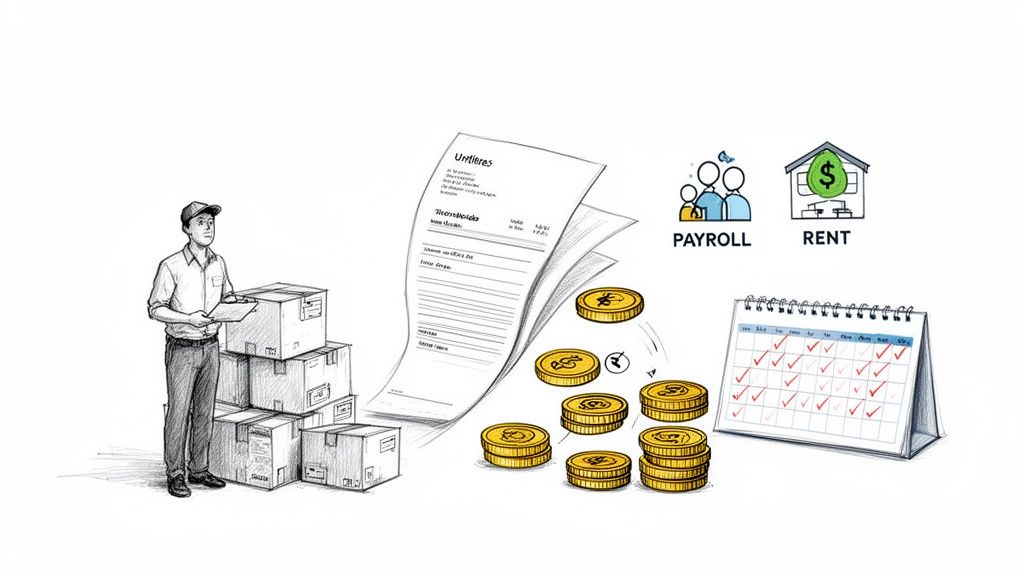
For Small and Medium-sized Enterprises (SMEs), this is a lifeline. By turning a major capital expense into a predictable operational cost, you keep your cash where it belongs—in your business. This frees up funds for the things that keep your company running day-to-day, like:
- Making payroll on time, every time
- Covering rent for your office or warehouse
- Investing in marketing to bring in new customers
- Handling those unexpected expenses that always pop up
Unlocking Business Growth Opportunities
The power of installments isn't just for your own purchases. Offering these terms to your B2B customers can completely transform your sales.
Suddenly, a large order that was once out of reach for a client becomes an easy yes. By removing that initial sticker shock, you make it easier for them to buy more from you, more often. This flexibility can give you a serious edge over the competition and drive a real increase in sales.
The whole system hinges on a clear schedule of payments that lays out exactly how much is due and when. This predictability is what makes it work so well for both the buyer and the seller. No surprises, no confusion—just a clear path forward for everyone.
Ultimately, a monthly installment structure turns a potentially crippling one-time hit into a sustainable, routine expense. It empowers you to invest in growth—whether that's stocking up on inventory or landing bigger clients—without risking the financial stability you need to operate smoothly day in and day out. It's a simple concept that acts as a powerful engine for expansion.
How to Easily Calculate a Monthly Installment
Figuring out a monthly installment shouldn't feel like you need a finance degree. At its core, it’s just a simple way to budget for a large purchase. You only need to get a handle on three key pieces of the puzzle to understand exactly what you’ll be paying.
Once you know these elements, you’re in the driver's seat. You can confidently assess any payment plan and make smart financial decisions for your business, moving the whole idea from confusing theory into something you can use every day.
Breaking Down the Formula
The math for a basic monthly installment is refreshingly simple. It’s all built on three pieces of information you’ll need to have before running any numbers.
- Principal: This is the starting line—the total purchase price of the goods or services before anything else gets added.
- Fees or Interest: This is the cost of convenience, the price for spreading your payment out over time. It could be a straightforward flat service fee or an interest rate applied to the principal.
- Term: This is your payment timeline, the total number of months you have to pay back the full amount. Common terms are often three, six, or twelve months.
Got those numbers? The rest is easy. Just add the principal and any fees together, then divide that total by the term (the number of months).
(Principal + Total Fees) / Term (in months) = Your Monthly Installment
This simple equation cuts right through the complexity, turning a potentially confusing financial deal into a clear, predictable monthly expense.
A Real-World Calculation Example
Let's see how this works in practice. Picture an electronics distributor right here in the UAE who needs to purchase AED 100,000 worth of new inventory. Their supplier offers a payment plan with a flat service fee of AED 3,000 spread over a 6-month term.
Here’s the step-by-step breakdown:
- Add Principal and Fees: AED 100,000 (Principal) + AED 3,000 (Fees) = AED 103,000
- Divide by the Term: AED 103,000 / 6 months = AED 17,166.67
So, the distributor's fixed monthly installment is AED 17,166.67, paid each month for six months. It’s that straightforward.
This kind of predictability is a lifeline for SMEs, especially in markets where costs can shift. In the UAE, short-term interest rates can have a real impact on payment plan costs, climbing as high as 5.60% per annum in November 2023 before settling down. You can dig into how these trends affect business payments with these insights on UAE interest rates.
Those fluctuations highlight why having clear, upfront terms is so critical. When you know your exact monthly outflow, you can manage your cash flow with confidence, no matter what’s happening in the broader economy.
What This Really Means for Your Cash Flow and Pricing
Adopting a monthly installment strategy does a lot more than just move a payment date around on the calendar—it can fundamentally reshape your company's financial health. The most immediate and powerful effect is on your cash flow, which is the absolute lifeblood of any small or medium-sized business.
When you break down big purchases into predictable monthly chunks, you're protecting your operational funds. Instead of seeing your bank account drained by one massive hit for new inventory or equipment, you keep that capital liquid and ready to deploy. It frees you up to cover the essentials—payroll, rent, marketing—without that nagging financial strain. For many business owners, this is how they can unlock working capital that would otherwise be stuck sitting in assets on their balance sheet.
Turning Payment Terms into a Sales Advantage
Protecting your own cash is one thing, but offering monthly installment terms to your B2B customers? That’s a seriously powerful sales tool. Think about it: when a potential buyer is staring at a huge upfront cost, they’re going to hesitate. They might shrink their order, or worse, walk away entirely. But if you give them the flexibility to pay over time, you remove one of the biggest roadblocks to closing a deal.
This simple shift can have a huge impact on your numbers. Businesses that get flexible with payments often see:
- Higher conversion rates on quotes and proposals.
- Larger average order values, because customers are more willing to commit to bigger purchases when the cash hit isn't immediate.
- Increased customer loyalty, as buyers genuinely appreciate the financial breathing room you’re giving them.
Offering flexible terms isn't just a different way to get paid; it’s a competitive edge. It shows you get your customers' financial pressures and you're willing to be a partner, not just a vendor. That’s how you build stronger, more collaborative relationships.
Adjusting Your Pricing to Stay Profitable
Of course, offering to wait for your money requires a smart approach to pricing to make sure you come out ahead. When you extend payment terms, you're waiting longer to get paid in full, and that has a real impact on your own financial planning.
The solution is to build the cost of offering these terms right into your pricing model. This doesn't mean you have to jack up your prices across the board. It could be a small, transparent service fee or a slight increase in the product cost for customers who opt for the installment plan. The goal is to balance the huge sales benefits with the financial reality of collecting your cash over time.
Get this right, and you create a win-win. Your customers get the flexibility they need, and you lock in larger sales without taking a hit on profitability. If you’re looking for other ways to manage cash flow while waiting for payments to come in, it’s worth exploring how invoice discounting helps UAE businesses bridge those gaps.
Ultimately, using the monthly installment as a strategic lever—both for how you buy and how you sell—is what enables more predictable and sustainable growth for your business.
Comparing B2B Payment Options for Your Business
Monthly installment plans don't exist in a vacuum. They're one of several tools you can use to manage your cash flow, and each one comes with its own set of trade-offs. The right choice depends entirely on your business model, your relationship with your customers, and how you need your cash to move.
Let’s break down how installments stack up against other common B2B payment options. Think of it this way: if your cash flow is a river, each of these methods is a different way to manage its flow—some build dams for steady release, while others open the floodgates for a quick surge.
For instance, invoice discounting is all about speed. It’s like selling your unpaid invoices to a third party to get cash in your pocket almost immediately, usually 70% to 90% of the invoice's value, for a small fee. It’s a quick fix for a cash crunch but isn't a long-term payment strategy for your customers.
The decision to offer installments fundamentally changes your cash flow dynamics. Do you want cash now, or a steady, predictable stream of revenue later?
B2B Payment Options Compared
To make the differences crystal clear, let's look at these options side-by-side. Each method serves a different strategic purpose, from encouraging larger orders to surviving a tight month.
- Typical Term: 3–12 months
- Cash Flow Impact (Supplier): Provides a steady, predictable monthly income stream instead of a single lump sum.
- Typical Term: 30–90 days
- Cash Flow Impact (Supplier): Immediate cash injection (70-90% of invoice value), but at the cost of a fee.
- Typical Term: 30–60 days
- Cash Flow Impact (Supplier): Supplier gets paid upfront (minus fees) while the BNPL provider handles collection.
- Typical Term: 90–180+ days
- Cash Flow Impact (Supplier): Can close large deals but adds significant administrative work and ties up capital for longer periods.
As you can see, there’s no single "best" option—it's all about what you're trying to achieve.
Choosing the Right Option for Your Business
So, how do you pick the right tool for the job? It comes down to your immediate needs and your customers' buying habits.
If your priority is predictable budgeting and simple forecasting, monthly installments are hard to beat. You lock in a consistent revenue stream, which makes planning much easier. Your customer gets to break down a large expense into manageable bites. Everyone wins.
Need cash right now to make payroll or buy inventory? Invoice discounting might be the answer, as long as you’re comfortable paying a fee for the speed. It’s a tactical move, not a long-term sales strategy.
Offering in-house credit terms often feels more like a long-term partnership or a leasing arrangement. It’s great for high-ticket items but can create a dependency on specific suppliers and adds a layer of administrative complexity you have to manage.
And for boosting immediate sales, Buy Now, Pay Later is a powerful tool. It’s perfect for encouraging customers to commit to a larger purchase by splitting the cost over a short period. Check out our Buy Now, Pay Later solution to see how you can enable your clients to unlock working capital and get your sales moving faster.
Key Insight: Monthly installments are fundamentally a risk-management tool. They smooth out the financial peaks and valleys for both you and your customer, turning a daunting one-time expense into a predictable, manageable plan.
By understanding the strengths of each method, you can build a flexible payment toolkit that fits your industry, your growth stage, and most importantly, your customers.
How to Implement Monthly Installment Terms Seamlessly
Alright, so you’re sold on the idea. Now, how do you actually make monthly installment terms a reality without drowning your team in paperwork?
Offering payment plans can be a massive sales booster, but let's be honest—doing it the old-school way is a huge headache. Manually tracking invoices, chasing payments, and dealing with the inevitable late payer can seriously strain your own cash flow and tie up your team.
The traditional path means setting up rigid payment policies, watching your accounts receivable like a hawk, and dedicating precious time to collections. For a growing SME, that’s a heavy lift. Thankfully, modern fintech has completely changed the game.
Imagine offering flexible terms to your buyers without carrying the financial risk or the administrative burden. That’s not a hypothetical anymore.
Partnering with a Fintech Platform
Fintech solutions like Comfi are built to take the entire process off your hands. The model is beautifully simple: you get paid upfront for the full invoice, and your customer pays the platform back over the agreed-upon term. Just like that, your credit risk vanishes and your working capital is freed up.
This approach delivers some serious wins for your business:
- Immediate Cash Flow: Get your money in as little as 24 hours, not weeks or months from now.
- Zero Credit Risk: The platform takes on the risk if a buyer doesn’t pay. Your business is protected.
- No Collections Hassle: A trusted partner handles the entire collections process professionally, saving you time and awkward conversations.
- Increased Sales: With an approval rate of 85%, more of your customers can get the terms they need to commit to larger orders.
By outsourcing the mechanics of your monthly installment plan, you can focus on what you do best—running your business—while offering a competitive payment advantage that helps you close more deals.
Seamless Integration and Operation
Getting started with these platforms is surprisingly straightforward. You can usually plug them into your existing workflow in one of two ways: either use a simple digital dashboard to upload invoices or connect the service directly into your e-commerce or accounting systems with a developer-friendly API.
This operational ease is happening at the perfect time, especially with the wider trends in the UAE's payment infrastructure. The rapid adoption of installment-linked direct debits and automated fund transfers shows the market is more than ready for these solutions. This shift toward digital, recurring payments is making business finance much smarter. You can learn more about the growth of these payment systems in the UAE.
With a paperless setup and instant eligibility checks, you can offer a monthly installment option that’s incredibly smooth for both you and your buyers. This isn't just another payment method; it's a strategic tool for unlocking growth, boosting your liquidity, and building stronger customer relationships.
Real-World Examples in Key UAE Industries
Theory is one thing, but seeing how monthly installment plans work on the ground is where it really clicks. Let's walk through a couple of common scenarios in the UAE's core B2B sectors. These examples aren't just hypotheticals; they show how smart payment terms solve real business problems and open up new doors for growth.
The simple truth in each case is this: when you make it easier for your customers to buy, you make it easier for your own business to sell and stabilize its operations.
The Automotive Parts Distributor
Picture an automotive parts distributor in Dubai. They're in a constant balancing act, trying to keep enough inventory to satisfy the urgent demands of garages and service centers without sinking all their cash into stock. Garages need parts right away but prefer to buy in bulk, which means a big upfront payment.
By introducing a three-month monthly installment plan, the distributor completely changes the dynamic. A garage can now secure AED 60,000 worth of essential parts today but spread the payment out into three manageable chunks of AED 20,000 per month.
- For the Distributor: They start closing bigger, more frequent deals because the financial hurdle for the garages is gone. This boosts their inventory turnover and creates a much more predictable revenue stream.
- For the Garage: They get the parts they need to service more cars immediately without wiping out their operating budget, giving them far better control over their own cash flow.
To see how this plays out in the UAE's vibrant auto market, you can learn more about empowering car dealers with flexible payment solutions.
The Electronics Wholesaler
Now, let's look at an electronics wholesaler aiming to land a major contract with a retail chain for the newest smartphones. The total order is substantial, and the retailer is naturally cautious about committing such a large sum before the peak sales season even begins.
The wholesaler gets creative and offers a 60-day payment term, which splits the total into two equal monthly installments. This lets the retailer fill its shelves right away and pay for the phones as they fly out the door.
This simple shift turns a high-stakes transaction into a genuine partnership. The wholesaler locks in a huge sale, and the retailer minimizes its upfront risk, building a stronger relationship for future business.
As financial agreements get more complex, new tools are emerging to help make sense of them. In a different sector like real estate, for instance, a specialized Real Estate Mortgage Document Analyzer can help quickly break down intricate payment schedules and clauses.
Frequently Asked Questions About Monthly Installments
Jumping into a new payment strategy always brings up a few questions. To help you feel confident about offering monthly installment plans, we've put together some quick, straightforward answers to the things business owners ask us most.
Key Differences and Considerations
Are monthly installments the same as a business loan?
Not quite. A business loan gives you a lump sum of cash to use for pretty much anything. A monthly installment plan, on the other hand, is tied directly to a specific purchase, letting a buyer spread the cost of an order over time.
Platforms like Comfi step in to manage these terms for suppliers. We make sure you get paid right away, while your buyers enjoy the flexibility of paying in installments. This setup is a smart way for clients to unlock cash that’s tied up in your invoices without you actually taking on new debt.
How do I know if offering installments is right for my business?
Take a good look at what you sell, who you sell to, and how your cash flow operates. If you're dealing with higher-value goods or find yourself in a competitive B2B market, offering a monthly installment option can be a serious advantage.
It's especially powerful when your buyers are trying to manage their own cash flow for big orders. Using a platform to handle the terms for you takes all the risk and administrative headaches off your plate.
The biggest risks of managing installment plans in-house are late payments or customer defaults, which can strain your cash flow and create a collections burden. There's also the administrative work of tracking many different payment schedules.
When you partner with a fintech platform, you sidestep those problems entirely. They handle the buyer assessment and the entire collections process. This means you get all the sales benefits without any of the operational drag.
Ready to offer flexible payment terms without the risk? Comfi pays you upfront while your customers pay over time, helping you increase sales and improve cash flow instantly. Learn more at https://comfi.ai.
Related Reading
- B2B Payments
- Solve Creative Agency Late Payment UAE Issues
- How Payment Default Dents Small Business Growth and Survival
- A Guide to B2B Payment Solutions for MENA Businesses
Ready to improve your business cash flow? Get started with Comfi today.